
AI Agents Explained: What's Genuinely New Here
"AI agent" might be the single most overused phrase in the field right now. Here's what actually separates an agent from a plain chatbot, and what's truly new about this trend versus just rebranded hype.
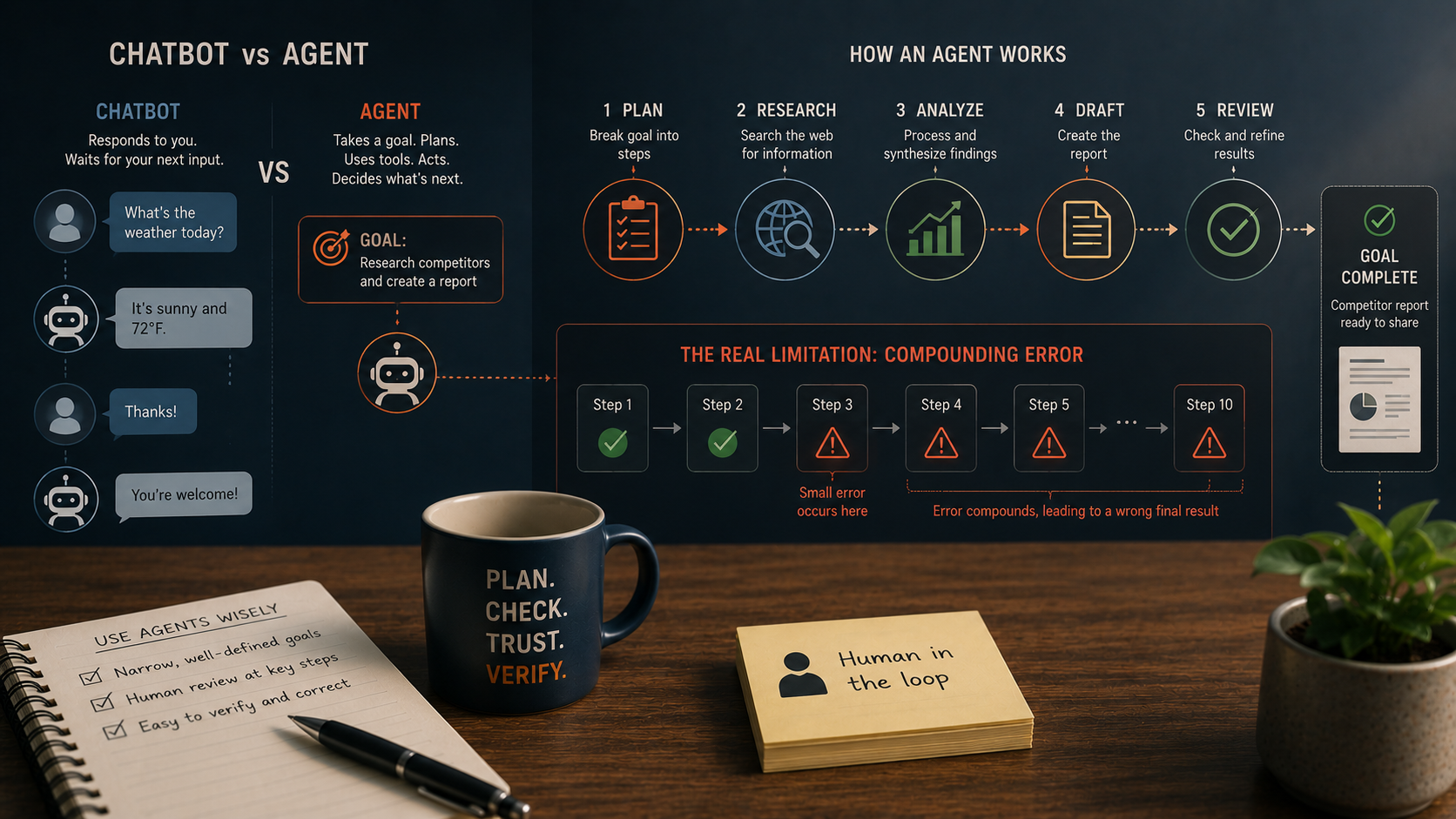
Key Takeaways
- Unlike a plain chatbot, an agent can take multi-step action toward a goal - calling on tools and deciding its own next move - without a human steering every single step.
- The concept itself isn't new - it's existed in research for years. What's actually new is that models finally became reliable enough at multi-step planning to make agents useful in practice.
- The real bottleneck right now is compounding error - every step depends on the one before it going right, so one small slip early in a ten-step task can throw off everything that follows.
About this app
"AI agents" has turned into one of the most overused phrases in AI coverage, stretched loosely enough these days to describe anything from a chatbot with a few plugins bolted on to a supposedly fully autonomous coworker. Here's what genuinely sets an agent apart from an ordinary chatbot, what's actually new about this trend, and where the real limits still show up.
What Actually Qualifies as an Agent
A regular chatbot answers your message and then sits idle until your next one. You ask, it responds, the exchange proceeds one turn at a time, and a human explicitly requested every step along the way. An agent operates on a different model: given a goal, it breaks that goal into steps, reaches for tools - web search, running code, calling other services, reading and writing files - to work through them, and decides its next move based on what each step returned, all with meaningfully less human hand-holding.
- Driven by a goal, not a turn: an agent is handed an outcome to aim for, not one message to reply to.
- Tool use inside a loop: it can call up a search engine, run code, or hit an API, check what came back, and pick its own next move.
- Planning across multiple steps: it splits a broad goal into an ordered sequence of smaller actions on its own, without being told each one individually.
- Lighter step-by-step oversight: a human sets the goal and might check in at milestones, but isn't signing off on every intermediate move.
The idea underneath all this - a system that plans and acts toward a goal instead of merely reacting to one prompt - isn't new at all; it's been a live research area for years, tracing back to early planning-agent and tool-use work well before today's chatbots existed. What's actually new is that the underlying language models have finally become reliable enough at multi-step reasoning and tool use to make agents genuinely useful for real work, rather than staying a research-stage curiosity that fell apart the moment you stepped outside a demo.
Chatbot Versus Agent, Head to Head
| Characteristic | Regular Chatbot | AI Agent |
|---|---|---|
| Unit of interaction | One message, one reply | A goal split into many steps |
| Tool use | Little to none | Actively searches, runs code, calls APIs |
| Decision-making | A human decides the next move | The system decides its own next step |
| Supervision | Every turn is human-directed | Checked at milestones, not every step |
| Failure mode | One wrong answer | Errors compounding across steps |
The Actual Bottleneck: Compounding Error
Compounding error is the real limitation right now. A single-step task simply works or it doesn't; a multi-step agent task depends on every single step landing correctly, and mistakes stack up - a small slip early in a ten-step task can wreck everything that comes after, often in ways that don't become obvious until several steps down the line. This is the central practical hurdle current agent systems run into, and it's a large part of why fully autonomous, long-running agents are still harder to trust than short, tightly scoped ones.
It's also why task length matters more than task difficulty when deciding whether an agent is the right fit for something. Handing over one complex step that an agent either nails or fumbles is generally safer than handing over a long chain of simple steps, since the long chain gives a small error far more places to sneak in and go unnoticed until it's already caused downstream damage.
Where Agents Actually Pull Their Weight Today
- Narrow, well-defined multi-step tasks: work with a bounded, checkable scope where success or failure is easy to confirm at the end.
- Tasks with human review built in: rather than complete unsupervised autonomy, someone checks in at key milestones along the way.
- Intermediate steps that are easy to fix: situations where a wrong step gets caught and corrected quickly rather than compounding silently and expensively.
- Repetitive research or lookup work: pulling together and synthesizing information from multiple sources, which is easier to check than to redo by hand.
- Coding tasks backed by tests: writing or editing code where automated tests can catch mistakes before they compound any further.
How to Judge Any Claim About an Agent
- Check the task's scope: is it a narrow, bounded job, or an open-ended goal with no obvious stopping point?
- Look for checkpoints: does the system actually pause for review, or is it being sold as fully unsupervised from start to finish?
- Ask how mistakes get caught: is there an actual way to verify the output, or does an error just get quietly carried forward?
- Look for independent testing: a demo shows the best-case scenario; independent, real-world evaluation shows what actually happens on ordinary tasks.
Marketing talk about fully autonomous agents handling open-ended, high-stakes goals with zero oversight is running well ahead of what's actually reliable in practice - treat any specific autonomy claim the same way you'd treat any other AI capability claim, by looking for independent real-world testing instead of taking a demo at face value. The trend itself is real, and so is the underlying jump in capability, but the gap between a slick demo and a tool you can actually depend on daily still mostly comes down to how well compounding error gets managed - not some single breakthrough that made agents magically foolproof.
Frequently Asked Questions
Is an AI agent basically the same thing as artificial general intelligence?
No - an agent describes a system architecture, one that plans and takes multi-step action toward a goal, not a claim about general intelligence. Today's agents run on the same underlying models, carrying the same underlying capabilities and limitations as ever.
Should businesses actually be trusting AI agents with important tasks right now?
For narrow, well-scoped tasks with human review built into key points, cautiously yes for a lot of businesses. For fully autonomous handling of open-ended, high-stakes goals with zero oversight, a more gradual approach is currently the more common recommendation, given the compounding-error limitation.