
AI Bias, Unpacked: Why Models Get Certain Things Wrong on Purpose
A biased model isn't holding an opinion - it's repeating a pattern baked into whatever it was trained on. Here's a plain-language walkthrough of where that pattern comes from and how it actually shows up.
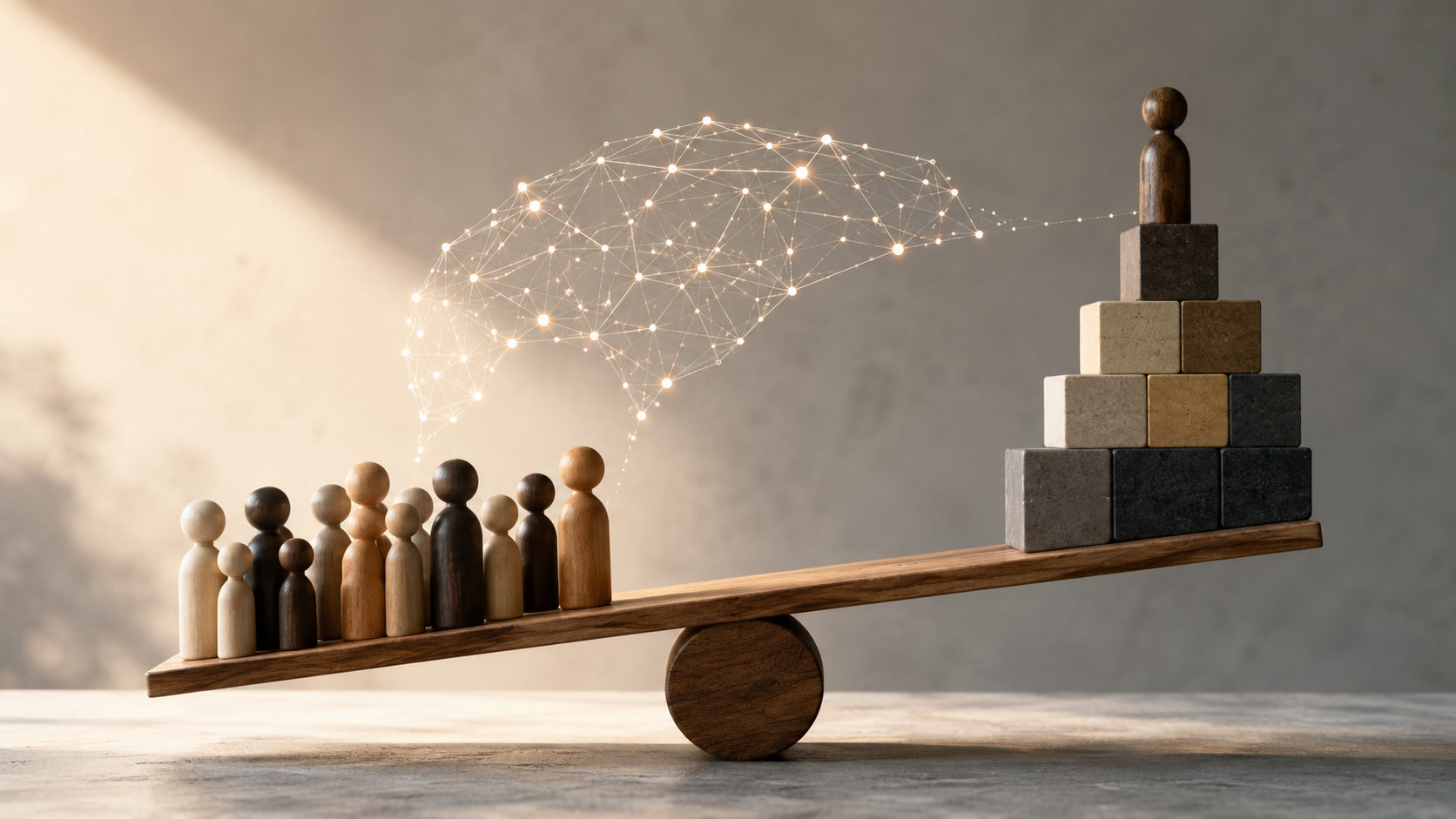
Key Takeaways
- Bias, in this context, means a model's output skews consistently for certain groups or situations - it's not a belief the model has, it's a pattern carried over from its training material.
- Training data that mirrors real-world historical inequities is the usual culprit - feed a model skewed examples and it tends to hand that skew right back to you.
- Nothing available today wipes this out completely - staying alert and testing continuously is still the job, not a fix you apply once and move on from.
About this app
"AI bias" gets thrown around loosely, and it means something slightly different depending on who's using the phrase. Pinned down precisely, though, it refers to one specific, well-studied thing: a model whose outputs skew consistently for certain groups, subjects, or situations. Not the model forming a view of its own - a pattern lifted straight from whatever it was trained on.
Tracing bias back to its source
A model picks up patterns from its training data, full stop - so when that data carries real-world historical imbalances (certain groups showing up less often, situations framed differently depending on who's in them, uneven coverage across topics and languages) the model absorbs those same imbalances and plays them back. It isn't dreaming up bias from nothing; it's reflecting, at enormous scale, whatever it was shown.
- Thin representation: Certain groups, jobs, or regions just don't show up often in training data, leaving the model with too few examples to form an accurate picture.
- Inherited framing: The same event described differently depending on who's involved is a pattern baked into decades of text and media, and the model soaks that framing up right alongside the facts.
- Lopsided coverage: Some languages, dialects, and subject areas simply have far more (and better-curated) material online than others, and that gap turns into uneven performance.
- Human judgment calls: Whoever annotates or ranks training data brings their own assumptions along, and those assumptions quietly shape what the model treats as 'normal' or 'correct'.
- Self-reinforcing loops: When a model's own output gets folded back into future training data without a check, existing skew can get amplified instead of smoothed out over time.
What this actually looks like day to day
It tends to surface in places you wouldn't necessarily think to look. A handful of recurring shapes are worth being able to name:
- Default representation: An image generator reaching for the same demographic pattern every time unless you specifically ask it to do otherwise.
- Uneven warmth: The identical request, with just the name or cultural detail swapped, coming back with a noticeably different tone or quality of response.
- Lopsided accuracy: Sharper, more fluent answers on topics and languages that were well covered in training, and visibly weaker output everywhere else.
- Quiet stereotyping: Default portrayals of jobs, roles, or family setups that fall back on dated or narrow assumptions unless a prompt actively pushes against it.
- False confidence: A model sounding just as sure of itself whether the data behind an answer was solid or paper-thin.
Why you can't just patch it like a bug
You can't fix this the way you'd fix a broken line of code, because there's no single broken line - the problem lives in the statistical shape of a massive dataset, not in one identifiable spot. The skew is spread across millions of training examples at once, and that's precisely what makes stamping it out completely so hard.
What mitigation actually looks like: curating training data more carefully, running extra training passes targeted at known weak spots, and testing on an ongoing basis - a continuous job, not a box you check once. Teams building these models generally stack several of these approaches together rather than betting on just one:
| Approach | What it does | Where it falls short |
|---|---|---|
| Data curation | Rebalances or filters the training set before the model ever encounters it | Nearly impossible to catch every imbalance in datasets this large |
| Targeted fine-tuning | Runs extra training aimed at specific known weak points or skewed patterns | Can fix one spot while leaving other gaps untouched |
| Output filtering | Reviews or adjusts what the model generates after the fact | Addresses the symptom, not the pattern underneath it |
| Ongoing evaluation | Keeps testing across demographics, languages, and phrasing variations | Only works if the effort actually keeps going - not a one-time fix |
What that means for how you actually use these tools
Whenever fairness or getting representation right actually matters - hiring materials, anything depicting a range of people, work that affects real outcomes for real people - it pays to actively probe a tool's output with different phrasings instead of assuming it's balanced by default. A few habits make that easier to keep up.
- Swap the details: Run the same request with different names, regions, or demographic markers and compare what you get back.
- Ask for range on purpose: When representation matters to the task, say so outright rather than trusting whatever the default hands you.
- Slow down on high-stakes work: Hiring, lending, and similar territory deserves a closer second look than something casual or creative.
- Don't confuse polish with correctness: A response that reads smoothly and confidently isn't automatically an unbiased one.
It helps to picture a model as reflecting the statistical average of its training data - skew included - rather than as some neutral judge straight out of the box. That mental picture alone beats assuming built-in fairness by default.
A small experiment that makes the bias visible
One of the easier ways to actually see this instead of just reading about it: ask an image generator for a picture of someone in a given profession without specifying anything else, generate a handful of results, then ask again but explicitly request a different gender, age, or cultural background for that same profession. Stack the unprompted results next to the explicitly-specified ones and a pattern usually jumps out that the default alone would never have revealed - a single unprompted image looks perfectly reasonable on its own, after all. It's a hands-on, concrete way to build real intuition for what training-data skew actually looks like, rather than leaving it as an abstract idea.
Frequently Asked Questions
Is AI bias always a serious problem, or can it be pretty minor?
It spans a wide range - some cases are just minor stylistic defaults, while others carry genuine consequences for fairness, especially in higher-stakes territory like hiring or lending. How bad it is really comes down to the specific situation.
Can I fix bias in a particular output just by prompting differently?
Being explicit - asking for varied representation, spelling out context - can help in that one instance, but it doesn't touch the underlying pattern baked into the model. It's a per-use workaround, not a fix at the source.