
Five Small AI Habits That Add Up to Real Hours Saved
Forget flashy automation - it's small, repeatable AI habits that actually add up. Five specific practices that save real time without bolting new tools or complexity onto your day.
Key Takeaways
- For most people, the biggest AI productivity gains come from small, repeated habits, not from one big dramatic automation project.
- Getting a "first pass" draft on any recurring writing task - not just reports - is one of the highest-leverage habits a knowledge worker can pick up.
- None of these require new tools - a general-purpose AI chat assistant, the kind most people already have access to, covers all five.
About this app
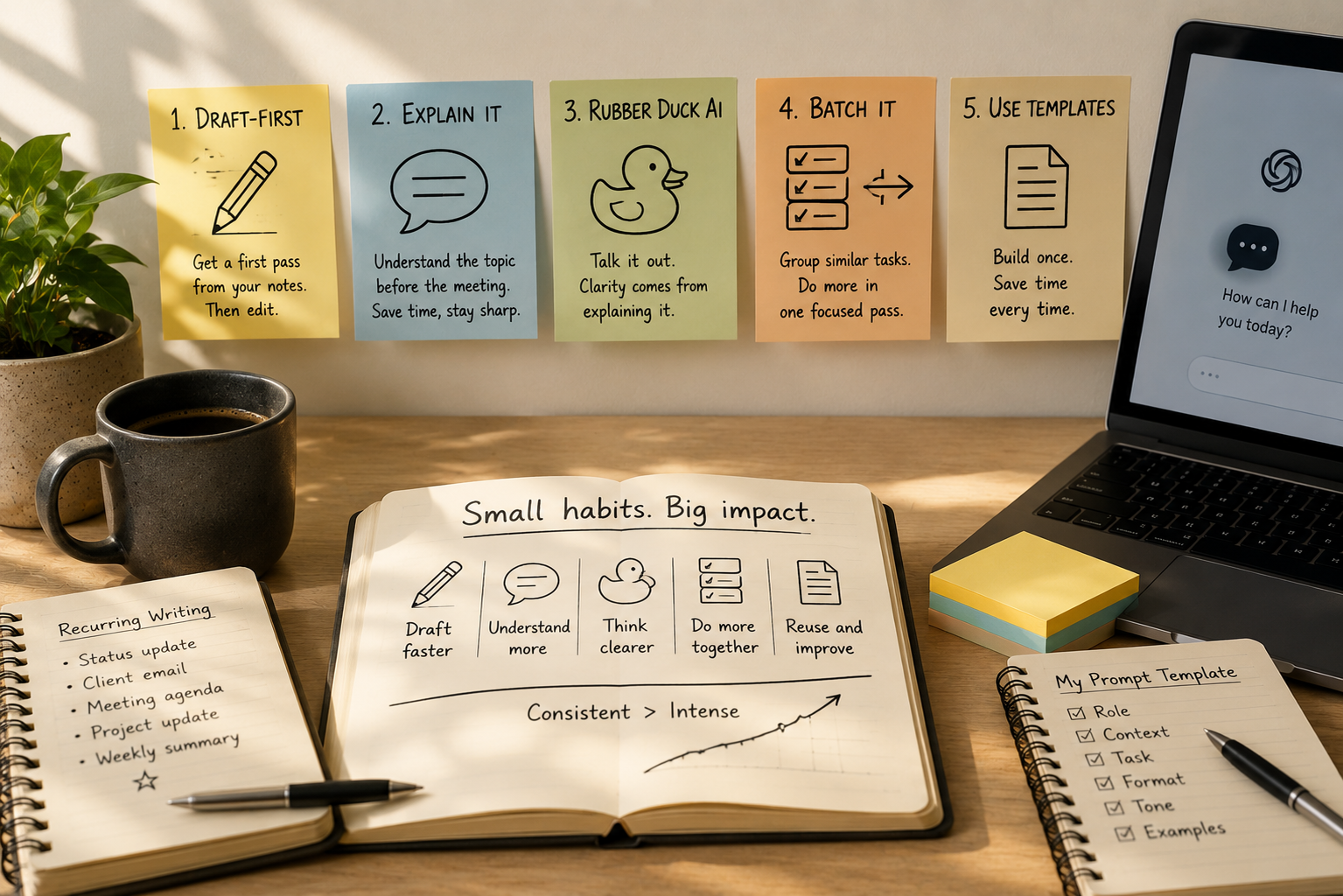
For most people, the biggest AI productivity gains don't come from some ambitious automation project - they come from small, unglamorous habits repeated consistently, week after week. None of them demand a new tool, a workflow overhaul, or much technical skill at all. They just ask you to do the same small thing every time a certain kind of task shows up. The five habits below are worth genuinely building in, and you could start using any one of them in your very next work session.
Habit One: Draft First, Not Blank Page First
For any writing you do repeatedly - a status update, a routine email, a meeting agenda, a project summary - ask for a rough draft built from your notes first, then edit it, rather than starting from a blank screen. Editing something that already exists is consistently quicker than generating it from scratch, even when you end up rewriting most of it. People underrate how much a blank page actually costs them mentally, and even a mediocre first draft removes nearly all of that cost.
- Feed it your raw notes: Bullet points, half-formed sentences, and fragments are plenty - the assistant supplies the structure.
- Ask for a rough version, not a polished one: Explicitly asking for 'a rough draft' gets you faster, more editable output than requesting something already polished.
- Edit it in your own voice: Treat the draft as scaffolding, not a finished product - the time savings come from reshaping it, not from copying it word for word.
Habit Two: Get the Concept Explained Beforehand
Two minutes before walking into a meeting on unfamiliar ground, ask for the core concept explained in plain language. That heads off the much larger time cost of sitting through a discussion half-lost, nodding along, then having to schedule a separate follow-up just to understand what was actually decided. It's an easy habit to skip because it feels like extra work in the moment, but it pays for itself the first time it keeps you from asking a question mid-meeting that everyone else already knew the answer to.
Habit Three: Talk It Out Like a Rubber Duck
This is the one that catches people off guard: use the assistant as a rubber duck. Walking an AI assistant through a stuck problem in detail - sometimes before it even replies - sharpens your own thinking the same way explaining code out loud to an inanimate object does for programmers. Putting a problem into full sentences, constraints and all, is often the actual unlock, regardless of what comes back from the assistant. Typing "here's exactly what I'm stuck on and why" forces a precision that thinking silently in your head almost never does.
Habit Four: Batch the Small Repetitive Writing
Group small repetitive writing together instead of chipping away at it one piece at a time all day. Five similar short messages folded into one request - "draft these five follow-ups based on these five situations" - and edited as a batch beats stopping and restarting that same kind of task five separate times. Context-switching isn't free: every time you step away from a task and come back later, there's a warm-up period before you're back up to speed. Batching cuts out most of those warm-ups.
Habit Five: Maintain a Standing Prompt Template
Keep a standing prompt template for whatever task comes up most, rather than rewriting the instructions from scratch each time. This is the habit that compounds quietly - a well-tuned template shaves a little time off every single use, and that adds up fast for anything frequent. A template that already specifies tone, format, and the details you always need turns a five-minute prompt-writing chore into a ten-second copy-paste.
| Habit | Best for | Time saved per use |
|---|---|---|
| Draft-first | Recurring writing tasks | Highest - applies almost daily in most roles |
| Pre-meeting explainer | Unfamiliar meeting topics | Moderate - prevents time lost down the line |
| Rubber duck | Stuck problems | Situational, but significant on the days it matters |
| Batching | Several similar short tasks | Moderate - cuts down on repeated context-switching |
| Prompt templates | Any frequent, repeated task | Small per use, adds up substantially over time |
Making the Habits Actually Stick
None of this calls for a new subscription, a new app, or a training session. What it calls for is paying attention, over the next week or two, to which of your recurring tasks matches one of the five patterns above, and then defaulting to the habit instead of the old routine. The habits that actually stick are the ones attached to something already on your plate daily - not a special one-off project built just to test whether AI is worth the hype.
- Start with just one habit: Trying to adopt all five simultaneously usually means none of them stick well.
- Attach it to a task you already have: Apply draft-first to the next status update you were going to write anyway, not some hypothetical future one.
- Keep at it for a week: One use rarely feels life-changing - the time savings only become obvious in aggregate.
Frequently Asked Questions
Do I need a paid AI subscription for any of this?
No - all five hold up fine on a free-tier general-purpose assistant. Paid tiers might get you more speed or higher usage limits, but nothing here specifically requires premium features.
Which of these five makes the biggest difference?
Draft-first for recurring writing tends to reach the most people, since nearly every knowledge worker produces some form of recurring content daily, and editing is consistently faster than starting from nothing.