
AI Meeting Notes: Which Parts to Trust, Which to Verify
AI-generated meeting notes are undeniably convenient, but they're not equally trustworthy in every section. Here's a practical guide to what you can take at face value and what still needs your own check.
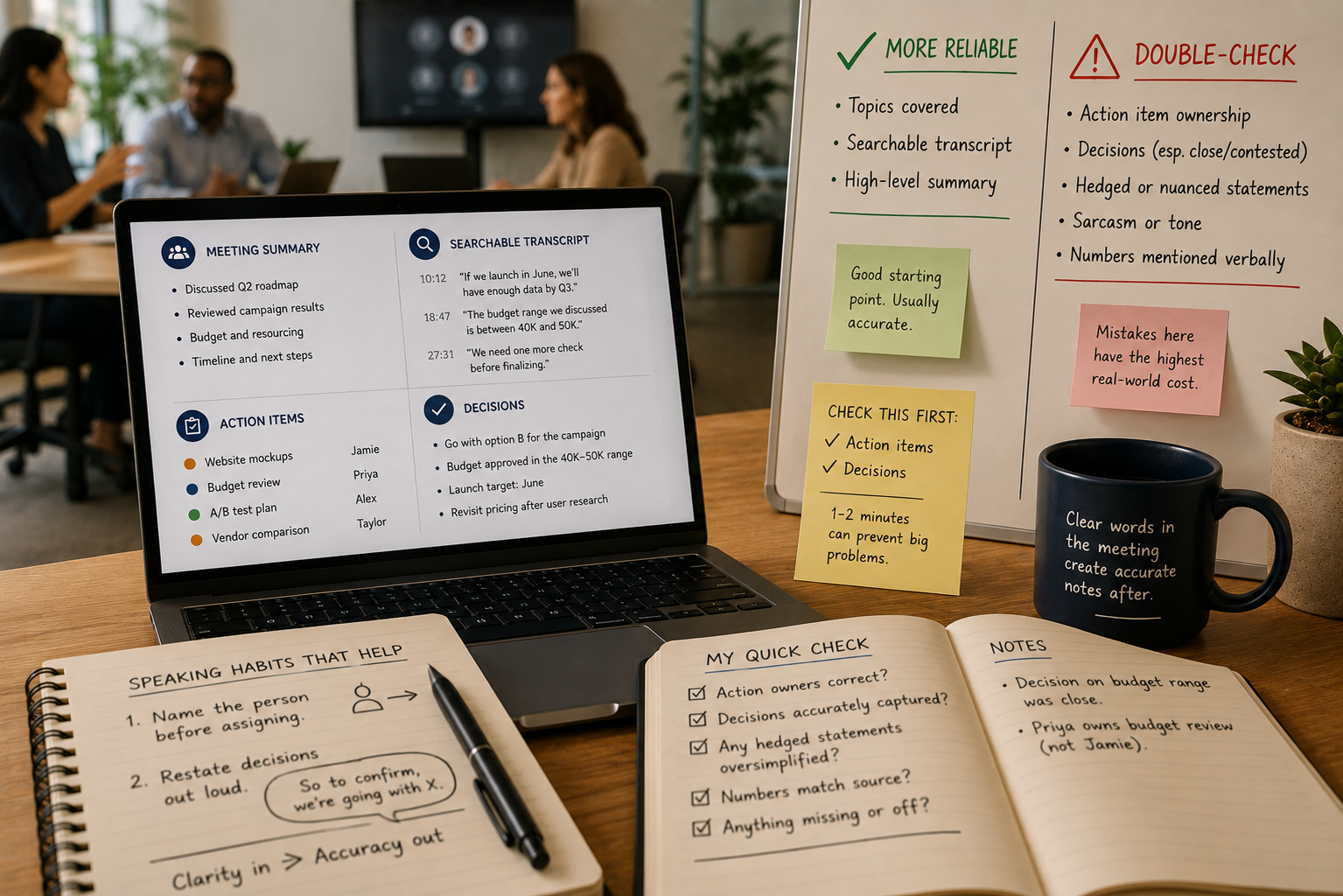
Key Takeaways
- Overall topic coverage and the searchable transcript hold up reliably well. Ownership attribution and hedged or nuanced remarks are where things get shaky.
- Decisions and action items are the two sections most worth a manual look - getting either one wrong carries the highest real-world cost on the entire page.
- One small speaking habit - naming a person before assigning them a task, saying a decision out loud once it's made - measurably improves accuracy right at the source.
About this app
AI meeting-notes tools have become the default choice for plenty of teams, and there's a good reason for that - but not every part of the output deserves equal trust. Knowing which sections to accept at face value and which ones need a second look saves you from the one mistake that actually costs something real: a wrong record of a decision.
Where these tools genuinely deliver
The strongest piece of any AI meeting-notes output is coverage - what got talked about, and roughly in what order. If it came up in the room, it will almost always turn up somewhere in the summary. The searchable transcript sitting underneath that summary might be the single most useful feature of the whole category: rather than scrubbing through a recording to find the exact moment someone mentioned a number or deadline, you just search the word and land right on it. A quick, high-level summary - the kind you'd skim in thirty seconds before hopping on a follow-up call - is also a solid starting point nearly every time.
- Topic coverage: If it got said out loud in the meeting, it tends to show up in the notes in some form.
- Searchable transcript: Tracking down a specific quote or number later beats scrubbing through the audio every time.
- Meeting structure: Agenda items and the rough order of the conversation come through accurately.
- Attendance and timing: Who showed up, when things started and ended - the basic metadata is rarely off.
What actually needs a manual check
The weak spots are fewer than people assume, but each one costs more than anything sitting in the reliable column. Action-item ownership is the biggest of them - getting who-agreed-to-what wrong has real downstream consequences, and it's an easy mistake to make when two people were talking over each other or an item got handed off with a vague pronoun instead of a name. Close or contested decisions are the second big risk area: a hedged "we'll probably go with X, pending one more check" turns into a flat "decided: X" more often than you'd think, because the tool has to resolve the ambiguity into something that reads clean.
- Action-item ownership: Double-check that the name attached to each task is actually the person who agreed to it.
- Contested or hedged decisions: Anything that sounded even slightly tentative in the room is worth re-reading against what was really said.
- Sarcasm and tone: Dry or sarcastic comments regularly get written down as if they were literal statements.
- Numbers spoken out loud: A dollar figure, date, or percentage said verbally should be confirmed against a written source, not just the transcript.
- Overlapping speech: Any stretch where two people talked at once is the most error-prone part of any transcript.
A habit in how you speak that fixes accuracy at the root
Worth knowing: these tools perform noticeably better when the meeting itself is a bit more explicit. Saying a person's name before you hand them an action item, briefly restating a decision out loud once it's actually locked in ("so to confirm, we're going with X") - that small speaking habit measurably sharpens both the human notes and the AI ones, because it kills ambiguity right at the source instead of hoping something patches it up afterward. It costs a few extra seconds per meeting and earns that back the first time it stops a wrong assignment from going out the door.
| Section | Trust level | Why |
|---|---|---|
| Topic coverage | High | Broad strokes are straightforward to capture correctly |
| Transcript search | High | Matching text does not require interpretation |
| High-level summary | Medium-high | A solid starting point, but skim it before you rely on it |
| Decisions | Medium | Hedged or contested calls often get flattened into false certainty |
| Action items | Medium-low | Ownership attribution is the riskiest single field |
| Tone and sarcasm | Low | Nuance is the hardest thing for these tools to hold onto |
A post-meeting check that catches the costly mistakes
For a post-meeting routine that actually catches the costly mistakes: skim just the action-items and decisions sections against your own memory before you send anything out. That's a minute or two, not a full line-by-line pass through the entire transcript. Nearly all the practical value of double-checking lives in that short pass - the rest of the document rarely needs it.
- Step 1: Read through the action-items list first and check each name against your own memory of who actually spoke up.
- Step 2: Re-check any decision that felt shaky or debated in the room - skip the ones that were unanimous.
- Step 3: Search the transcript for every number spoken out loud and verify it against a written source.
- Step 4: Only send it out after that - skip a full re-read of the general summary unless something genuinely looks wrong.
None of this means the tools are unreliable overall - for most of what comes out of a meeting, they're accurate enough to trust without question. The point is narrower than that: know which two or three fields carry the actual risk, aim your limited attention there, and let the rest of the automation do its job unchecked.
Frequently Asked Questions
Is it still worth taking my own short notes if an AI tool is recording?
Yes - a brief personal note on decisions and your own action items gives you an independent check against the AI record, and it takes very little effort during the meeting itself.
Does the size of the meeting change how accurate the notes turn out?
Generally, yes. Bigger meetings, with more speakers, more overlapping talk, and more simultaneous conversation threads, are tougher to attribute and summarize accurately than smaller, more structured ones.