
The Vendor Lock-In Questions Worth Asking Before You Sign an AI Contract
Walking away from an AI vendor later can be a lot harder than switching old-school software ever was. Here are the specific lock-in risks to check for, and the questions worth asking before you sign anything.
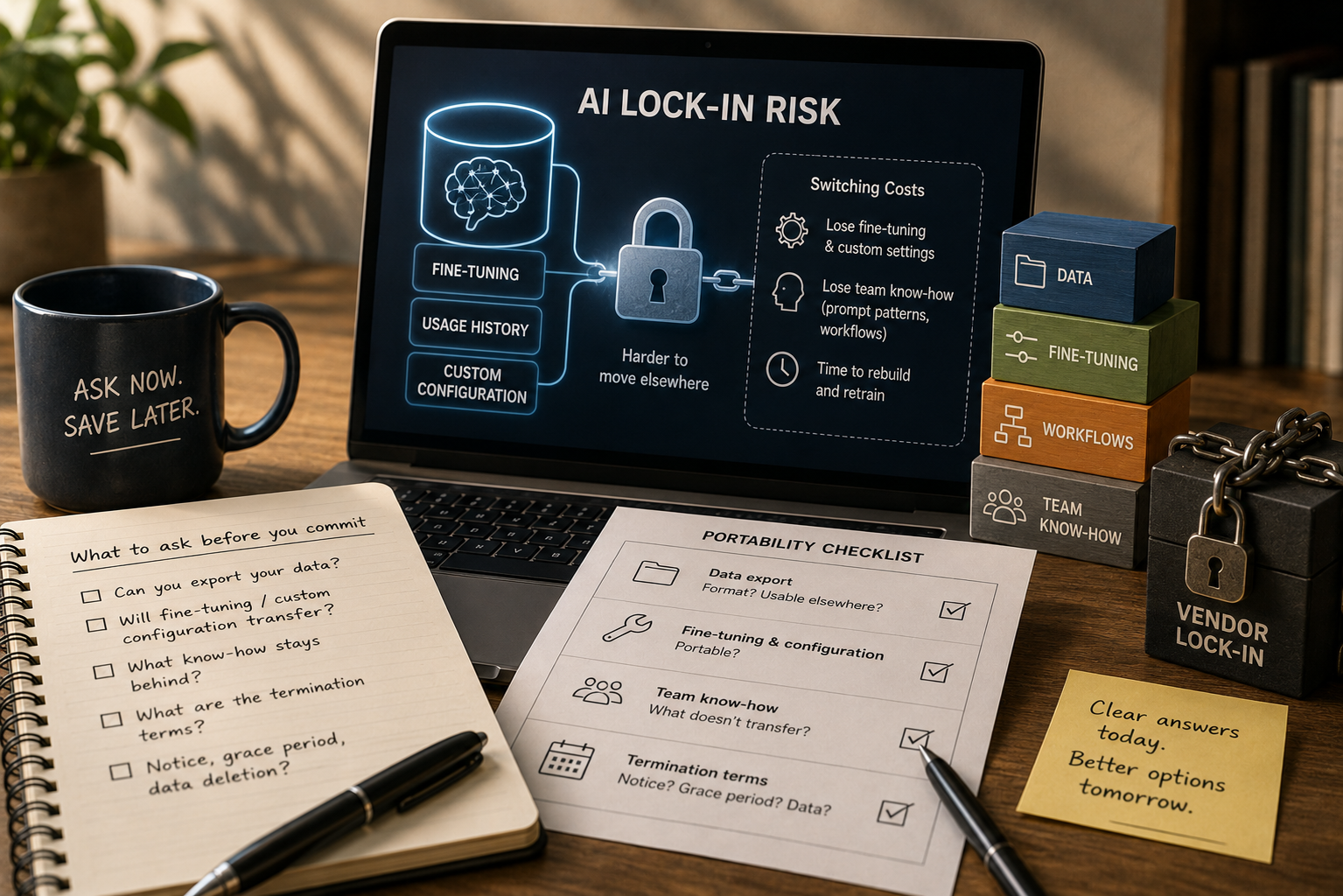
Key Takeaways
- AI tools carry a lock-in risk that ordinary software doesn't - your fine-tuning, usage history, or custom setup might not move to a competitor at all.
- Export and portability terms deserve a hard look before signing - don't assume it exports cleanly just because older software categories usually did.
- A vendor that won't give you a straight answer on data export and termination is telling you something real about the relationship, whether they mean to or not.
About this app
AI tools come with a lock-in risk that regular software-switching costs don't fully cover, because a meaningful chunk of what you build with them - custom setup, accumulated usage patterns, fine-tuned behavior - can end up tied to one vendor in ways you don't notice until the day you try to leave. Old-school software lock-in was mostly about file formats and migration work. AI adds another layer on top of that: the tool actually improves the longer you use it, and that improvement often doesn't come with you when you go.
What makes AI lock-in different from a normal software switch
Switch spreadsheet tools or CRMs and the cost is mostly re-entering data and getting staff comfortable with a new interface. With an AI tool, there's often a third layer on top of that: the model itself has been shaped by how your team has used it. Fine-tuning, custom instructions, retrieval indexes built from your own documents, even the informal prompting tricks your team has picked up - all of that represents real invested effort, and none of it automatically comes along to a competing vendor. It doesn't show up in a demo or on a pricing page. It only becomes obvious once you're actually trying to walk out the door.
Four questions worth asking before signing
- Can you actually get your data out?: Not just in a technical sense, but in a format something else can genuinely use - a raw JSON dump nothing else can ingest isn't real portability, even if it checks a box in a compliance document.
- Does custom configuration actually move with you?: Ask directly whether any fine-tuning, custom instructions, or trained behavior transfers to a different vendor, or whether leaving means rebuilding all of that from zero. This is frequently the single biggest hidden switching cost with AI tools specifically.
- What becomes of your team's know-how?: Prompt patterns, workflow quirks, and the informal tricks your team picked up for getting good output don't necessarily carry over even when the raw data does. No contract clause covers this - it's a real cost you should budget for regardless.
- What do the termination terms actually spell out?: How much notice does cancelling require, what happens to your data once you're gone, and is there a grace window to export before it's deleted? Read this part of the contract before you ever need it, not after.
Warning signs that lock-in risk runs higher than normal
A handful of patterns tend to show up wherever exits get harder. A vendor storing your data in a proprietary structure with no documented way out is one. A pricing model that rewards sticking around - discounts that only kick in after months of usage history, or features that unlock based on cumulative volume - is another, since it quietly raises the cost of leaving even without anything in the contract explicitly forbidding it. So is a product whose whole value comes from a model fine-tuned on your own data, since that fine-tuning usually has no equivalent waiting for you at the next provider.
| Lock-in factor | Lower risk | Higher risk |
|---|---|---|
| Data export | Documented, standard format, self-service | Manual request only, proprietary format |
| Fine-tuning/customization | Portable or not required for core value | Core value depends on custom-trained behavior |
| Termination terms | Clear notice period, export grace window | Vague or silent on post-termination access |
| Pricing structure | Flat, usage-based, no loyalty cliffs | Discounts or features tied to accumulated history |
What the answers actually tell you
None of this is an argument against signing with an AI vendor - it's an argument for asking these specific questions out loud, the same way you would for any other vendor relationship that matters. Get the questions in writing, even a simple email will do, so the answers are on record instead of a verbal reassurance from a sales call. A vendor that's confident in what they've built can answer export and termination questions clearly and specifically. Vague or dodgy answers here tell you something real about what you're about to sign up for, no matter how impressive the demo was.
Matching the level of scrutiny to how the tool gets used
Not every AI tool deserves the same level of scrutiny. A lightweight tool you use for drafting marketing copy carries a low switching cost even with weak export options, because there's not much irreplaceable work piling up inside it. A tool sitting at the center of customer support, coding workflows, or decision-making - where fine-tuned behavior and accumulated context are doing real work - deserves the full list of questions above before any contract gets signed. Scale the diligence to how deeply embedded the tool is likely to become, not to how smooth the sales pitch sounded.
A Habit Worth Keeping: Ask Again Every Year
Lock-in risk isn't locked in at the moment you sign - it tends to creep up quietly the longer a tool stays embedded, as more custom configuration and team-specific workflow builds up around it. Asking the same export and termination questions again roughly once a year, even for a vendor relationship that's going fine, catches the slow drift where a tool that was low-risk at signing has quietly become hard to leave two years on, without anyone ever deciding that on purpose. Treat it like reviewing any other recurring contract - not a one-time check that only matters before you sign.
Frequently Asked Questions
Is vendor lock-in actually worse with AI tools than with traditional software?
It can be, specifically because of fine-tuning and accumulated custom setup - old-school lock-in was mostly about data format, while AI lock-in can also involve model customization and team know-how that's much harder to cleanly hand off.
Should lock-in risk keep a small business from adopting an AI tool at all?
Not necessarily - it's something to weigh and ask about, not a reason to write off AI tools entirely. For lower-stakes, easily-swappable use cases, lock-in risk matters a lot less than it does for a deeply embedded core system.