
Voice Cloning With AI: What It's Capable Of, and Where the Line Sits
Feed an AI model a short clip and it can rebuild a voice convincingly enough to fool people. Here's how the tech actually works, where it's used legitimately, and the ethical line that actually matters.
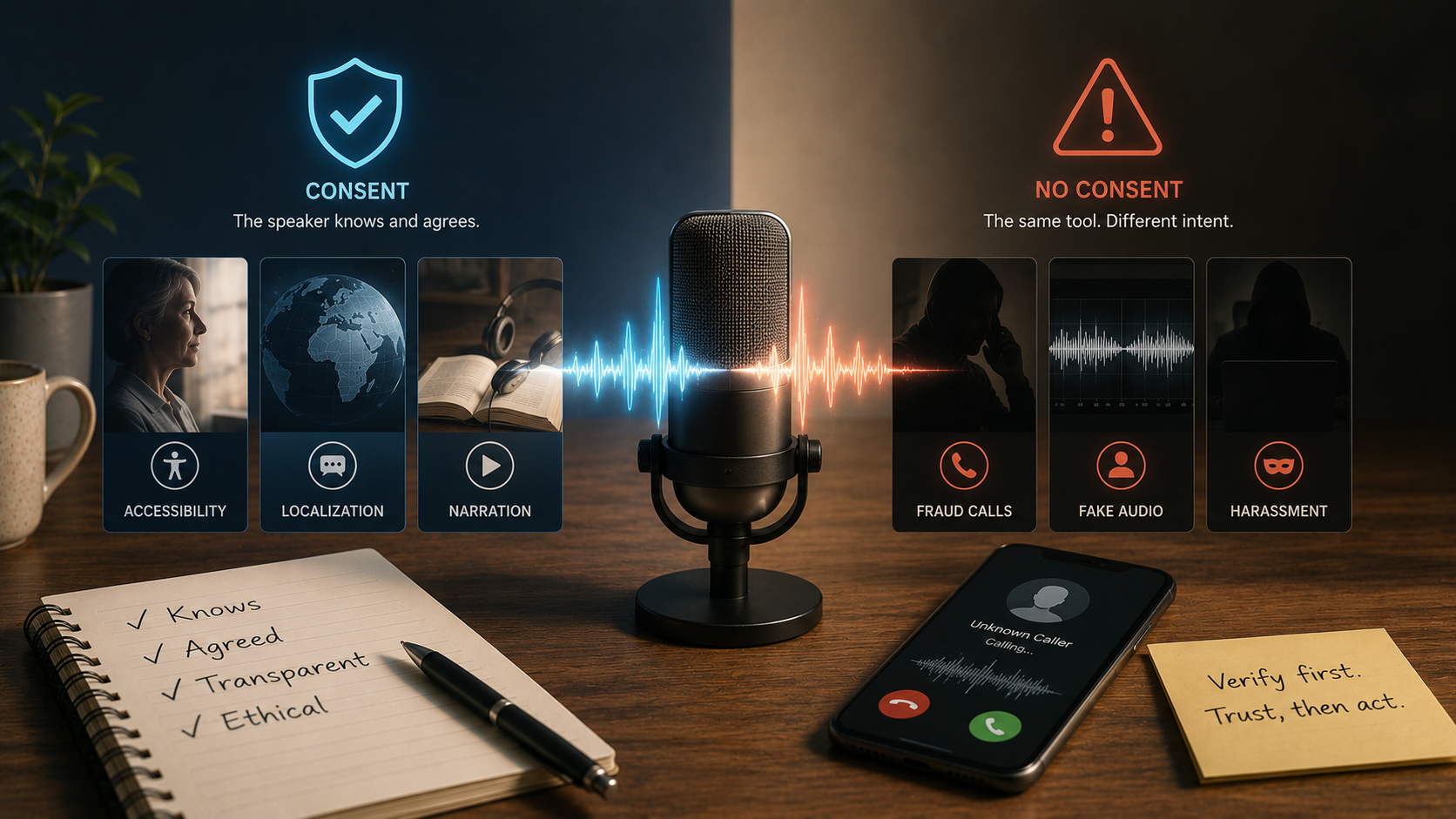
Key Takeaways
- Today's cloning tools can fake a believable voice off a clip as short as a few dozen seconds - you don't need much source audio at all.
- Every above-board use of this - accessibility work, dubbing, narration - has one thing running through it: the actual speaker knew and said yes.
- Take consent out of the picture and that same tool turns into an impersonation weapon. Nothing about the technology shifts - only whether permission was ever given.
About this app
It didn't take long for voice cloning to jump from a lab demo to an app anyone can download. Hand one of these tools a short recording and it'll spit out brand-new sentences in that exact voice - words the actual person never said. It's remarkable engineering, and it cuts both ways. Understanding what the tech actually does matters, but understanding where the ethical line sits matters more, and that line turns out to be a lot simpler than the underlying technology.
How the Cloning Actually Works
A voice-cloning system - either trained properly or, in a lot of today's tools, just given a short sample to work from - picks up on what makes one voice distinct: its pitch, tone, cadence, breathiness, the little verbal tics a person has. Once it's captured enough of that fingerprint, it can produce fresh speech in that voice, saying whatever text you give it, none of which the real person ever spoke. In practice, that shows up in a few different flavors.
- Few-shot cloning: you hand the model a short clip - often under a minute long - and it approximates the voice on the spot, with no dedicated training run involved.
- Fine-tuned cloning: the model gets actually trained on a bigger batch of recordings from one person, which usually buys you a steadier, more convincing result - the trade-off is you need a lot more source audio to start with.
- Text-to-speech synthesis: with the voice profile built, you can turn any block of typed text into audio in that voice - which is exactly why this is so easy to abuse at scale.
Where This Gets Used for Good
Accessibility is probably the case that hits hardest emotionally - giving someone back a voice they lost to illness or injury, rebuilt from whatever old recordings exist of them. Localization teams use the same tech to keep a creator's voice identity intact across languages, so dubbed content still sounds like the original speaker. Audiobook and media studios lean on it too, always with the voice actor's knowledge and sign-off, to tweak or extend narration without dragging everyone back into the booth for a minor fix. And some customer-facing voice assistants run on a licensed synthetic voice built this exact way, with the actor behind it paid and credited for the work.
See the common thread? In every one of these, the person whose voice is being used knew about it and signed off. That's not some minor detail tacked on at the end - it's the whole reason any of this is acceptable in the first place.
Pull Consent Out, and It's a Different Story
Take consent away and you're left with the exact same capability, just repurposed for impersonation - a scam call built to sound like a panicked family member asking for money, fabricated audio put in a public figure's mouth, harassment campaigns, faked evidence in a legal fight. The underlying tech doesn't change one bit between the harmless version and the harmful one. What actually separates them is consent and disclosure - full stop, not anything about the software.
| Scenario | Was Consent Given? | Verdict |
|---|---|---|
| Rebuilding a voice lost to illness, using that person's own old recordings | Yes, from the person or their family | Legitimate |
| A voice actor licensing their voice out for narration work | Yes, by contract | Legitimate |
| Dubbing a creator's own content into a different language | Yes, by the creator | Legitimate |
| Cloning a relative's voice to run a scam call | No | Fraud / impersonation |
| Putting fabricated words in a public figure's mouth | No | Harassment / disinformation |
The Legal Picture Right Now
Legislation here is genuinely playing catch-up, and unevenly so - some places have already passed rules aimed squarely at AI voice impersonation and disclosure of synthetic media, others haven't gotten there yet. The older likeness-rights statutes on the books were written before any of this was even technically feasible, and they don't fit cleanly around a cloned voice showing up in an ad, a political message, or a scam script.
Building something commercial that touches cloned voices? Look up the actual, current rules in your jurisdiction instead of assuming an old likeness-rights statute already covers you - it probably doesn't. That means getting the voice owner's consent in writing, flagging synthetic audio as synthetic, and keeping a paper trail of that consent rather than relying on a verbal handshake.
A Simple Test to Apply
Here's a test that holds up no matter where you are legally: would the person whose voice you're using be genuinely fine knowing exactly how it's being used, and did they actually say yes to it? If both are true, you're almost certainly in the clear. If either one isn't, you've found the line. You don't need a law degree to run this check, and it doesn't get more complicated as the tech gets better.
Defending Yourself Against the Scam Angle
Most people are far more likely to run into the scam side of this than to ever build anything with the technology, so it's worth having a plan ready before you get a panicked call claiming to be a relative in trouble. These scams work precisely because they hijack the instant where you'd normally pause and think things through - which means your defense needs to be a habit you've already locked in, not something you try to reason out while you're panicking.
- Pick a family code word or question ahead of time - something a stranger couldn't guess or dig up online - and require it before you act on any urgent ask.
- Hang up, then call back on a number you already have saved - never stay on the line that called you, and never use a number given to you mid-call.
- Treat urgency as the red flag on its own - being pushed to act right now, with no room to double-check, is a scam tactic no matter how real the voice sounds.
- Stay suspicious of any ask for cash, gift cards, or wire transfers that rests on a phone call alone - especially payment methods a real relative would almost never actually request.
Frequently Asked Questions
How little audio can actually produce a convincing clone?
Less than you'd think. Current tools can pull off a recognizable approximation from under a minute of source audio, though feeding it more, cleaner material generally sharpens the result.
What's the actual defense against a voice-cloning scam call?
Assume any urgent, emotional call asking for money or sensitive details is suspicious, regardless of how real the voice sounds, and confirm through a separate channel - call the person back on a number you already had saved - before you do anything else.