
AI, Machine Learning, Deep Learning: Untangling What Separates Them
These three phrases get tossed around as if they're interchangeable, but they actually describe three nested, distinct ideas. Here's a clear-eyed look at what each one means and how they fit together.
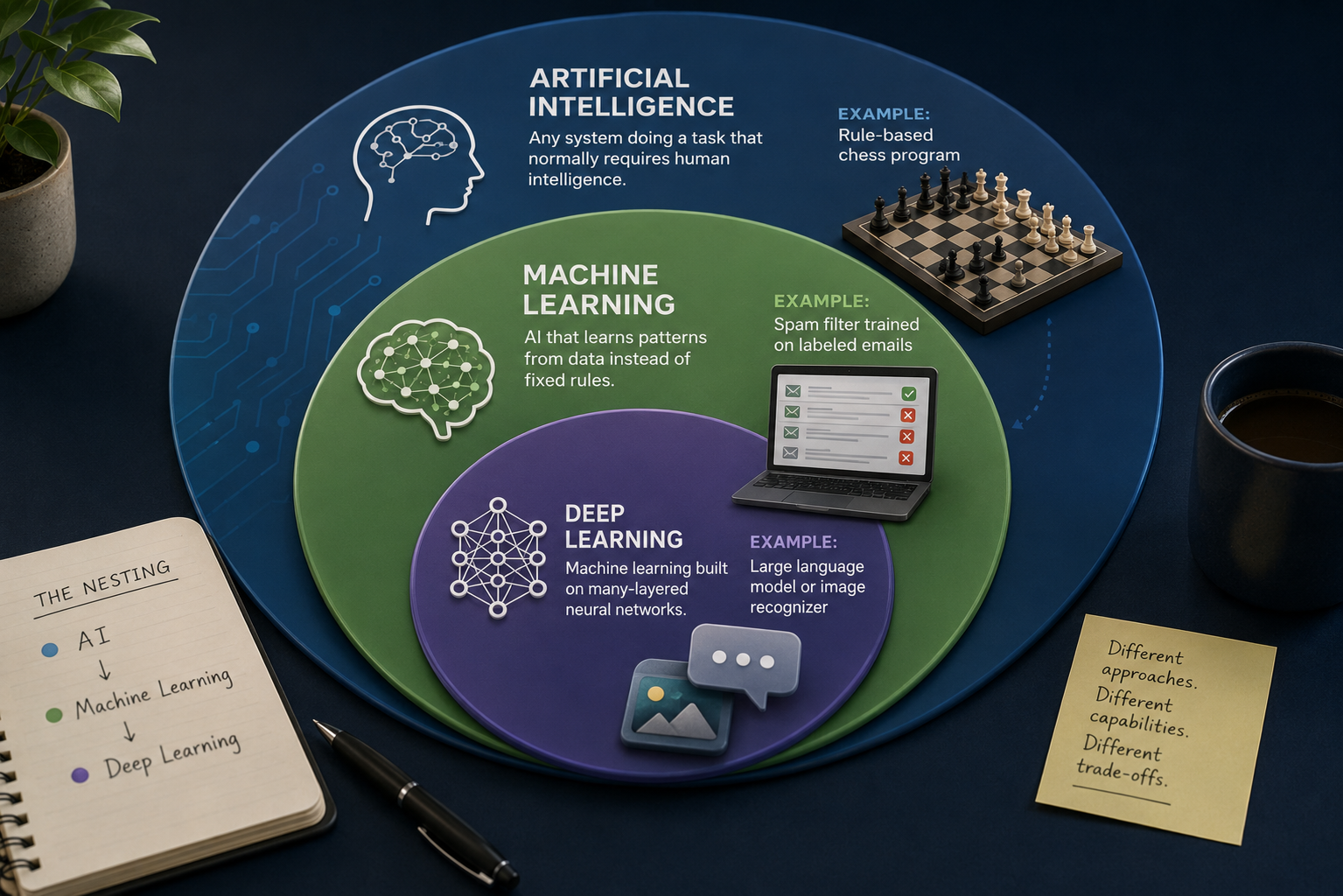
Key Takeaways
- AI is the broadest category of the three - any system designed to do something that would ordinarily require human intelligence, regardless of the method behind it.
- Machine learning is one particular way of building AI: instead of following hand-written rules, the system picks up patterns directly from data.
- Deep learning is a narrower slice of machine learning, built on neural networks with many stacked layers - a subset within a subset, not interchangeable with either broader term.
About this app
Marketing copy tends to use these three terms as if they were synonyms, which does everyone a disservice, because they're really three nested categories, each one a tighter slice carved out of the one before it. Once that nesting makes sense, a lot of hand-wavy product claims get much easier to see through, and the distinction stops feeling like trivia and starts working as a genuinely practical lens for judging what a piece of software is actually doing.
AI: The Broadest Category by Far
AI describes any system built to carry out something that would typically call for human intelligence - reasoning, understanding language, recognizing what's in an image, making a call on something. Notice what's absent from that definition: any mention of *how* the system gets there. A bare-bones rule-based program - if the opponent plays here, respond there - that plays a flawless game of tic-tac-toe technically counts as AI, even with zero learning happening inside it anywhere. Same goes for a thermostat running a handful of hardcoded conditions, or an old-fashioned chess engine that just brute-forces its way a few moves deep. None of that resembles learning in any sense - it's logic somebody wrote out in advance, and it still qualifies.
- Learning isn't required: A system can still count as AI while running entirely on rules a person typed out by hand.
- A category with decades behind it: The term dates back well before modern computing power existed - it's not shorthand for anything new.
- Defined by the task, not the technique: What earns something the AI label is that it does a job normally tied to human intelligence, not the method it uses to do it.
Machine Learning: One Particular Route Into AI
Machine learning narrows the field: rather than a person spelling out explicit rules, the system extracts its own patterns straight from examples. A spam filter that improves by working through thousands of labeled emails counts as machine learning. Build that identical spam filter by having someone type out five hundred "if it contains this word, flag it" rules by hand instead, and it's still AI - just not machine learning. What separates them is where the rules originate: a person writing them out, or the system inferring them from data on its own.
That distinction has teeth because machine learning systems tend to improve with more data and degrade when the data is sparse, skewed, or outdated - a trait rule-based AI simply doesn't share. A hand-coded system behaves identically on day one thousand as it did on day one, whether that's good or bad. A machine learning system trained on last year's data, though, can gradually fall out of sync with how people behave now, which is exactly why retraining and ongoing monitoring are recurring costs rather than a one-and-done setup step.
Deep Learning: A Narrower Slice Still
Narrow things down once more and you arrive at deep learning - machine learning specifically built on neural networks stacked with many layers, which is exactly where "deep" comes from. It's become the default approach behind most of the recent breakthroughs in AI (image recognition, language models, speech synthesis) because it's exceptionally good at teasing complex patterns out of huge datasets without anyone needing to manually spell out what those patterns should look like.
That capability doesn't come free. Deep learning models generally demand more data and more computing power than simpler machine learning approaches, and they're notoriously opaque to inspect - it's genuinely hard to pin down exactly why a deep neural network landed on a specific call, which becomes a real issue in fields like lending or medicine where regulation, not just curiosity, often demands an explanation. Simpler, more transparent approaches - decision trees, linear models - sacrifice some raw predictive punch in exchange for being able to actually show their work.
| Term | What it actually means | Example |
|---|---|---|
| Artificial Intelligence | Any system carrying out a task that would normally need human intelligence | A rule-based chess program |
| Machine Learning | AI that picks up patterns from data instead of running on fixed rules | A spam filter trained on labeled emails |
| Deep Learning | Machine learning built on neural networks with many stacked layers | A large language model or image recognizer |
A Quick Filter for Sizing Up Any AI Claim
Next time a product page announces it's "powered by AI," run the phrase through a short checklist rather than accepting it at face value.
- Does it learn from data, or run on fixed logic?: If no one can point you to a training dataset, it's likely rule-based AI rather than machine learning.
- Does more data change its performance?: Machine learning systems shift, for better or worse, with the data they're exposed to; rule-based systems don't budge.
- Is it built on neural networks?: If so, and those networks run many layers deep, that's deep learning specifically - not machine learning in the broader sense.
- Can the vendor point to a reason for a specific decision?: Simpler machine learning and rule-based AI are generally easier to explain than deep learning is.
- Does the tool actually fit the task?: Deep learning excels on messy, high-volume data like images or language; on small, structured datasets it's frequently overkill.
Why This Distinction Is Worth Caring About
Beyond just cutting through marketing fluff, knowing where a product falls in this nesting tells you something useful: how it's likely to behave over time. Rule-based AI is predictable and easy to audit but brittle - it snaps the moment reality drifts outside whatever rules someone anticipated. Machine learning adjusts to new data but needs a steady stream of good examples to stay accurate, and it can absorb biases baked into that data without anyone meaning for that to happen. Deep learning pushes that adaptability further still, but it asks for more resources and more trust in return, since what's happening inside it is genuinely harder to audit than either of the other two.
"Powered by AI" is technically accurate for an enormous range of wildly different systems, everything from a basic decision tree to a state-of-the-art language model - which is exactly why it's such a convenient piece of vague marketing language. Understanding the nesting gives you a sharper question to ask instead: is this actually machine learning, and if it is, is it deep learning specifically? The answer to that tells you far more about what a product can realistically deliver than the bare word "AI" ever will.
Frequently Asked Questions
Does every AI product run on machine learning under the hood?
No - a fair amount of software marketed with AI language runs on fixed, hand-written rules with no learning component at all. The word "AI" by itself doesn't guarantee machine learning is involved, so it's worth asking directly if that distinction matters to you.
Does deep learning beat other machine learning methods across the board?
Not across the board, no. It tends to need substantial data and computing power before it really pays off, and simpler machine learning methods can outperform it on smaller, more structured datasets where a large neural network is genuinely more than the job calls for.