
Before You Buy That Couch Online, Measure the Room With What's Already in Your Pocket
AR Ruler: Tape Measure Tool turns a phone camera into a quick AR measuring tool for distance, height, area, and angles - a practical look at using it to avoid the classic "it doesn't fit" furniture return.
Key Takeaways
- AR-based measuring estimates distance, height, width, area, and angles by pointing the camera at real-world points - no physical tape needed.
- Check the doorway and hallway path a piece has to travel through, not just the room itself - it's the step people skip most often.
- It's well suited to quick space-planning estimates, but not a substitute for a physical tape measure on precision work like cutting material to size.
- It's a young listing with 58 reviews and a 4.5-star rating, and includes ads and in-app purchases.
Get this app
About this app
Online furniture shopping has a specific failure mode that has nothing to do with quality: the couch shows up, and it's either too big for the wall, too deep for the walkway, or it makes the room feel like a furniture showroom rather than a living room. Industry return-rate data on furniture and home goods consistently points to size and fit - not defects - as one of the biggest drivers of returns, and it's not hard to see why: judging real-world scale from a product photo and a set of dimensions on a page is genuinely difficult.
That's the specific, avoidable mistake AR Ruler: Tape Measure Tool is useful for heading off, even though it's a general-purpose measuring app rather than a furniture-specific one.
What it actually measures
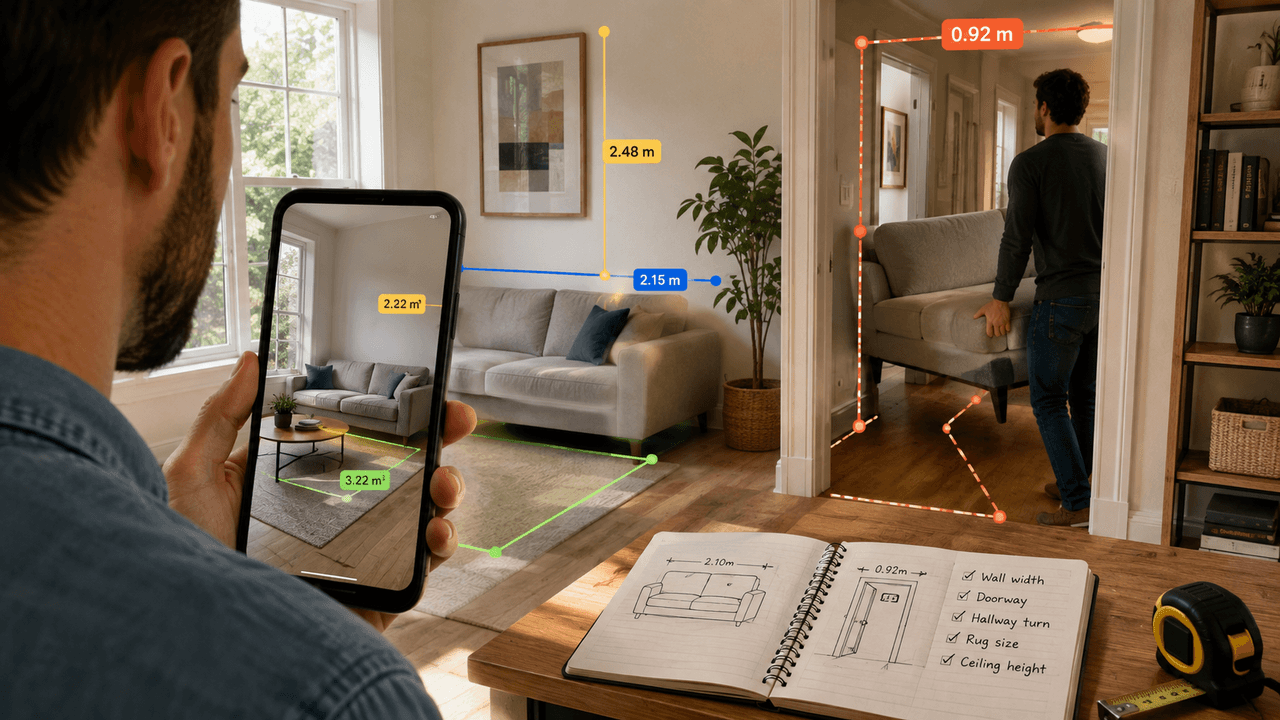
The app uses the phone's camera and AR tracking to estimate distance, height, width, area, and angles by pointing at real-world points rather than physically holding a tape against them. Practically, that covers the exact questions that come up before a furniture order: how wide is this wall, how deep is this alcove, will this doorway actually let a couch frame through, how much floor space does this rug size actually take up.
A quick pre-purchase routine
- Measure the wall or space where the piece will actually sit, not just "the room" in general
- Check the doorway, hallway, and any turns the piece has to travel through to get there - this is the step people skip most often
- Use the area tool to compare a rug or rectangular piece's footprint against the actual floor space, not just a mental estimate
- Save the measurement so it's on hand while browsing listings, rather than trying to remember a number from an hour earlier
The angle tool: a less obvious use
The angle measurement tool is easy to overlook next to distance and area, but it covers a specific niche of its own - checking whether a corner is a true right angle before ordering a sectional built for a 90-degree corner, or making sure two points, like curtain rod brackets, sit level with each other before drilling. It's not something most people think to check with a phone before a purchase, but it's exactly the kind of small measurement that's easy to skip and mildly expensive to get wrong.
Height measurement gets less attention than width, but it matters just as much for anything tall - a bookshelf, a floor lamp, a bed frame with a headboard. Checking ceiling clearance and door height before ordering something tall enough to matter avoids a version of the same mistake: an item that measures fine on paper but doesn't actually clear the space it needs to pass through or sit under.
Where AR measuring is genuinely useful - and where it isn't
This kind of tool is well suited to exactly this use case: quick, practical estimates for space planning, furniture arranging, and general home projects, where being off by a small margin doesn't matter much. It's a different job from a metal tape measure and a pencil mark, and it shouldn't be treated as a substitute for precision work - cutting a shelf to size, ordering custom blinds, or anything else where a small error actually costs money. For the "will it fit through the door" and "how much wall do I have" questions that come up before an online order, though, it's a genuinely faster and more convenient tool than digging out a physical tape measure and trying to hold a phone light steady at the same time.
A few other things it covers
Beyond room and furniture measurement, the app supports both metric and imperial units, keeps a saved history of past measurements, and lets you share results - handy if you're coordinating a purchase or a project with someone else. It's a young listing (58 reviews, currently rated 4.5 stars) with ads and in-app purchases, which is standard for a free utility app in this category.
None of this requires much setup, either. There's no need to calibrate the app to a specific room or object beforehand - point the camera, tap the two points, and the measurement appears in real time, which is part of why it fits into a five-minute pre-purchase check rather than becoming its own separate task. The same routine works just as well for smaller purchases that get overlooked - a rug, a floor lamp, a bookshelf - where a small size misjudgment is less costly than a couch return but still adds up in wasted time and shipping. It's worth doing the same check before assembling flat-pack furniture too, since a footprint that looked fine in a product photo can still crowd a room once it's actually standing in it.
The bigger habit worth building here isn't really about this specific app - it's the five-minute pre-purchase check itself. Whatever tool does the measuring, doing it before checkout rather than after delivery is the difference between a couch that fits and one that goes straight back in a box.
Frequently Asked Questions
Can AR Ruler replace a physical tape measure entirely?
Not for precision work. It's well suited to quick, practical estimates like space planning and furniture arranging, but it shouldn't be treated as a substitute for a physical tape measure on anything that needs to be exact, like cutting material to size.
What should I measure before ordering furniture online, besides the room itself?
The doorway, hallway, and any turns the piece has to travel through to reach the room - that's the step people skip most often, and it's just as likely to cause a return as the room measurement itself.