
The Feet-and-Inch Mistake That Quietly Wrecks a Job Estimate
Construction Master Calculator is built around feet-inch-fraction math instead of decimals - a look at the specific estimating mistake that causes, and how a dedicated construction calculator avoids it.
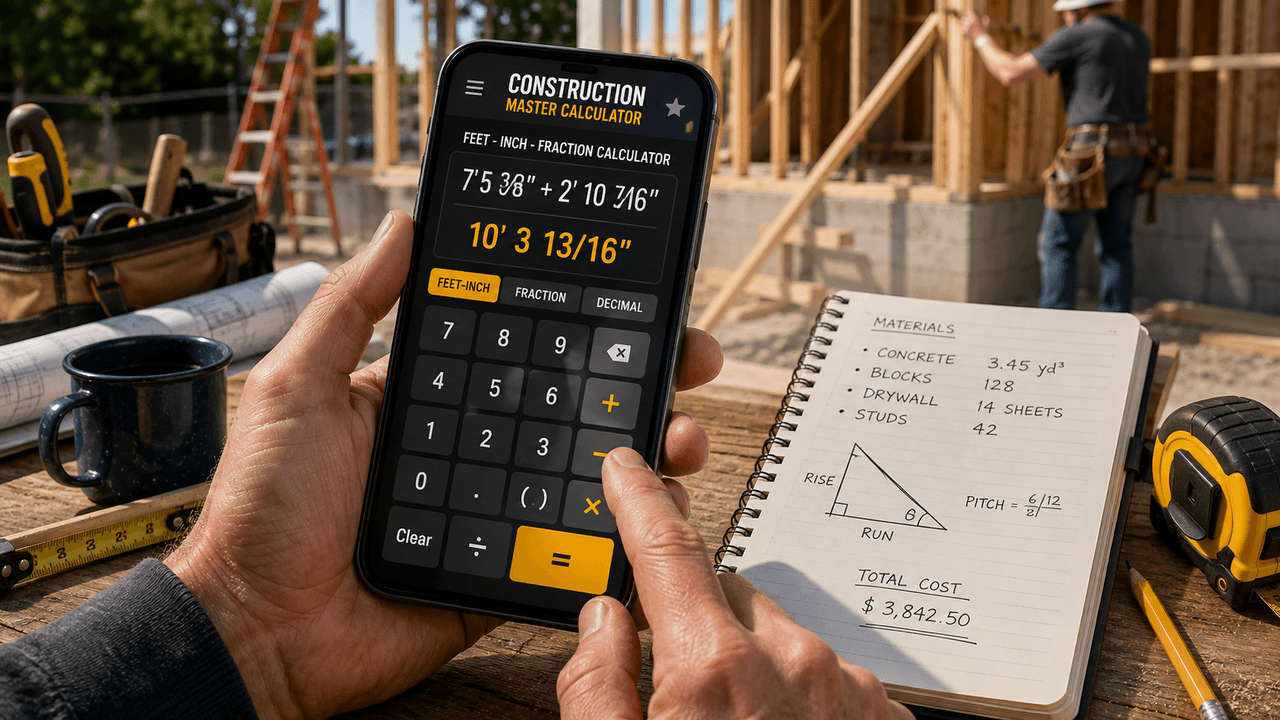
Key Takeaways
- Standard phone calculators work in decimals, while construction measurements are expressed in feet, inches, and fractions - every conversion between the two is a chance for a rounding error to sneak in.
- The core keypad adds, subtracts, multiplies, and divides directly in feet-inch-fraction form, removing the manual conversion step entirely.
- Dedicated calculators cover roof and rafter slope, concrete and footing estimates, material counts (blocks, drywall, studs), and general project geometry and cost.
- It's a newer listing with installs still in the low hundreds, so it's worth trying on its feature set rather than treating it as a proven industry standard yet.
Get this app
About this app
Here's a mistake that's easy to make and expensive to catch late: converting 7 feet 5 and 3/8 inches into decimal form to run a quick calculation, rounding somewhere along the way, and coming out with a measurement that's off by a fraction of an inch. On a single cut, that barely registers. Multiplied across a full framing job, a set of stair stringers, or a concrete pour, that same small rounding habit is exactly the kind of error that turns into wasted material, a bad fit, or a callback.
It happens because a standard phone calculator - and most people's mental math - works in decimals, while construction measurements are almost always expressed in feet, inches, and fractions. Every time a measurement crosses between those two systems, there's a chance for a small error to sneak in. Construction Master Calculator exists specifically to remove that conversion step.
Math in the units the job actually uses
The core of the app is a keypad built to add, subtract, multiply, and divide directly in feet, inches, and fractions - no converting to decimal and back. That alone removes the most common source of small measurement errors: the manual conversion step where a rounding mistake is easiest to introduce and hardest to notice until something doesn't line up on-site.
Purpose-built calculators for the recurring jobs
Beyond the core keypad, the app includes dedicated calculators for the specific math that comes up constantly on a job site:
- Roof, rafter, and stair calculators - for slope, rafter length, and rise-and-run without working the trigonometry by hand each time
- Concrete and footing estimators - figuring out how much material a pour actually needs before ordering
- Material estimators - blocks, drywall, and studs, so a materials list is based on a calculation rather than a guess with some padding added "just in case"
- Geometry and cost calculators - for area, volume, and rough project-cost estimates while still on-site
A concrete example of where the conversion step bites
Take a simple example: a stair stringer needs a rise of 7 and 3/4 inches per step across 14 steps. Converting that fraction to decimal, multiplying, and converting back introduces two separate opportunities for a rounding slip before the number ever reaches a saw or a cut list. A keypad that does the whole calculation in feet-inch-fraction form from input to output removes both of those conversion points, not just one - the number that comes out is exact in the same units the tape measure and the lumber are already in.
Keeping the numbers organized, not just calculated
A calculation is only useful if it's still findable later, so the app also supports saved calculation "tapes," notes, folders, and attached photos - a simple way to keep a job's numbers, sketches, and site photos together instead of scattered across a notepad, a phone's photo roll, and a separate spreadsheet.
Who actually needs this versus a standard calculator
- Contractors and tradespeople doing feet-inch-fraction math daily, where small conversion errors compound across a project
- Serious DIYers tackling a framing, roofing, or concrete project who don't want to relearn imperial-to-decimal conversion by hand
- Anyone estimating material needs before placing an order, where a rough guess tends to mean over-ordering "to be safe" - or under-ordering and making a second trip
Worth knowing
This is a newer listing, with installs still in the low hundreds, so it doesn't yet carry the kind of long track record that older, more established construction calculator apps have built up over years. It's worth trying on the strength of what it does - dedicated feet-inch-fraction math and job-specific calculators in one place - rather than treating it as a proven industry-standard tool just yet. It includes ads and in-app purchases, standard for a free utility in this category.
The same logic extends to ordering materials. A footing calculator that outputs an exact concrete volume in the units a supplier actually quotes in removes another spot where a decimal-to-fraction round trip could quietly shave a few percent off an order - the kind of shortfall that isn't obvious until a crew is standing around waiting on a second delivery mid-pour. None of this replaces double-checking a number that looks off, but it does remove the specific, repetitive source of error that comes from converting between two measurement systems dozens of times over the course of a single project. For a solo contractor or a small crew without a dedicated estimator, that's a meaningful amount of risk removed from a job's numbers before a single order gets placed.
The underlying point holds regardless of which specific calculator someone ends up using: any tool that keeps construction math in feet, inches, and fractions from end to end - instead of forcing a mental round-trip through decimals - removes one of the quieter, more common ways an estimate goes wrong.
Frequently Asked Questions
Why does feet-inch-fraction math cause more estimating errors than decimal math?
Because a standard phone calculator works in decimals while construction measurements are expressed in feet, inches, and fractions. Every time a measurement has to be converted between the two systems, there's a chance for a rounding error to sneak in - and that habit compounds across a full framing job or concrete pour.
Does it do more than basic feet-inch-fraction arithmetic?
Yes - beyond the core keypad, it includes dedicated calculators for roof, rafter, and stair math, concrete and footing estimates, material counts like blocks and drywall, and general project geometry and cost, plus saved calculation tapes, notes, folders, and photo attachments for keeping a job's numbers organized.