
Why You Can't Stop at "Just One More Level" in Gate-Picking Runner Games
Count Master: Ant Crowd Run is built on a simple gate-choice mechanic - a look at why that specific kind of decision loop is so hard to put down, and how to actually play it well.
Key Takeaways
- The core loop is picking gates that add to, multiply, or shrink an ant "army," then colliding with an enemy crowd - whichever side is bigger wins.
- Instant, low-cost decisions with immediate visible feedback are what make the format so hard to put down, not the graphics or story.
- Multiply gates generally outperform flat-add gates once a crowd is already large, and red/enemy gates are almost always worth avoiding.
- It's a very new listing with minimal install history, worth trying as a solid genre example rather than an established hit.
Get this app
About this app
There's a particular genre of mobile game - running forward, picking a gate, watching a number grow or shrink - that shouldn't be as compelling as it is. The premise is almost absurdly simple: pick the bigger number, avoid the smaller one, keep running. And yet it's one of the stickiest formats in casual mobile gaming, precisely because of how little it asks of a player in exchange for how much it visibly rewards them.
Count Master: Ant Crowd Run is a clean example of the format, built around growing an ant "army" through a sequence of gates before crashing it into an enemy crowd at the finish line - and it's worth looking at through the lens of why this structure works so well, not just what the game looks like.
The loop, broken down
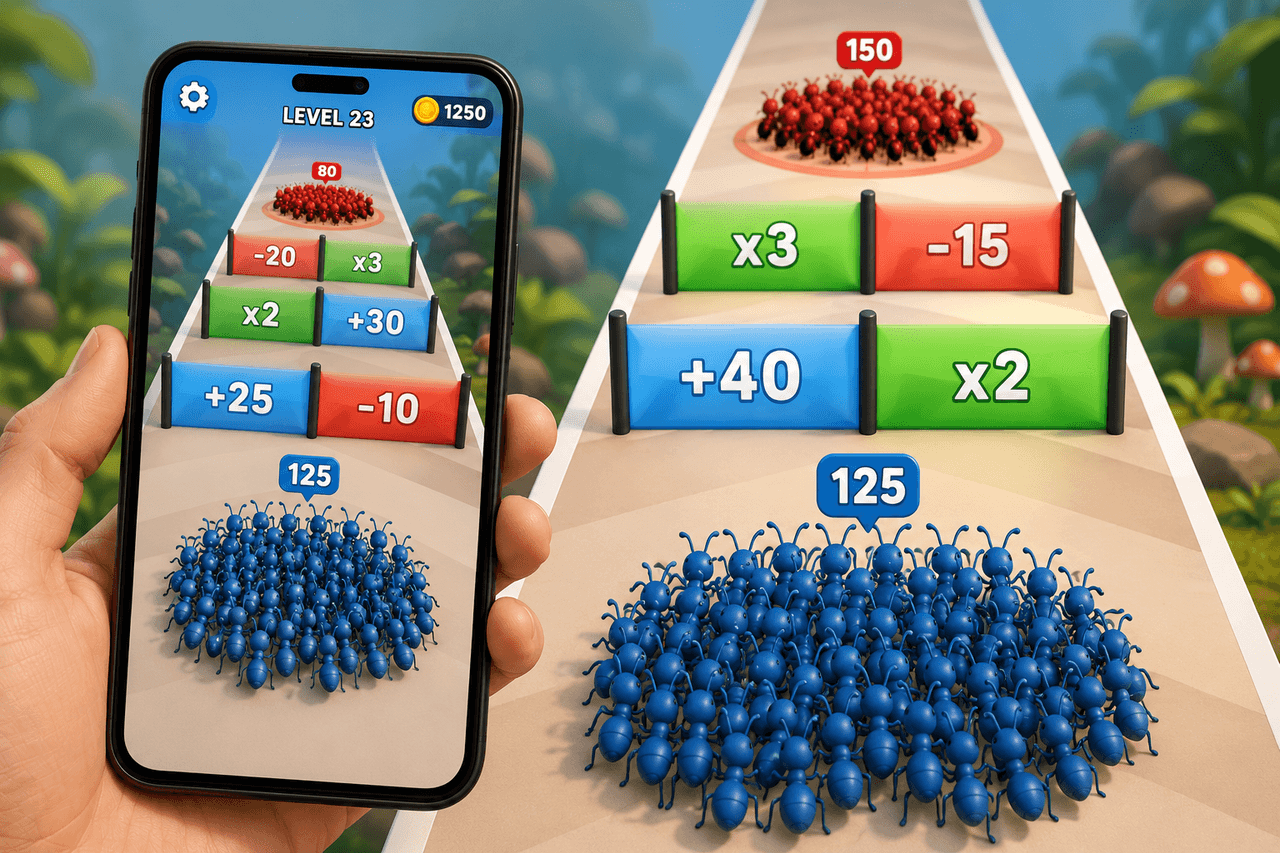
Each run is a straight line forward through a series of gates - some add to your ant crowd, some multiply it, and some (marked as enemy or "red" gates) shrink it. Choosing correctly grows a visibly bigger army trailing behind the player in real time; choosing badly visibly shrinks it. At the end of a stretch, that crowd collides with an enemy crowd, and whichever side is bigger wins the clash and pushes forward.
Why this specific structure is so hard to put down
A few things are doing the work here, and none of them are complicated:
- The decision is instant and low-cost. There's no menu, no stats screen, no pause to think - just pick left or right in under a second. That removes almost all the friction between "decide" and "see the result."
- The feedback is immediate and visible. The crowd behind the player visibly grows or shrinks the moment a gate is chosen - there's no delay between decision and consequence, which is a big part of what makes quick-choice games feel satisfying rather than tedious.
- The reward keeps escalating. A bigger crowd doesn't just look better, it directly determines whether the next clash is won or lost, which keeps every gate choice feeling consequential rather than cosmetic.
That combination - instant decisions, immediate visible feedback, and stakes that keep climbing - is a well-worn but genuinely effective design pattern, and it's a big part of why "just one more level" ends up being three or four.
Why a visible, physical crowd works better than a number
A lot of games could show the same information as a plain number in the corner of the screen - "312 units" instead of an actual crowd running behind the player. It's a small design choice, but it's not a cosmetic one: seeing the crowd physically grow or shrink is processed faster and more viscerally than reading a number, which is part of why the feedback in this format lands as instant even though, technically, a number update would convey the same information. Games that swap this out for a plain score tend to feel less immediately satisfying, even when the underlying math is identical.
It also makes a bad decision easier to spot and correct. A shrinking crowd is an obvious visual cue to change strategy on the next gate, in a way a small numeric decrease easily gets missed. That immediate, visible correction loop is part of what keeps a run feeling controllable even when it's moving fast.
Playing it well, not just playing it
- Multiply gates (like x2) generally outperform flat-add gates once a crowd is already reasonably large - the bigger the base number, the more a multiplier is worth
- Enemy/red gates shrink the army fast and are almost always worth avoiding, even when they look tempting
- The toughest moments tend to cluster right before the finish line, so it's worth staying focused rather than coasting once the end is in sight
- Replaying an earlier level to build a bigger crowd before pushing further is a legitimate strategy, not a failure to progress in a straight line
Worth knowing
This is a very new listing with minimal install history so far, so it's fairer to describe it as a solid, well-made example of the genre worth trying than as an established hit with a long track record. It includes ads, consistent with how free games in this category are typically supported.
None of this is unique to this particular game - the same loop shows up across dozens of similar runner titles - but execution still matters. A crowd that doesn't render smoothly, or gates that are hard to read at a glance, would undercut the whole effect no matter how sound the underlying design is. What makes a title in this genre worth actually opening isn't the concept, since the concept is shared across the category - it's whether the moment-to-moment feel of picking a gate and watching the crowd react is satisfying enough to want to do again immediately.
The bigger takeaway applies beyond this one game: when a mobile game feels unexpectedly hard to put down, it's rarely the graphics or the story doing that work - it's almost always this same underlying pattern of fast decisions, instant feedback, and visibly escalating stakes.
Frequently Asked Questions
Are multiply gates always better than add gates?
Generally yes once your crowd is already reasonably large - the bigger the base number going into a multiplier, the more it's worth. Add gates matter more early in a run when the crowd is still small.
Should I always avoid the red or enemy gates?
Almost always. They shrink your army fast, and even though they can look tempting compared to a smaller add or multiply gate, they typically cost more than they're worth.