
Hallucination Debugging: Concrete Techniques for Trustworthier Model Output
A model stating something false with total confidence isn't a bug you can patch out - it's a pattern you have to design around. Here are the practical techniques that actually move the needle on hallucination risk.
Key Takeaways
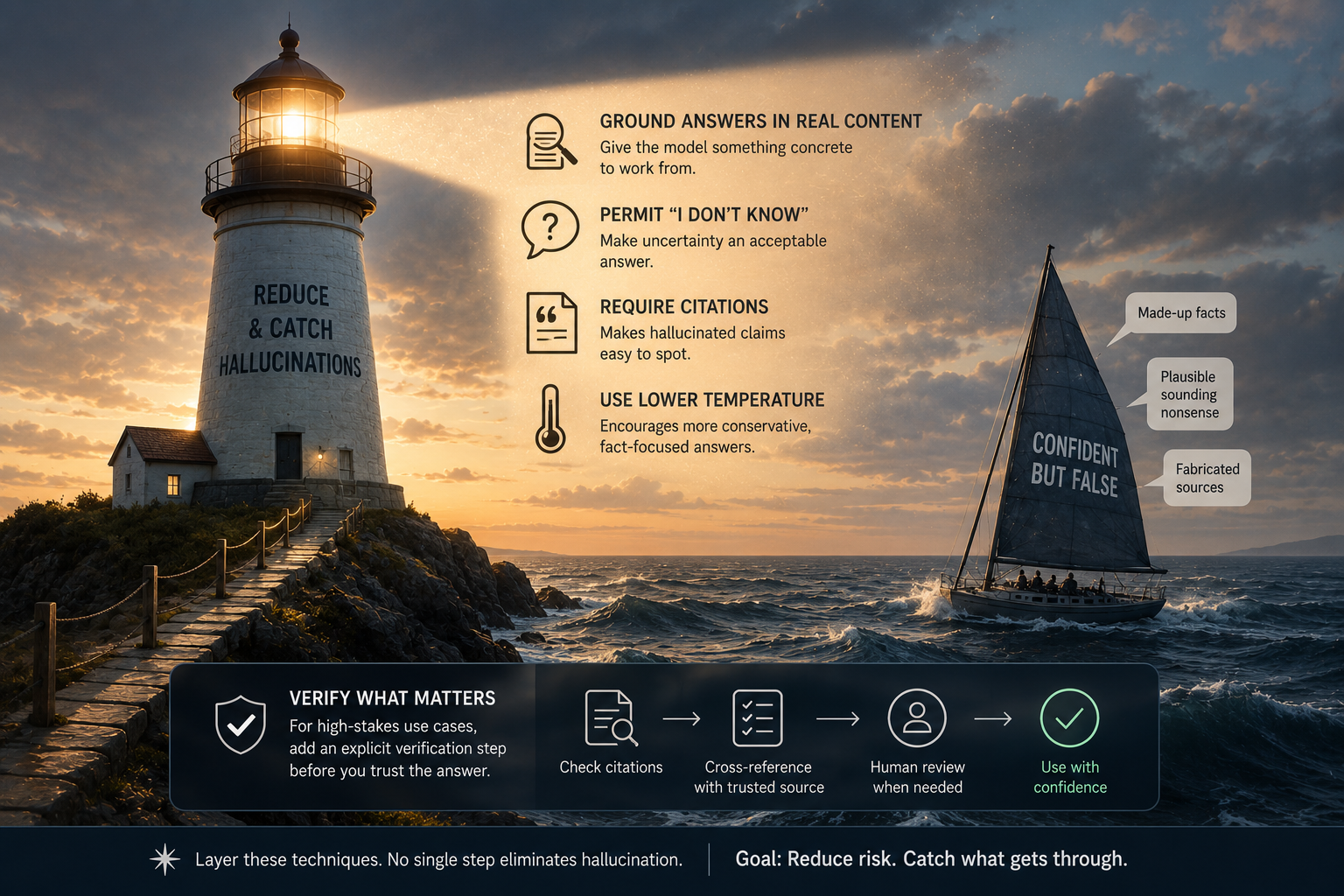
- Hallucination isn't a defect waiting to be squashed - it's baked into how generative models operate, so the realistic aim is catching and shrinking it, never wiping it out completely.
- Grounding responses in retrieved, real source material (RAG) and explicitly telling the model it's allowed to say "I don't know" are among the most effective mitigations you can apply.
- Requiring citations won't stop a model from hallucinating, but it turns hallucinations into something you can actually spot.
- Wherever a wrong answer has real consequences, add a dedicated verification step - prompt engineering alone isn't a full safety net.
About this app
A hallucination - a model stating something false with total confidence - can't be patched away entirely, because it's a straightforward byproduct of how generative models function: predicting plausible-sounding text rather than looking anything up. The achievable goal is catching and shrinking it, not eliminating it. Treat hallucination like a fixable defect and you'll chase a perfect prompt that never materializes; treat it as an ongoing risk to design around and you end up with systems that actually survive contact with production.
What actually causes a model to hallucinate
There's no lookup table inside a language model that it consults for facts. It's predicting the next token based on statistical patterns it picked up during training, and when it doesn't actually have the specific information an answer requires, it doesn't pause - it fills the gap with whatever sounds plausible given everything else it's seen. That's not laziness or deception; it's the system doing exactly what it was built to do, which is produce fluent, coherent text, not verified truth. Grasping that distinction is what separates a mitigation that actually works from a prompt tweak that just feels like it should.
- Training rewards confidence: models are shaped to come across as helpful and thorough, which nudges them toward a smooth-sounding guess over an awkward "I'm not sure."
- Nothing fact-checks by default: unless you build one in, no step in the generation process cross-references a claim against a real source before it goes out the door.
- Gaps in training coverage: ask about something outside the training data, or something obscure enough to be underrepresented in it, and the model often answers anyway with nothing solid to go on.
- Longer answers carry more risk: the more detailed a response gets, the more individual claims it packs in, and the more chances one of them turns out wrong.
Anchor the answer to something real
Grounding a response in retrieved, real source material (our RAG explainer covers the mechanics) gives the model something solid to work from and meaningfully cuts down on it inventing facts wholesale - it's one of the strongest mitigations available for anything factual. Rather than letting the model answer purely from what it absorbed during training, you pull relevant passages from a trusted source at the moment of the query and tell it to answer strictly from that material. That reframes the task from "recall a fact from memory" to "summarize what's right in front of you," and models are noticeably better at the second one.
Pair that with something just as important: explicitly telling the model, in the system prompt, that it's fine to say it doesn't know or that the supplied context doesn't cover the question. Models lean toward sounding confidently complete partly because their training rewarded exactly that, and spelling out that uncertainty is an acceptable answer measurably cuts down on confident fabrication. One added line - along the lines of "if the context doesn't contain the answer, say so instead of guessing" - costs almost nothing to add and reliably changes the behavior.
Make it easier to catch what slips through
Requiring citations - pointing to exactly which part of the context backs up a given claim - won't stop hallucination from happening, but it makes it much easier to catch when it does. A claim with nothing backing it becomes an obvious, checkable red flag rather than something invisible buried inside otherwise-fluent prose. When factual accuracy matters more than creative range, dialing down the temperature setting helps too, pushing the model toward more conservative, repeatable output and cutting back (though not erasing) its tendency to wander into invented detail.
- Require inline citations: make the model point to the exact passage or field a claim came from, not just gesture at a source in general.
- Turn the temperature down: on factual or technical work, a lower setting sacrifices some creativity for steadier, more repeatable answers.
- Split long generations into pieces: shorter, checkable chunks are far easier to verify than one uninterrupted wall of text.
- Scrutinize numbers and names on their own: hallucinations tend to cluster around specific figures, dates, and proper nouns, so give those extra attention.
| Technique | What it addresses |
|---|---|
| Retrieval grounding (RAG) | Gives the model real source material instead of leaning solely on training knowledge |
| Explicit "I don't know" permission | Cuts the default pull toward a confident-sounding guess |
| Requiring citations | Doesn't stop hallucinated claims, but makes them far easier to spot |
| Lower temperature | Cuts down on wandering into unsupported specifics |
| Verification step | Catches what slips past every prompting-level mitigation |
Add a verification layer wherever the stakes are high
Anywhere a wrong answer has real consequences - financial, legal, medical, reputational - add an explicit verification step (a second model pass, a human reviewer, a check against a trusted source) rather than relying on prompt engineering by itself. Every technique here lowers risk; none of them brings it to zero, and treating any single one as a complete solution for high-stakes work is a risk of its own. Stack them - grounding, permission to say "I don't know," citations, and verification where it counts - instead of expecting one lever to carry the whole load.
- Send high-stakes answers through a second check: a separate pass - another model call, a rules-based validator, or a person - catches what the first pass let through.
- Keep a person in the loop where it counts: for medical, legal, or financial output, an automated check by itself isn't sufficient accountability.
- Log and review flagged claims: statements without a citation or that can't be verified should get tracked down, not quietly shipped.
- Treat the cost of verification as a design input: if checking an answer is expensive, that's telling you to narrow the task, not to drop the check.
None of this eliminates hallucination, and any team claiming otherwise is overselling. What these techniques actually do is narrow the window where a false claim goes undetected, turning the failure mode from "wrong and invisible" into "wrong and flagged." That's a realistic bar for building with generative models right now, and a reachable one - provided you engineer toward it deliberately instead of hoping a well-worded prompt covers everything.
Frequently Asked Questions
Will future model generations eventually eliminate hallucination for good?
They keep getting better at it, but hallucination is tied to the basic prediction-based way these models generate text. Continued improvement seems likely; total elimination is a much bigger, currently unproven claim, and it's worth staying skeptical of anyone promising it.
Does telling the model to "double-check its work" actually help?
A little, as one extra layer, since it forces a second reasoning pass - but it's not a dependable fix on its own. A model can still confidently back up its own wrong answer when asked to self-check.