
Deepfakes, Demystified: How They Get Made and How to Actually Catch One
Your eyes alone won't catch a good deepfake anymore. Here's a straight explanation of how these things get built, and the verification habits that hold up far better than staring closely at the footage.
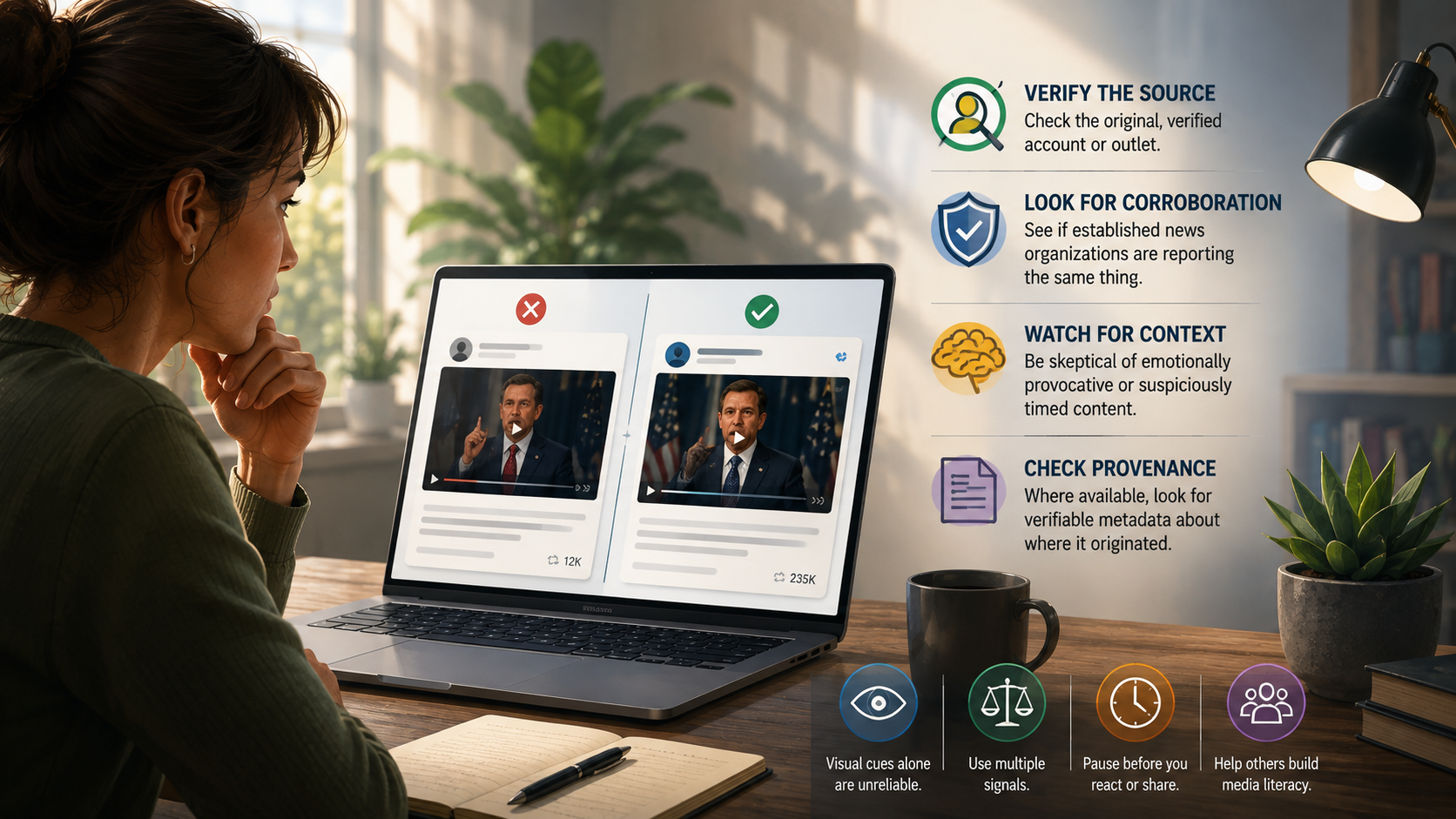
Key Takeaways
- A deepfake is manufactured media - typically video or audio - that AI has generated or altered to make it look convincingly like someone did or said something that never happened.
- The old detection tricks (odd blinking patterns, rough edges around the face) have gotten shakier as the generation tech improved - don't build your whole defense on them.
- Tracing whether footage actually shows up on the real, verified account it's supposedly from beats squinting at the pixels every time.
About this app
Deepfakes - video and audio that AI has generated or doctored to show someone doing or saying something they never actually did - have gone from a novelty act to a real, everyday media-literacy problem. Knowing how these are actually put together, and what genuinely works for verifying them, matters more with each passing year, exactly because spotting one by eye keeps getting harder.
How a deepfake actually gets built
Most methods start by training a model on existing footage or photos of a target, then putting that model to work generating something new - grafting a face onto a different clip, building an entirely fresh video of the person from nothing, or cloning their voice to narrate speech they never gave. The more footage of someone that's floating around out there, the more convincing a fake targeting them can get, which explains why public figures and anyone with a big online presence draw a disproportionate share of attempts.
- Face swapping: A model trained on the target's face gets mapped onto an actor's real performance, carrying over expressions and mouth movement frame by frame.
- Full synthesis: Instead of grafting onto existing footage, the model builds an entirely new video of the person from scratch, driven by a text or audio prompt.
- Voice cloning: A brief sample of someone's actual speech is enough to train a model to produce new audio in their voice, saying things they never said (our voice-cloning piece covers this angle in more depth).
- Lip-sync manipulation: The original footage stays largely untouched, but the mouth and jaw get regenerated to line up with a different, fabricated audio track.
Why watching closely doesn't cut it anymore
The old advice - watch for weird blinking, lighting that doesn't match, blurry edges - actually worked back when generation quality was rougher. Once the tech got better, those exact tells stopped showing up reliably, and leaning on visual inspection alone turned into a shaky defense. Current-generation models nail lighting consistency, blink naturally, and render skin texture well enough that even a careful viewer, not just a casual one, often won't spot anything off just by staring at the screen.
That's not to say visual cues are useless - just that they can't be the only thing you check. Glitches still tend to crop up around fast motion, awkward angles, fiddly hand movement, and lip sync during rapid speech. But treating any one visual tell as definitive proof, in either direction, doesn't hold up anymore.
Tracing the source beats scrutinizing the pixels
What actually holds up better is source verification: does this footage show up on the original, verified account or outlet it's supposedly from? A clip claiming a public figure said something notable, sitting only on some unfamiliar account with zero pickup from established sources, is a far bigger red flag than anything visual. This turns the question from "does this look fake?" into "where did this actually come from?" - and the second question is a lot easier to answer with confidence.
- Track down the original account: Search for the identical clip on the subject's verified profiles or official channels before assuming it's real.
- Look for outside coverage: A genuinely notable statement from a public figure almost always gets picked up fast by established outlets - if that coverage isn't there, treat it as a warning sign.
- Look into the poster's history: An account with no history, a recent creation date, or a feed of nothing but inflammatory clips deserves far more skepticism than an established one.
- Run a reverse image search on a still: Grabbing a frame and reverse-searching it sometimes turns up the original, unaltered footage the fake was built on.
Provenance tracking and other habits worth building
Industry efforts around content provenance - embedding metadata that verifies where a piece of video or an image genuinely originated - are a genuinely promising step forward, even though not every platform or device supports it yet. Where that metadata exists, it beats eyeballing the footage outright, since it traces a file back to the moment it was captured or generated instead of relying on how convincing it happens to look.
| Signal | How much to trust it |
|---|---|
| Visual glitches (blinking, edges, lighting) | Low - doesn't hold up against current-generation fakes |
| Verified provenance metadata | High - traces the origin directly, when it's present |
| Confirming the source account | High - checks whether the claimed source actually posted it |
| Matching coverage from established outlets | High - real, notable claims get picked up fast |
| Automated deepfake-detection tools | Medium - useful as one data point, not a final verdict |
In practice: before reacting to, or sharing, surprising footage of a public figure, check whether established sources are reporting the same story. Be extra skeptical of anything designed to provoke a strong emotional reaction or timed suspiciously well to an ongoing controversy - that pattern shows up a lot in deliberately deployed deepfakes, separate entirely from how the fake was technically made. And resist treating any single visual cue as decisive proof either way - it's verification habits, not sharper eyesight, that hold up as this technology keeps advancing.
A thirty-second gut-check before you hit share
- Look for the same clip or claim covered by at least one established news outlet before sharing - genuinely significant stories usually get picked up within hours.
- Check whether the account posting it actually has a history, or whether it popped up out of nowhere just to push this one clip.
- Pay attention to your own reaction - content engineered to provoke outrage or shock is disproportionately the kind someone had a reason to fake.
- When you're unsure, hold off instead of sharing right away - a few hours costs you nothing and gives real coverage a chance to catch up, or not.
Frequently Asked Questions
Can I actually trust deepfake-detection tools?
They help, but the same way AI text detectors do - imperfectly. Both false positives and false negatives happen. Treat what they tell you as one signal among several, not the final word.
Does every piece of AI-altered media count as a harmful deepfake?
No - there's plenty of legitimate, disclosed use of similar technology out there, from film production to dubbing to artistic projects, all done with the subject's knowledge and consent. What makes something a harmful deepfake specifically is deceptive use, without consent, meant to mislead.