
From Text to Image: How Diffusion Models Turn Words Into Pictures
The idea powering most AI image generators, laid out with zero math: begin with random noise, then gradually scrub it clean into a picture that matches whatever you typed.
Key Takeaways
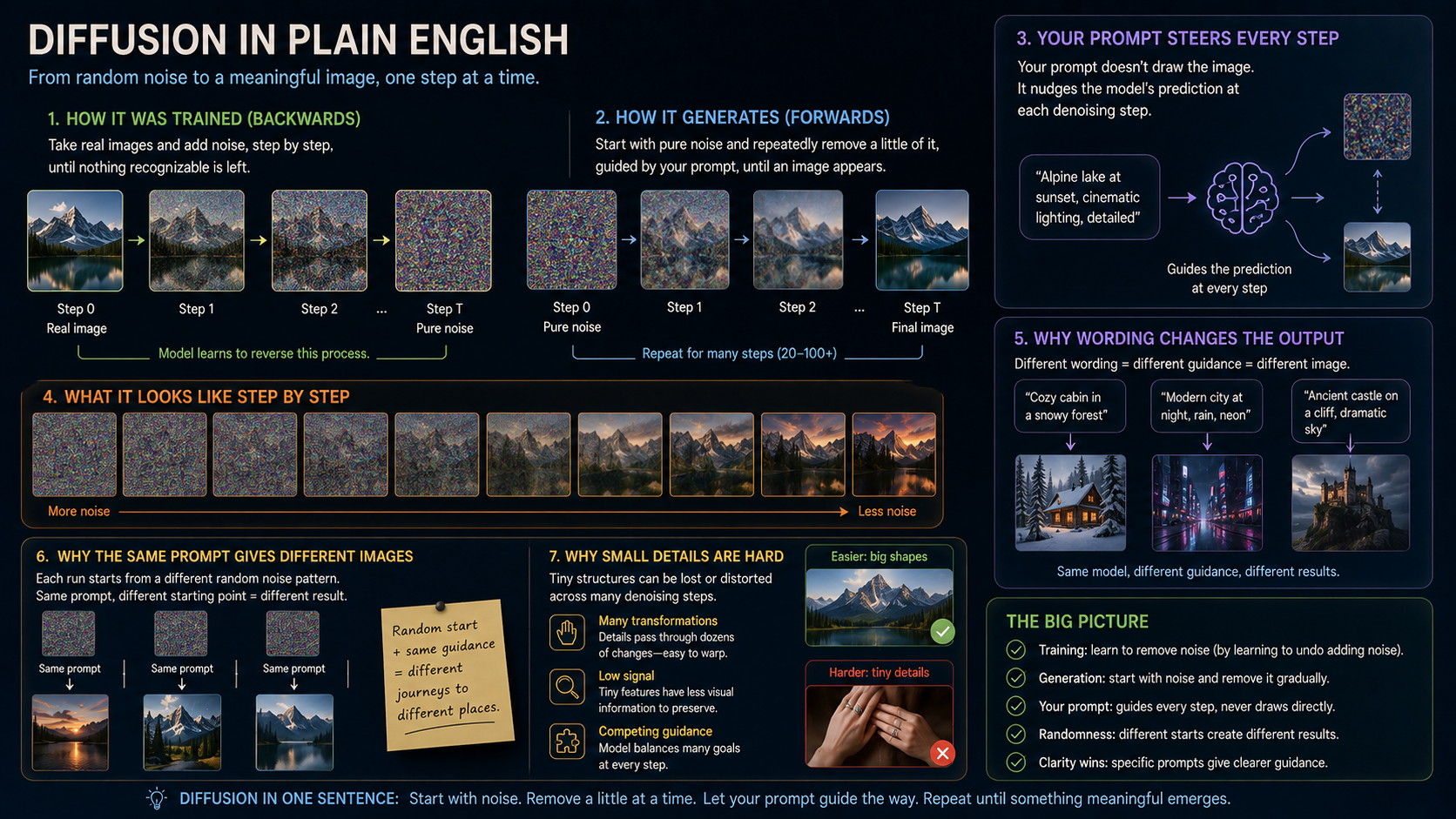
- Most AI image generators run on diffusion: begin with random visual static, strip away a bit of it at a time, with your prompt guiding every single pass.
- The model picked this skill up by training in reverse - fed real images with noise piled on gradually, then taught to undo that process step by step.
- Your prompt never actually paints anything. It nudges the denoising at every stage, which is exactly why changing the wording shifts the result so noticeably.
About this app
It seems like a magic trick - you type a sentence and a fully-formed picture materializes out of nowhere. It's not magic, though. It's diffusion, and it happens to be one of the cleverer ideas to come out of recent AI research. You don't need any math to get your head around it, just a willingness to picture the process running backwards.
Generation Clicks Once You Understand the Training
The key to grasping how these models actually generate images lies in how they were trained in the first place. Researchers took real photographs and buried them under random visual noise a little at a time, step after step, until nothing recognizable remained - just static. Then they trained the model to run that in reverse: hand it a noisy image, and have it predict what the slightly cleaner version underneath should look like.
Generation is that identical trained skill, just deployed from the other direction. You start with pure noise, no image whatsoever, and repeatedly apply that learned "clean this up a touch" move. Each pass makes the picture a little sharper. Do it enough times and a coherent image emerges gradually, built up in layers rather than drawn all at once.
- Forward process (training only): take a real image, add a little noise, repeat until it's pure static - this teaches the model what noise looks like at every stage.
- Reverse process (what you actually see): start from pure static, strip a little noise, repeat until a picture resolves - this is generation.
- One shared skill: the model really only masters one thing - predicting a slightly cleaner version of whatever noisy image it gets handed.
- Step count: more denoising steps typically buys a more refined image, at the cost of more compute time.
Think of Your Prompt as a Steering Wheel, Not a Paintbrush
And here's the piece that explains everything downstream: your prompt isn't drawing the picture. It's nudging the model's prediction, at every single denoising step, toward something that matches your description. That's exactly why changing the wording shifts the results so much - you're steering a gradual formation process, not touching up an already-finished image.
It's also why the identical prompt hands you a different image on every run - each generation kicks off from its own random noise pattern, so the model is denoising a genuinely different starting point each time, wording aside. That randomness isn't a bug, it's deliberate; it's the entire reason one description gives you several distinct options instead of the same picture repeating.
This same mechanism clears up a few things that used to look like odd quirks: why generation unfolds in visible steps you can sometimes watch sharpen into focus, why unusually specific prompts beat vague ones (more specific guidance gives each denoising step a clearer target to aim at), and why small precise details - hands, legible in-image text - have historically been the toughest thing to nail. Fine structural detail is simply easier to lose or warp across dozens of denoising passes than broad composition is.
Where Words Actually Connect to Pixels
Your prompt doesn't reach the image model as raw text. A separate language-understanding component converts it into a numerical representation capturing its meaning first, and that representation is what gets consulted at every denoising step. That's why prompts built from common, well-represented phrasing tend to land more predictably than obscure or ambiguous wording does - the model is working from how well it understood the text, not the literal words on their own.
It also explains why two differently worded versions of the same idea - "a dog running on a beach" versus "a beach where a dog is running" - often produce closely related output, while two phrasings that sound alike but mean different things can pull results in very different directions. The model steers toward meaning, not toward the literal character string.
What This Actually Changes Day to Day
This isn't just trivia - it shapes how you should actually work with these tools.
- Regenerate rather than fiddling blindly: since the randomness comes from the starting noise, hitting generate again with the same exact prompt is a legitimate way to get variation, not a sign something's broken.
- Add detail when a result feels vague: a flat, generic output usually means the guidance was too thin at each step, not that the model "failed" - more specific wording gives it a clearer target to steer toward.
- Expect fine detail to be the fragile part: hands, small text, and repeating patterns are what distort most often, since they're the easiest structure to lose across many denoising passes.
- Late steps polish, they don't rebuild: composition mostly gets locked in during the early denoising steps; later steps refine details rather than reshape the overall layout.
Diffusion is also the reason these tools keep getting better without needing an entirely new architecture underneath - most recent gains in image quality and speed come from refining the denoising process itself (smarter noise schedules, fewer steps required per image, sharper text understanding feeding each step) rather than swapping out the core idea.
Zooming Out
Once the noise-to-image framing sinks in, most of what feels unpredictable about AI image generation stops seeming random. The model isn't improvising from nothing, and it isn't pulling up a stored picture either - it's running a learned, repeatable cleanup process, steered by your words at every step along the way. That one mechanism accounts for the variability, the sensitivity to wording, and the particular kinds of mistakes these tools still make.
Frequently Asked Questions
Is diffusion the only method behind AI image generation?
It's the dominant approach in most popular tools right now, though other techniques exist and research keeps evolving. Diffusion won out largely because of the quality and controllability it offers over earlier methods.
Does knowing how diffusion works actually improve my prompts?
Indirectly, yes - once you understand the model is steered at every single step rather than working off one instruction, it makes sense why more specific, descriptive prompts produce tighter, more on-target results.