AI Adoption Readiness: A No-Nonsense Checklist for Businesses
Run this readiness check before you spend a dollar on an AI tool - the process, data, and staffing questions that decide whether adoption actually holds.
Key Takeaways
- Whether you're ready has almost nothing to do with your industry or headcount - what matters is whether there's a well-defined process you're actually trying to fix.
- A chaotic, undocumented process is a bad place to start - automate a mess and you just get a faster mess.
- Naming one person who's accountable for the rollout is one of the best real-world predictors that it'll actually take hold.
About this app
"Should we be using AI?" isn't really the question most businesses should be asking. A sharper one is: which process do we test this on first, and have we actually done the groundwork to make that test meaningful? Below is a readiness check worth running before a dollar of budget gets committed.
Size and industry tell you almost nothing
It's easy to assume a software company starts out more AI-ready than a landscaping crew, or that 200 employees beats 10. That intuition doesn't hold up. A ten-person shop with a tight, documented intake process and clean customer records can be far more ready than a large company running that same process five different ways across five branch offices. What actually predicts readiness comes down to two checkable things: is the target process clearly defined, and can the tool actually get at the data it needs? Budget, headcount, and industry matter a lot less than most people assume.
Pick the process before you pick the tool
AI tends to work best when it's applied to a process you can already walk through step by step - that's exactly what lets you tell whether the tool is doing a good job. If you can't put into words what a good outcome looks like at each stage, you've got nothing to measure the AI's output against, and no way to know if it's actually helping or just quietly causing new problems. A fuzzy, inconsistent, undocumented process is a bad candidate for automation - you just end up with faster, messier inconsistency that's harder to trace back to its source. The businesses that get burned usually didn't pick a bad tool. They picked a process nobody had actually bothered to map out.
Data access matters every bit as much as knowing your process. A tool is only as useful as what it can reach - customer records, historical support tickets, product details, pricing history - and when that information is spread across five systems, buried in someone's personal spreadsheet, or stale, that's a much more common failure point than any shortcoming in the tool itself. Before you even talk to a vendor, ask yourself something blunt: could we hand this tool everything it needs, today, right now? A lot of businesses, if they're honest, would have to say no.
Who owns this matters more than which tool you pick
There's one question that predicts success better than almost anything: is there a specific person whose job it is to see this through? Rollouts with one named, accountable owner - someone whose responsibilities include actually making the pilot happen and judging whether it worked - succeed far more often than ones where "the team" is supposedly responsible, which in practice means no one is. That's exactly how a promising trial quietly dies: the license expires, nobody catches it, everyone drifts back to the old way of doing things, and now there's a mystery charge on the books nobody remembers signing off on.
A single owner does three things a committee almost never manages. They put a hard end date on the pilot instead of letting it drift on forever. They decide what success means before the test starts, instead of retroactively deciding whether it "seemed" worthwhile. And they're the one who actually notices when the tool messes something up, rather than assuming somebody else is watching.
Run through this before you spend anything
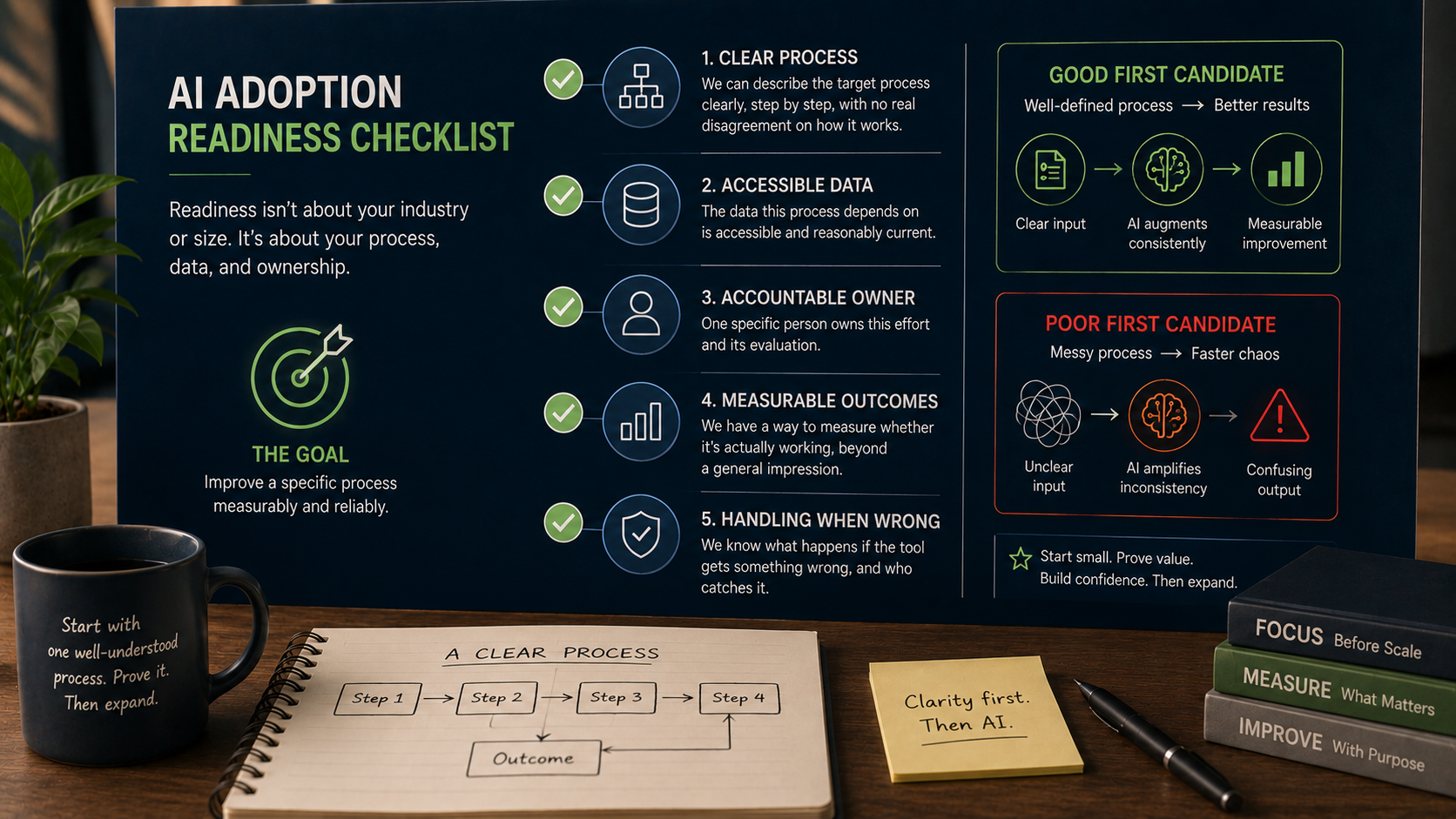
Before you commit any budget to an AI tool, work through these five checks. If two or more come back as "not really," treat that as a signal to close the gap first, before you start talking to vendors - not a reason to write off AI entirely, just a reason to do things in a different order.
- Process clarity: Everyone on the team would describe this process the same way, step by step, with no real disagreement about how it currently runs.
- Data access: Whatever data the process runs on is reachable and reasonably up to date, not scattered across five different systems.
- Named owner: A specific person, not a committee and not "the team," owns this project and is on the hook for judging whether it worked.
- A way to measure it: There's an actual metric for whether it's working - not just a vague sense that things "feel faster" now.
- A plan for errors: There's a clear answer for what happens when the tool gets something wrong, and someone specific catches it before a customer sees it.
Go narrow first, widen from there
Companies that succeed at this tend to start with one process they understand deeply, not a company-wide rollout on day one. A single, focused win builds both the internal case for going further and the in-house expertise to do it. Try to go broad from the start and you're much more likely to trip over exactly the gaps this checklist is meant to catch - one undocumented process or one missing data source, tucked away in a single corner of the rollout, is enough to stall the whole thing.
| Signal | Ready to proceed | Fix first |
|---|---|---|
| Process definition | Documented and something the whole team agrees on | Every person explains it a little differently |
| Data | Centralized and kept current | Spread across spreadsheets and separate systems |
| Ownership | A single named person is accountable | Split across a team, so no one really owns it |
| Success metric | Set before the pilot even begins | Figured out informally after the fact |
If the answer is "not ready" yet
Failing this checklist isn't a reason to shelve the idea of AI adoption - it's just a punch list. Writing down a process that's only ever existed in one person's head, pulling customer data out of three separate tools into one place, or simply picking a name to own the effort: none of that takes quarters, it takes weeks. Do that groundwork on the one process you've chosen, and the actual vendor evaluation goes faster later, with a much lower chance of an expensive false start.
Frequently Asked Questions
Does the size of a company change how ready it is for AI?
Less than people tend to think. A small operation with a clean, well-defined process can be more ready than a large one running a messy, undocumented version of the same thing. It comes down to process clarity and data access, not how many people are on payroll.
What most often causes an AI adoption effort to fail?
Pointing the tool at a process that was never really defined in the first place, combined with nobody being specifically on the hook for whether the whole effort actually pans out.