
A Calmer Way to Keep Up With AI News
Chasing every AI headline was never actually the goal. Here's a practical routine for staying genuinely informed without that nagging feeling you're already behind.
Key Takeaways
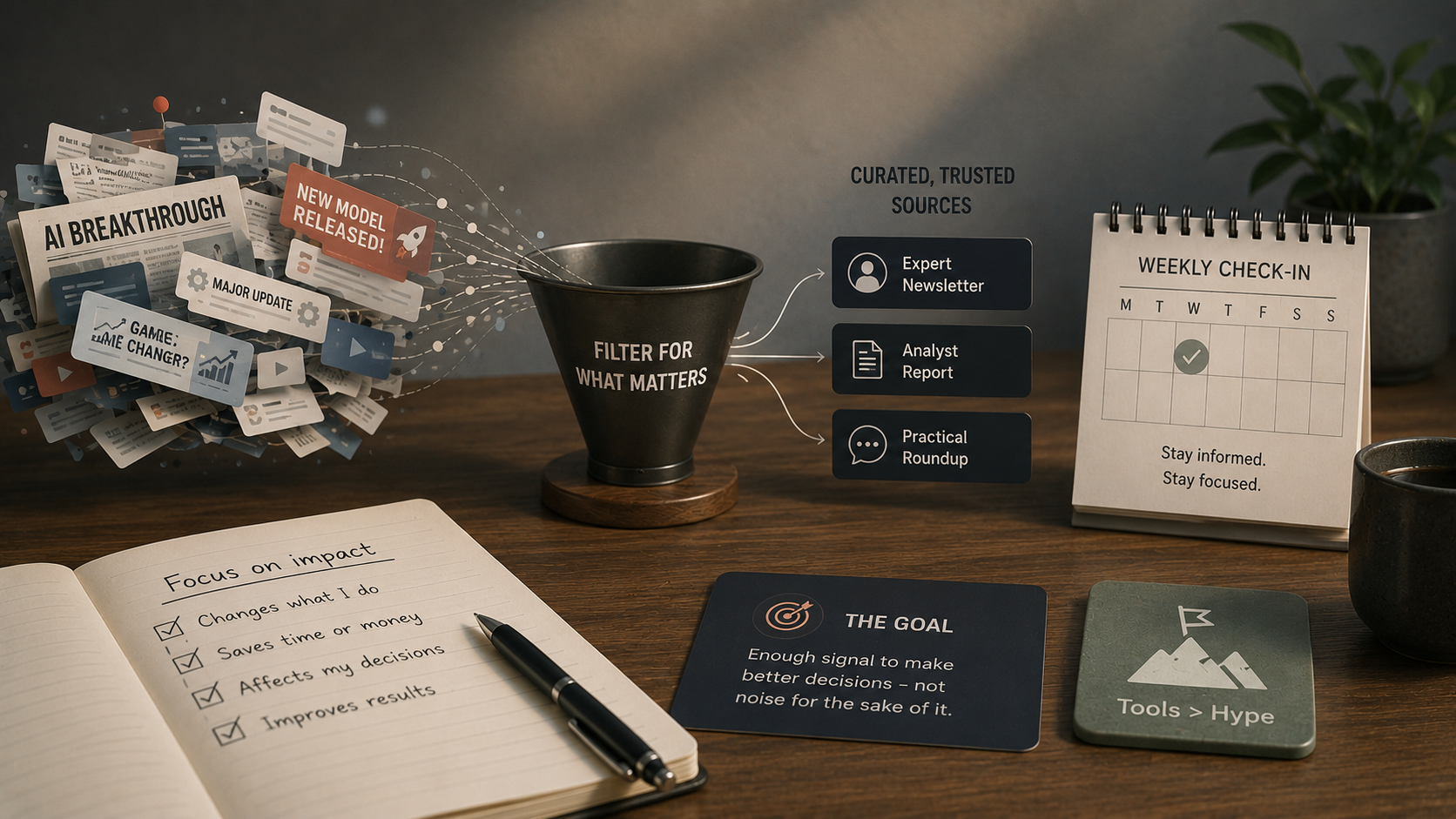
- The vast majority of AI headlines have nothing to do with how you actually work - what helps is a filter that screens them out, not a faster way to plow through more of them.
- A small set of sources you actually trust to curate will serve you better than personally trying to monitor a sprawling pile of raw announcement feeds.
- For nearly everyone, checking in on a set schedule - weekly instead of constantly - gets you about as far as watching things unfold around the clock.
About this app
New AI announcements, product launches, and research papers arrive faster than anyone could realistically absorb them, so trying to keep pace with the entire pile was never a sensible target to begin with. What actually works is narrowing your intake rather than trying to widen it - a short set of rules deciding what deserves your attention and what doesn't, so you stay properly current without the constant low-grade feeling of being permanently behind.
Why the treadmill never seems to stop
Worth accepting up front: most of what gets published under the AI umbrella - a small paper, a minor product tweak, vendors jockeying for position, a benchmark score that'll be topped again within six weeks anyway - changes nothing about how you actually work or which tool you'll reach for tomorrow. Once that sinks in, the anxious pressure to track all of it just fades, because you were never actually obligated to, regardless of what someone's job title suggests.
For whatever you do choose to read, one question does most of the sorting: would this genuinely change what I do next, or is it merely interesting to know? Plenty of AI coverage is genuinely interesting while being completely useless to act on, and skimming past that is perfectly fine. Keep "interesting" and "relevant to me" in separate mental buckets - conflating the two is really why the feed never feels like it ends.
Why curated sources beat raw feeds
Following a small number of sources that already filter and add context beats subscribing to raw announcement feeds or a scattered handful of individual accounts. Someone has already separated signal from noise, checked whether a claim actually holds up, and worked out why it matters, or doesn't - lean on that work instead of redoing the same legwork yourself every time something starts trending.
- Trims the volume: minor incremental updates, duplicate stories, and pure promotional noise have already been filtered out.
- Fills in the context: it explains why something matters, or doesn't, instead of just reporting that it happened.
- Checks back on old claims: revisiting which earlier predictions actually panned out is the fastest way to spot a source that chronically overhypes.
- Keeps things separated: research, launches, and opinion pieces stay clearly labeled apart instead of blurring into one undifferentiated stream.
Swap constant monitoring for a set check-in time
A defined check-in window - weekly, or even monthly - beats watching things unfold live, and it holds up nearly as well as round-the-clock monitoring for almost anyone genuinely trying to stay informed. Watching continuously mostly buys you anxiety and nonstop interruptions rather than better information; whatever genuinely matters this week will still be sitting there on Friday afternoon.
| Approach | What it feels like day to day | What you actually walk away with |
|---|---|---|
| Watching in real time | Always a step behind, interrupted constantly | A marginal speed edge on stories that almost never matter |
| Ignoring it completely | Occasionally blindsided by a real shift | Gaps in awareness of tools or changes that genuinely affect your work |
| A fixed weekly check-in | Bounded, calm, done when it is done | Nearly all the signal you need, none of the drip-feed anxiety |
A weekly routine that actually sticks
- Pick two or three curated sources instead of a stack of raw feeds - a newsletter, podcast, or analysis site that's earned your trust over time.
- Choose one recurring time slot - Friday afternoon, Monday morning, whatever works - rather than checking in sporadically throughout the day.
- Sort while you read: divide things into "this changes what I do" and "just interesting," and only act on the first group.
- Notice repeated mentions: when the same tool or trend keeps surfacing across independent sources over several weeks, it's earned a closer look.
- Accept that you'll miss things: that's expected, not a failure - full awareness of the entire field isn't a reasonable goal unless you're actively doing AI research for a living.
The one exception worth keeping
There's one legitimate reason to break the schedule: something that directly touches a tool you already depend on - a pricing shift, a major capability update, a security problem. Those earn a quick off-cycle look even outside your set check-in, precisely because the whole point of a fixed cadence is protecting your attention from everything else, not from something that genuinely needs a decision right now.
What you actually need is enough information to make sound calls about the tools touching your work, not full awareness of the entire field. A lean system built on a short list of trusted sources plus a fixed check-in gets you there for a fraction of the effort that watching everything demands, and it holds up far better across months and years than nonstop scrolling ever will.
The Signs This Routine Is Actually Working
A fair gut-check after running something like this for a month or two: can you still talk confidently about the tools you use daily, and have you stopped compulsively opening five tabs the moment a notification mentions AI? If so, the system is doing its job. Genuine gaps in your awareness tend to surface on their own anyway - a coworker brings something up, or an update to a tool you actually use forces the issue - and that's a far more reliable trigger to go look something up than a steady background drip of headlines you feel obligated to chase.
Frequently Asked Questions
Will skipping constant tracking of every AI development actually hurt my career?
For nearly every role, no - genuine competence with the tools your actual job depends on counts for far more than broad familiarity with everything happening across the industry.
How can I tell whether a given trend is actually worth my attention?
A reasonable rule of thumb: if several independent sources you trust keep covering it with comparable weight over more than a few days, it's probably more substantial than a single hyped-up story that fizzles fast.