
Why Multimodal AI - Text, Image, and Audio Together - Actually Matters
A single multimodal AI system can now handle text, images, and audio together. Here's what that unlocks that a pile of separate single-purpose tools never could.
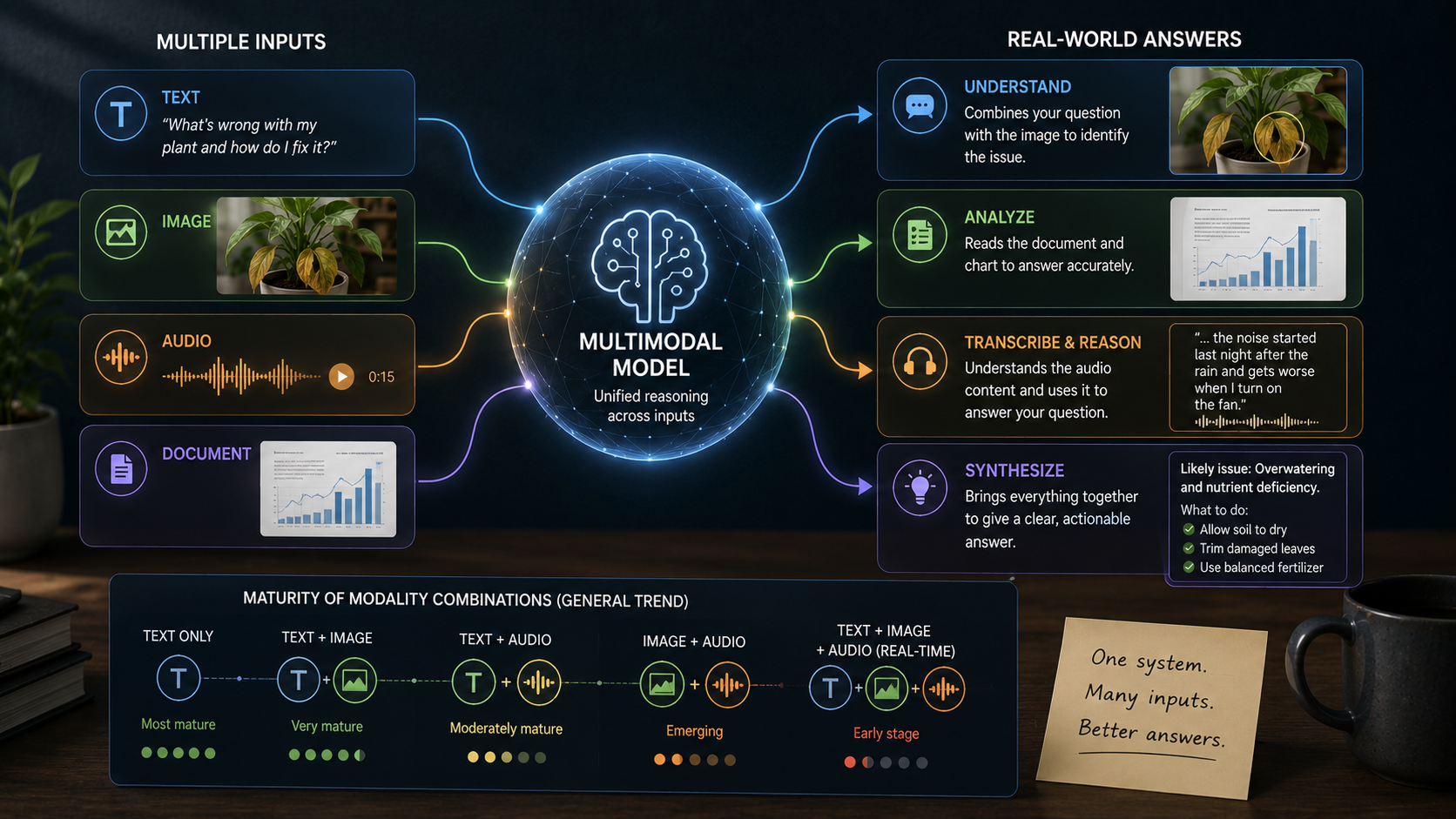
Key Takeaways
- A multimodal model reasons across more than one kind of input - text, images, audio - inside a single system, instead of relying on separate specialized tools stitched together after the fact.
- This matters in practice because real-world questions naturally mix modalities all the time - a photo paired with a spoken question, a document that combines text with a chart.
- Capability still isn't uniform across every combination - text-and-image tends to be the most mature pairing, and the gap with trickier combinations keeps shrinking.
About this app
Multimodal AI - a single unified system handling text, images, and audio instead of demanding separate specialized tools for each - has moved from a research ambition to a practical, increasingly standard feature. Here's what that shift actually opens up.
What it actually means to "reason jointly"
A multimodal model can accept more than one kind of input at once - text plus an image, say, or audio alongside text - and reason across all of it together, rather than forcing you to run a separate text tool and a separate image tool and stitch the outputs together by hand. This matters because real questions blend modalities constantly: "what's wrong with this photo of my plant" requires the model to actually look at the image and think about it in light of your question, not handle either piece in isolation. A document that pairs explanatory text with a chart needs both understood together to answer a question about it correctly.
The difference between joint reasoning and separate processing sounds like a fine distinction until you actually hit a case where it falls apart. Ask an older, mostly-text setup to describe a chart and then answer a question about the trend it shows, and you'll often get a description that entirely misses the point of your question, because the describing step and the reasoning step never actually communicated with each other. A model reasoning jointly can jump straight from image to answer, keeping your specific question in mind the whole way through instead of losing that context at the handoff.
Where you actually run into this day to day
- Snapping a photo of a broken part and asking what it is and how to fix it in one go, instead of describing it in words and hoping the description is close enough.
- Sharing a screenshot of an error message and getting an actual diagnosis, rather than retyping the error text and losing whatever visual context surrounded it.
- Asking a spoken question about a document that's right in front of you, instead of typing everything out manually.
- Having a model check the actual work shown in a photo of handwritten homework steps, not just a typed final answer.
Before this became the norm, any task spanning multiple content types usually meant juggling several specialized tools and manually converting or merging their outputs yourself. A unified multimodal system simply removes that friction - genuinely helpful for casual everyday use, and for the more involved technical workflows that used to demand exactly this kind of manual tool-chaining.
Where the capability gap is still visible
Capability still isn't even across the board, though. Text-and-image remains generally the most mature pairing across most tools today; trickier combinations - real-time audio-and-video reasoning, for example - are earlier-stage and more inconsistent. That gap keeps narrowing steadily, but it's worth testing your specific combination directly rather than assuming uniform capability across every input type a tool claims to support. The broader trend among major providers is toward handling a growing range of modalities within one default system - worth keeping an eye on if something you care about currently requires several tools stitched together, since that friction keeps shrinking.
A practical way to check this for yourself: run the same task with a slightly awkward or lower-quality input - a blurry photo, a noisy audio clip, a chart with tiny text - instead of a clean, ideal example. Marketing demos, unsurprisingly, are always shown with pristine inputs, so the gap between a polished demo and your actual messy real-world photo is exactly where capability differences show up first.
How this differs from simply chaining tools together
It's worth spelling out exactly what "joint" buys you over the older method of running a photo through an image-captioning tool and then feeding that caption to a separate text model. In a chained setup, information leaks out at every handoff - a caption is a lossy summary of an image, not the image itself, so any detail the captioning step failed to mention is simply gone by the time the text model ever sees it. A model reasoning jointly keeps the original input in view the whole time, which is why it can still answer a follow-up question about some small detail in a photo that a caption-based pipeline would already have thrown away.
A fast test for whether a tool is genuinely multimodal
- Ask a follow-up question about one small, specific detail in an image instead of a generic "what is this" - a genuinely multimodal system can usually still answer it, while a captioning pipeline often can't.
- Check whether the tool can compare two images, or mix image and audio, within the same exchange, rather than handling just one modality per conversation turn.
- See whether it can point to exactly where in an image or document it pulled an answer from, which usually means it's still reasoning over the original input rather than working off a pre-generated summary.
Frequently Asked Questions
Does a multimodal model always beat a specialized single-purpose tool?
Not for every task - a dedicated, specialized tool can still outperform a general multimodal model at the one narrow thing it was purpose-built for. Multimodal models offer breadth and less friction, not a guarantee that they'll win everywhere.
Does using multimodal capability cost more than sticking to text only?
It varies by provider and by the specific modalities involved - image and audio processing often get billed differently than plain text. Check current pricing for whichever combination you actually plan to use.
Why does the same model sometimes handle images noticeably better than audio?
Different modalities matured at different speeds during training and research, mostly because of how much high-quality paired data existed for each combination. Image-and-text pairing has simply had more time and more data behind it than some of the newer audio and video pairings.