
Neural Networks, No Math Required: How Machines Spot Patterns
What a neural network actually is, laid out through everyday comparisons instead of formulas - and why the whole trick comes down to "layers."
Key Takeaways
- A neural network is just a stack of simple, connected layers - loosely inspired by how neurons pass signals in a brain, though not a literal copy of one.
- Each layer builds on what the last one found - early layers pick up simple features, later ones assemble those into full concepts.
- It learns by nudging the connection strengths between units whenever it guesses wrong, over millions of examples, until those nudges settle into something dependable.
About this app
Neural networks sit underneath nearly every AI tool you've ever touched, and the name alone makes them sound like they'd require a physics background to grasp. They don't. Strip away the equations and what's left is an idea simple enough to feel almost anticlimactic - and once it clicks, several AI quirks that used to seem baffling suddenly make sense.
Start From Something You Already Do Without Thinking
You look at a photo and recognize a friend in an instant - you're not consciously scanning individual pixels to do it. Your brain assembles simple visual fragments (an edge, a curve) into more complex ones (an eye, a nose) into a whole face you recognize, all inside a fraction of a second. A neural network works through an image in a remarkably similar layered fashion, and that's actually where the word "neural" comes from.
That brain comparison is also where a lot of the confusion creeps in, though. A real neuron is a living cell with its own chemistry and timing, and it took researchers decades just to partially map out how one behaves. The "neuron" inside a neural network shares none of that complexity - it's a tiny unit that takes in some numbers, combines them, and hands a new number downstream. The name stuck because the layered, interconnected structure echoes how a brain is organized, not because the underlying mechanics have anything in common.
So What Is a Layer Actually Doing?
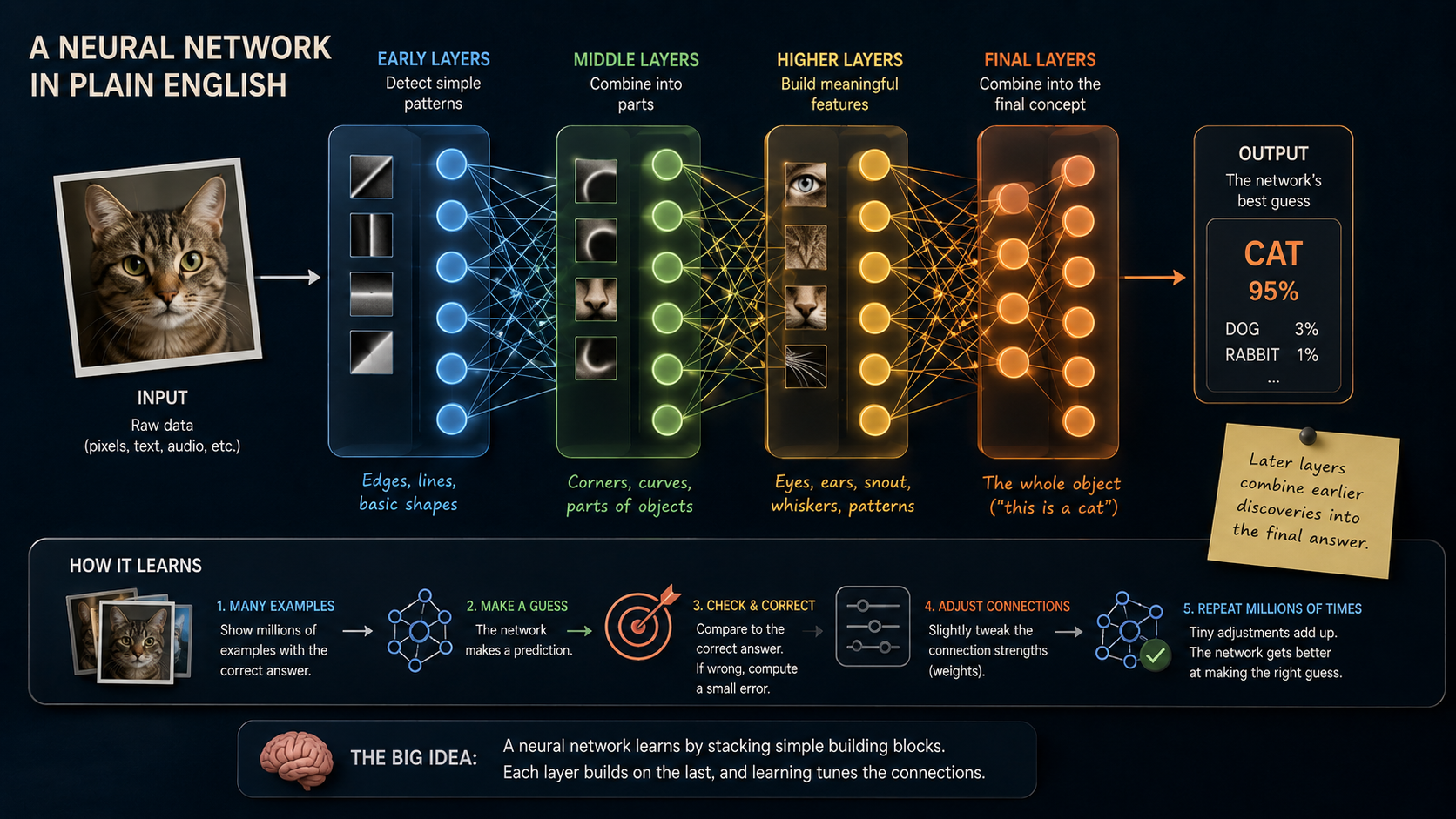
Early layers latch onto simple, low-level patterns - edges, curves, rough shapes, or with text, basic word patterns. Middle layers combine those into something closer to meaning: a shape begins registering as "eye-like," a phrase pattern begins registering as "this sounds like a question." Later layers take those building blocks and assemble whatever final concept the network is actually meant to identify or produce. Pile enough of these layers on top of one another and you get what's called "deep" learning - deep just means lots of layers, nothing spookier than that.
- Input layer: raw pixel values come in, with nothing interpreted yet.
- Early layers: pick out edges, corners, and basic shifts in color.
- Middle layers: assemble those into textures and parts - fur, an eye, a wheel.
- Late layers: assemble parts into full objects - a cat, a car, a face.
- Output layer: converts that final combination into an answer, such as a label or a probability score.
No One Hand-Wrote Any of the Rules
Here's the part that still feels a bit uncanny even after you understand it: no one ever sat down and typed out "here's what an eye looks like." The network sees a huge stack of examples, each tagged with the right answer - this one's a cat, this one isn't - takes a guess, and receives a small correction whenever it's wrong. After millions of those small corrections, it recognizes the pattern reliably, and at no point did a person hand-code what that pattern is supposed to look like.
That correction process is what people mean by training, and it's a loop that repeats rather than a single event. The same short sequence of steps runs again and again, each pass nudging the network a bit closer to making fewer mistakes.
- 1. Feed in an example: an image, a sentence, whatever kind of input the network is meant to handle.
- 2. Get a guess: the input passes through the network's layers and comes out as an answer.
- 3. Measure the gap: compare that guess against the known correct answer.
- 4. Adjust the connections: nudge every connection strength slightly to shrink that gap.
- 5. Repeat: keep going across millions of examples, until the nudges stop changing much.
Two Different Things People Lump Together as "Learning"
It's worth pulling apart two ideas that tend to get blurred in casual AI talk: the network's structure (how many layers exist, how they connect) versus its learned connection strengths (what training actually produces). A person designs the structure up front, and it stays fixed from there. The connection strengths are what training changes, and a large modern network can have billions of them. When people say "the model" for a given AI system, they really mean that enormous set of learned numbers, sitting inside a structure somebody else laid out.
| Concept | Who sets it | Does it change during training? |
|---|---|---|
| Network structure (layers, connections) | Designed by engineers ahead of time | No, it stays fixed |
| Connection strengths (the learned values) | Adjusted automatically as training runs | Yes, constantly, right up until training stops |
Why an Everyday User Should Even Care
A handful of AI oddities stop feeling mysterious once this sinks in. Why a system can be tripped up by an input that a human wouldn't confuse with the target at all, just because it happens to activate the same learned pattern. Why these systems need such absurd quantities of example data before they get any good. And why they sometimes fail in odd, seemingly random ways on inputs sitting just outside what they were trained on.
That last one deserves a moment of thought. A network only ever picks up patterns that showed up in its training examples - it has no independent capacity to reason through a truly novel situation the way a person could. Nudge it past familiar territory and its confident-sounding output can quietly stop being trustworthy, with nothing in how it responds giving that shift away. Once you know the whole thing is pattern-matching rather than reasoning from scratch, that behavior stops seeming so strange.
What This Clears Up About the AI Tools You Already Use
With the layered pattern-matching picture in mind, a lot of ordinary product behavior starts making sense. A photo app that mislabels your pet is usually just a case where the pattern it learned for that animal overlaps with a different one. A writing tool that keeps reaching for the same odd phrase across unrelated answers is often echoing something that showed up frequently in its training data. None of it requires the tool to "understand" anything the way a person does - it's layers of learned pattern recognition, stacked deep enough to look impressively sharp most of the time.
Frequently Asked Questions
Does a neural network really work like a human brain?
Only loosely, as inspiration for the layered, connected structure - not as an accurate stand-in for biology. Real neurons are far messier and more intricate, so it's best treated as a helpful analogy rather than a literal description.
Do I need to understand any of this to use AI tools well?
Not for day-to-day use, no. It starts paying off once you want to figure out why a tool is misbehaving in a particular case, or you're trying to judge how believable a bold claim about a product actually is.