
AI Voice-Cloning Scams: How to Keep Your Business From Getting Fooled
A cloned voice impersonating a boss or a vendor is now good enough to talk someone into an unauthorized payment - and it's a risk businesses actually need to plan for. Here's what actually stops it.
Key Takeaways
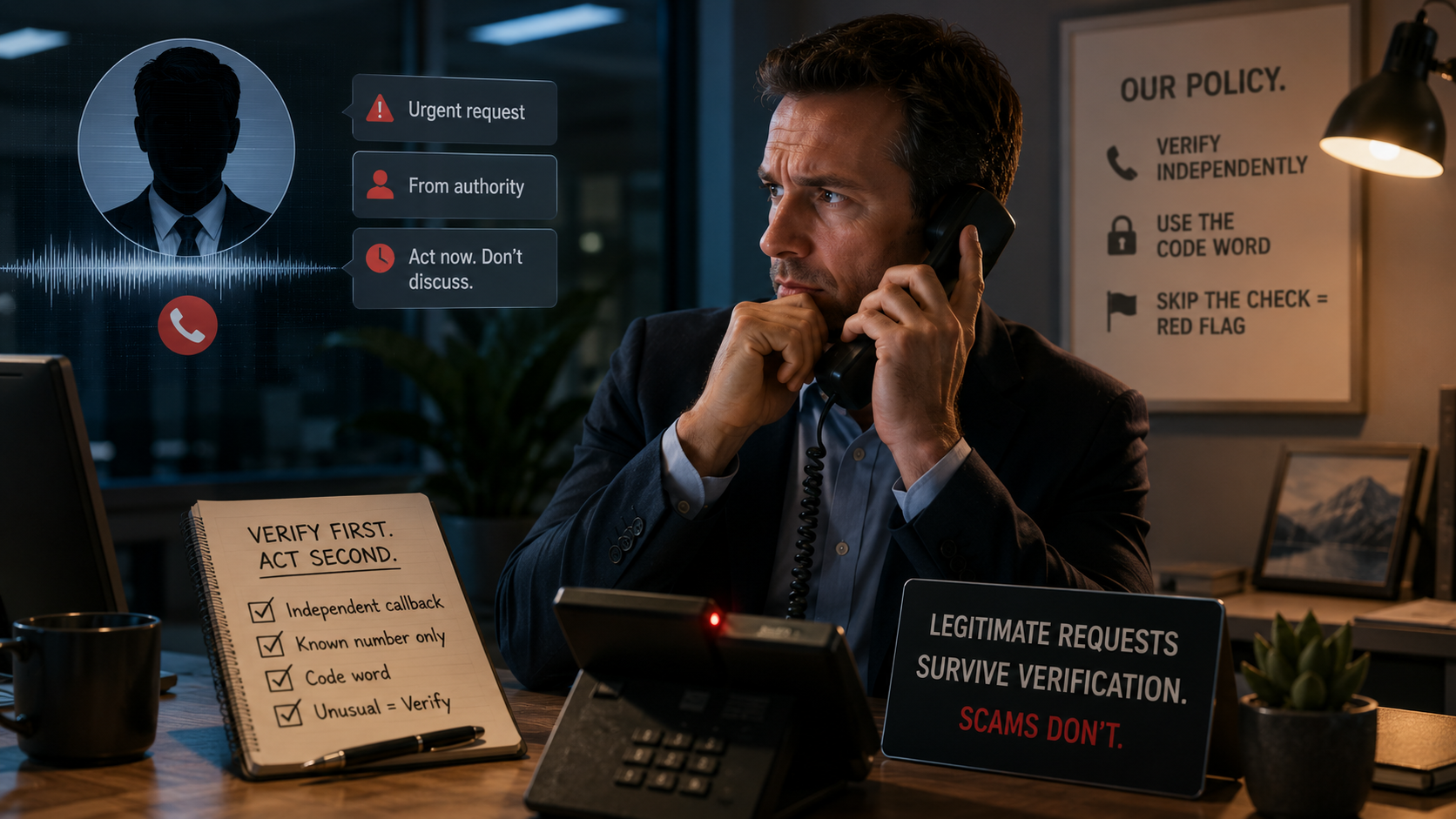
- The usual formula is a convincing cloned voice paired with manufactured urgency and borrowed authority - something that sounds like a boss or vendor demanding immediate action.
- A pre-agreed verification step for anything unusual or time-pressured shuts this scam down no matter how good the cloned voice is.
- Teaching staff to notice the urgency-plus-authority combination matters far more than teaching them to spot a fake voice by ear, which is a skill most people simply don't have.
About this app
It's no longer far-fetched to get a call that sounds precisely like your CEO, demanding an emergency wire transfer right now - voice cloning has turned that scenario into something scammers can pull off cheaply and convincingly. Here's the good news: nothing about stopping it requires you to catch a fake voice by ear, which is nearly impossible to do reliably in the moment. What stops it is process, and process is exactly the kind of thing a business can build and control.
What the scam actually looks like
Case after case follows the same blueprint: a cloned voice - an executive, a vendor, or in the personal version of the scam, a relative - paired with manufactured urgency and borrowed authority. "Do this now, and don't loop anyone else in." That urgency isn't accidental; it exists specifically to blow past whatever verification step would otherwise catch the fraud. And cloning a voice doesn't take hours of recordings anymore. A short public clip - an interview, a voicemail greeting, a talk someone gave at a conference - is often plenty to fake something convincing enough for a phone call, where the audio is already compressed and a little rough to begin with.
These scams tend to run the same playbook. The target picks up a call, sometimes primed beforehand by a text or an email, and hears a voice that's unmistakably someone they know. The ask is financial - a wire, a batch of gift cards, a rushed vendor payment - and it lands with two pressures stacked on top of each other: authority ("your boss is telling you to do this") and urgency ("it needs to happen in minutes, not hours"). That pairing is the actual tell here, and it's a far more dependable signal than trying to decide whether a voice sounds a little off.
Why "just listen closely" doesn't work
Betting on staff to catch a cloned voice by ear is a losing strategy - the tech is good enough now that expecting anyone to spot a fake in real time, under pressure, from someone who sounds exactly like their boss, is simply too much to ask. Cloning tools have gotten skilled enough at nailing pacing, tone, even someone's verbal tics, that the audio itself almost never gives it away. What gives it away is the setup: an out-of-pattern request, delivered with urgency, paired with instructions to skip the usual checks.
What actually stops it
The thing that actually holds up isn't sharper listening - it's a verification step agreed on ahead of time for anything unusual or urgent involving money. Call back on a number you already have and trust, never one given to you during the suspicious call itself, or lean on a pre-agreed code word for anything genuinely time-sensitive. Both work for the same reason: neither depends on a judgment call made under pressure. They're fixed rules that apply no matter how real the voice sounds.
- Make independent callback verification mandatory for any payment request that's unusual in amount, urgency, or method - no exceptions, regardless of how convincing the call sounded.
- Pick a code word for genuinely urgent authorizations, and rotate it every so often.
- Spell out that "skip the verification, just do it" is itself the red flag - never a legitimate reason to bypass the check.
- Send large or unusual payment requests through a second approver by default, someone other than whoever took the call.
- Keep a short, internal list of verified numbers for executives and key vendors so nobody's hunting for a number while under pressure.
Building the process, step by step
None of this needs new software or a bigger budget - it just needs a short, clear procedure that everyone who can sign off on a payment already knows cold, before they ever need it.
- Figure out exactly who can request or approve transfers, and make sure every one of them knows the callback rule applies to them too - not just to the newest hire.
- Put the verification steps in writing somewhere everyone can find them - a one-page policy beats an unwritten expectation every time.
- Settle on a code word, or a rotating phrase, with anyone likely to make a genuinely urgent request by phone.
- Run one short tabletop drill so people have actually practiced saying "let me call you back on the number I have" to someone who sounds exactly like their boss.
- Refresh verified numbers and code words on a regular schedule, and definitely after staff turnover.
| Signal | What it usually means | What to do |
|---|---|---|
| An urgent money request over the phone | Standard pressure tactic - true regardless of how the voice sounds | Stop. Don't act on the call itself |
| "Keep this between us" instruction | A tactic built to block verification | Treat it as a warning sign, not a real instruction |
| Caller ID shows a familiar number | Caller ID is trivially spoofed and proves nothing on its own | Still call back on a number you already had before this call |
| A last-minute request to change payment method or account | A common fraud pattern well beyond voice cloning | Confirm independently before touching anything |
Who ends up most exposed - and what to do about it
The raw material a scammer needs to clone a convincing voice is just publicly available audio - interviews, conference talks, a voicemail greeting, a video posted online - which is exactly why executives and anyone public-facing carry the highest exposure. That's not an argument for disappearing from public life; it's an argument for being a bit more thoughtful about what's easy to find, and for making sure the people closest to those executives - assistants, finance staff, anyone who might plausibly get an urgent call claiming to be them - are the most drilled on the verification routine.
If something about a call feels like it might be a scam in progress, stop and verify independently before you act on anything - a legitimate request holds up fine after a five-minute confirmation call, and a fraudulent one usually doesn't survive it. Hang up, take a breath, and dial the number you already had on file. Nobody making a genuinely urgent, legitimate request is going to be upset that you confirmed it - and if they are, that reaction is worth paying attention to on its own.
Frequently Asked Questions
Does caller ID catch these calls?
Not reliably. Caller ID can be spoofed completely separately from the voice-cloning itself, so a call showing a familiar number tells you nothing. That's exactly why independent callback verification - dialing a number you already had, not calling back whoever just called you - is the step that matters.
Is this just a business problem, or do individuals get hit too?
Individuals see a similar version of this scam constantly, usually a fabricated relative claiming a sudden emergency and asking for money right away. The same fix applies either way: verify independently before you act.