
The Real Reason Most Daily Quran Habits Never Stick
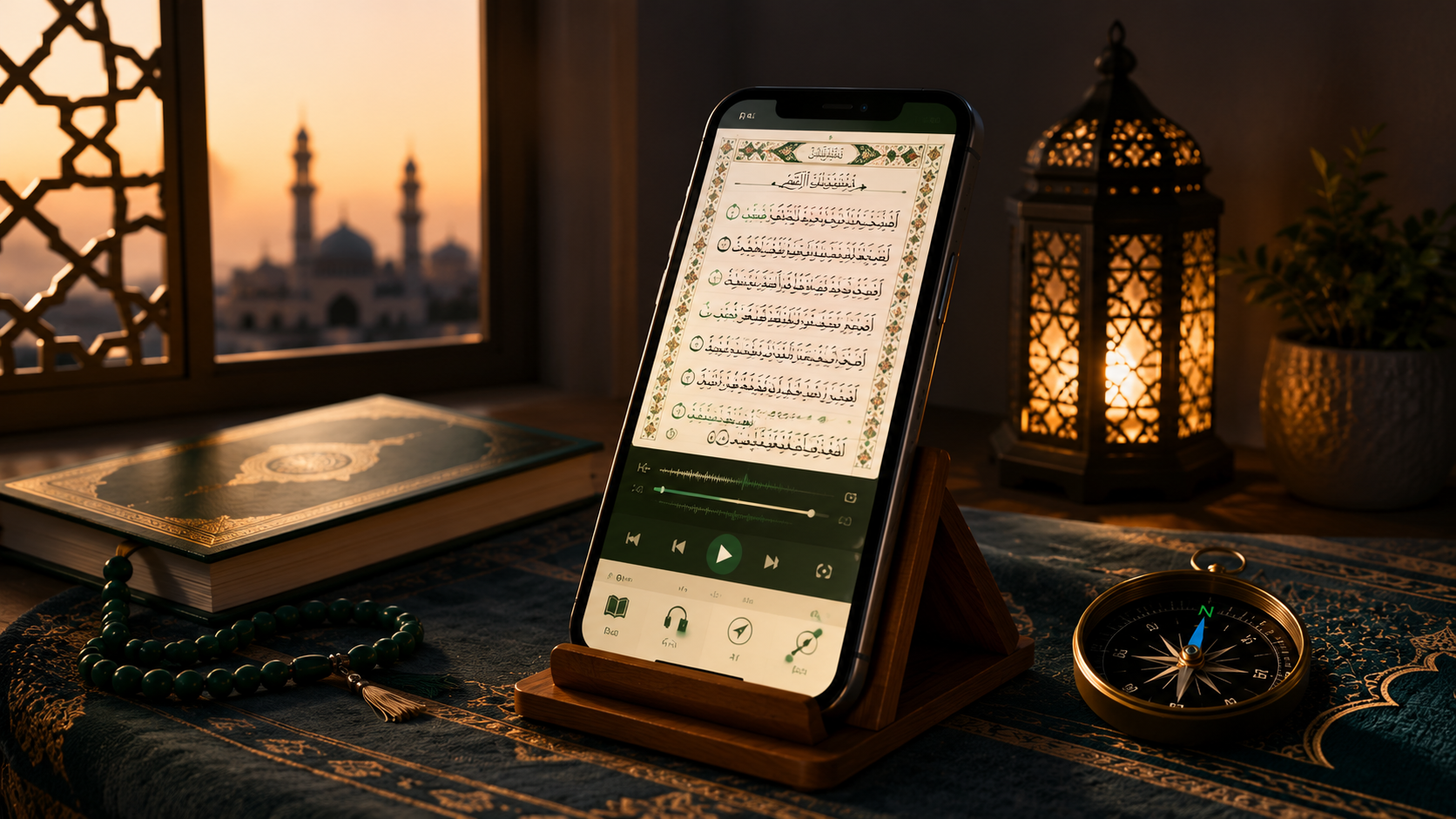
Quran Majeed - A Kareem Journey brings word-by-word Quran explanation, uninterrupted Surah audio, Qibla direction, and prayer reminders together into a single daily companion app.
Get this app
About this app
Wanting to read Quran every day is rarely where people fall short - the intention is almost never the problem. It's the friction stacked on top of it. The right Surah lives in one app, the translation sits in a separate browser tab, the Qibla compass is yet another app entirely, and by the time everything's finally open, the ten free minutes you had have evaporated.
Why Daily Reading Habits Fall Apart
A habit only holds up as well as its weakest link, not its strongest intention. Opening a browser to look up a translation, jumping to a separate audio app for recitation, then hunting down a Qibla compass before prayer turns a simple ten-minute window into three separate decisions. Every switch is another chance to get pulled away by a notification and never actually come back. Bringing the whole routine into a single app doesn't just save time - it removes the exact decision points where the habit usually falls apart.
What Actually Lives in One Place Here
Quran Majeed - A Kareem Journey is built specifically to cut that friction out. Reading, listening, translation, and everyday practice tools all sit inside a single app rather than being scattered across four. You can read a verse with a word-by-word explanation sitting right beneath it, jump straight into audio for that same Surah, and check Qibla direction without ever leaving to open something else. It aims to be less of a Quran reader and more of the one app you actually reach for every single day.
What's Packed In
- Word-by-word explanation - every ayah comes with a breakdown plus full verse tafsir, rather than a bare translation that gives no context for individual words.
- Uninterrupted Surah and Juz audio - full playback start to finish, with a choice of reciters so you can settle on a voice that actually holds your attention.
- Qibla direction and distance - an instant compass reading pointed at the Kaaba, usable anywhere without a separate compass app.
- Prayer reminders - timely notifications for all five daily prayers, meant to build consistency instead of relying on memory alone.
- A Tasbih counter with session history - daily dhikr tracked over time rather than resetting to zero each time you open the app.
- Light, dark, and system reading themes - comfortable night reading without a separate hunt through settings.
A Simple Way to Get the Habit Off the Ground
- Lock in one fixed slot - right after Fajr or right before sleep works better than "whenever there's time," since a floating slot is the first thing to get skipped.
- Start with audio before reading - play a Surah during a commute or while doing chores before committing to sit down and read; it lowers the bar on busy days.
- Spend five minutes with the word-by-word view - one short passage with the breakdown beats a long session that fizzles out halfway through.
- Turn on prayer reminders first - they anchor the day and naturally drag the Quran session along with them.
- Let the Tasbih counter tick along in the background - a small, visible streak of dhikr sessions is often what keeps the bigger reading habit alive.
Against Juggling a Handful of Separate Apps
| Task | Separate apps | Quran Majeed |
|---|---|---|
| Reading with word meaning | Reading app plus a separate dictionary or tafsir lookup | Built right into the same screen |
| Listening to recitation | Switching over to a dedicated audio app | Same app, same Surah, one tap |
| Finding Qibla direction | Opening a compass app | Built in, no extra download needed |
| Prayer time reminders | A separate prayer times app | Comes as native notifications |
| Tracking dhikr | Manual counting or yet another app | Tasbih counter with history |
A Few Straight Facts
This is a newer arrival with a modest user base so far, and it stays free by running ads, though it skips in-app purchases entirely - a genuinely welcome touch for something centered on daily religious practice. It's rated for everyone, and the audio-first design makes it just as usable with the phone tucked in a pocket during a commute as it is sitting still with the screen open.
A smaller footprint also means fewer extras than some of the older, more established Quran apps out there - don't expect a sprawling library of alternate tafsir sources or dozens of reciters to browse through. What's here is aimed squarely at the daily-use path: read, listen, orient toward Qibla, get reminded, track dhikr. For someone trying to build a habit rather than research every translation available, that narrower focus reads more like a feature than a shortfall.
The apps people actually open every day tend to be the ones that cut out a step, not the ones stuffed with the most features. Word-by-word reading, full audio, Qibla, and prayer times all living inside one app is exactly the kind of consolidation that turns "I really should read Quran more" into something that actually happens.
Turning the Word-by-Word View Into Something You Actually Use
A word-by-word breakdown only pays off if you build a real habit of using it instead of scrolling past it toward the translation. One approach that works well for a lot of people: read the Arabic first, glance at the word-by-word meanings for anything that doesn't ring a bell, then read the full translation last as confirmation rather than a replacement for that individual-word understanding. Doing it in that order, even slowly, builds real familiarity with recurring words over time in a way that jumping straight to a full translation never quite does.
Keeping the Momentum Past Week One
- Expect week one to feel like effort and week two to start feeling automatic - most reading habits collapse right in that gap, so plan for a shorter but non-zero session on the toughest days instead of skipping outright.
- Attach the reading slot to something that already happens daily without fail, like right after a specific prayer, rather than inventing a brand-new standalone time.
- Lean on the Tasbih counter's visible history as low-pressure accountability - watching a streak build is often motivation enough on its own, no external tracker required.