
What RAG Really Involves (It's More Than "Connect Your Data")
Retrieval-Augmented Generation gets pitched as plug-and-play - hook up your data, get grounded answers. Here's the actual mechanics, and the specific spots where real implementations trip up.
Key Takeaways
- RAG pulls relevant chunks of your own data at the moment a query comes in and drops them into the prompt - the model itself never gets permanently trained on anything.
- How source documents get split into chunks shapes retrieval quality more than most people expect - it's one of the most overlooked design calls in a RAG system.
- When a RAG system disappoints, retrieval quality is almost always the actual bottleneck, not the language model doing the answering.
About this app
"Just wire the model up to our data with RAG" makes it sound like a checkbox, when really there's a string of real design decisions standing between that idea and a system that works well. Here's what actually happens at each stage, and where teams commonly stumble.
What RAG is actually doing
Retrieval-Augmented Generation searches your own data for whatever's relevant to a user's question, then drops the most relevant pieces straight into the prompt the model receives - so the answer draws on that context rather than solely on what the model picked up during training. This happens freshly, every single time a query comes in. The model itself doesn't change, and nothing gets permanently memorized. Switch off retrieval and the model just falls back to answering from its general training knowledge.
That distinction is worth holding onto, because RAG and fine-tuning get lumped together more than they should. Fine-tuning actually adjusts the model's internal parameters through further training, so new knowledge gets baked in permanently. RAG doesn't touch the model at all - it changes what the model sees as context, query by query. The upside is that updates are cheap (edit a document and the very next query reflects it), but the tradeoff is that your answers are only ever as good as whatever got retrieved.
The five-stage pipeline
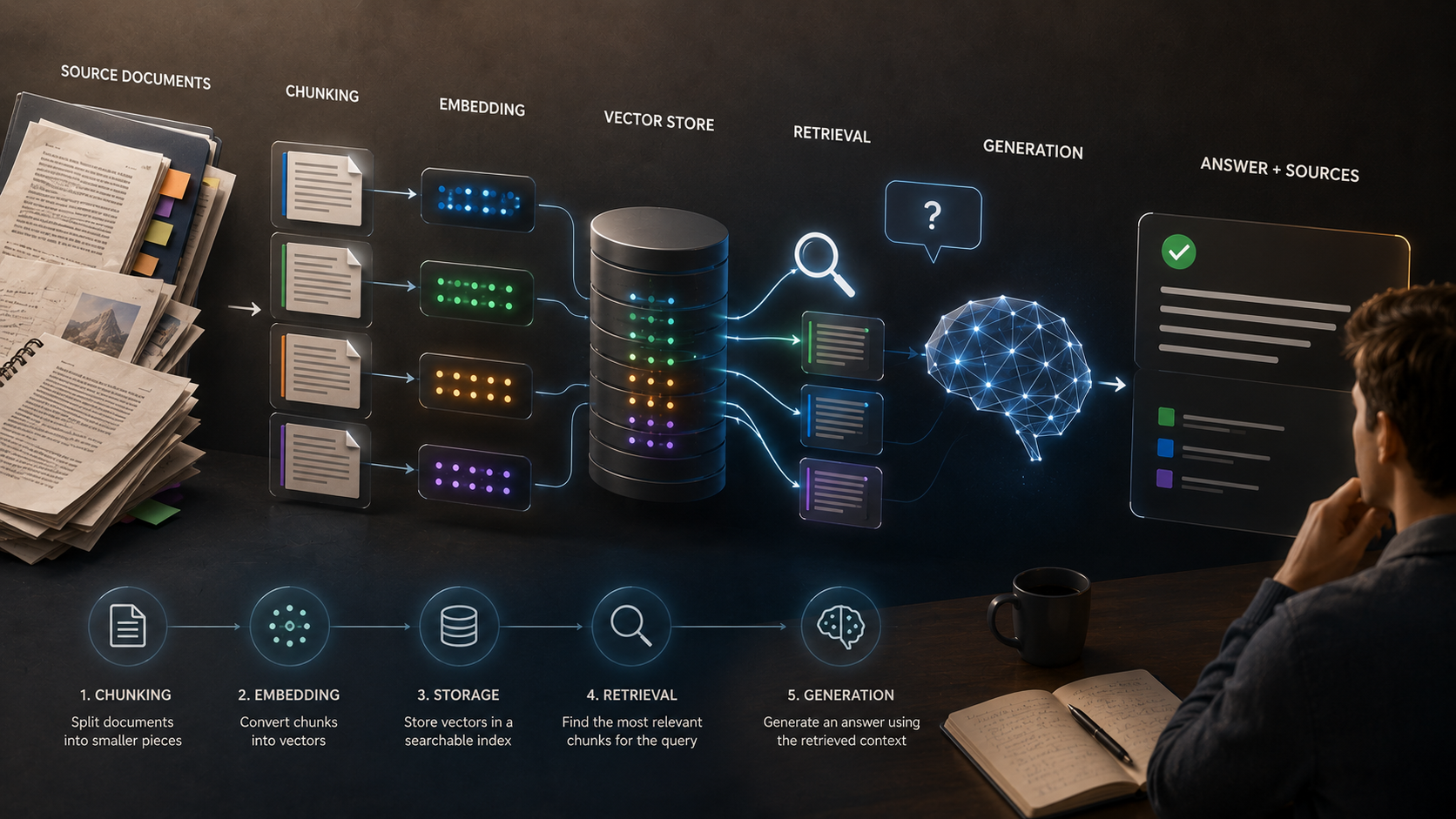
Every RAG system, regardless of scale, breaks down into the same five stages:
- Chunking: splitting source documents into smaller pieces, since you can't and shouldn't feed whole documents into every prompt.
- Embedding: converting each chunk into a numerical representation (a vector) that captures its meaning rather than just its exact wording.
- Storage: saving those embeddings in a searchable index, often called a vector database, so similar content can be found quickly.
- Retrieval: converting the user's question into that same kind of representation and finding the most similar stored chunks.
- Generation: inserting what got retrieved into the prompt and asking the model to answer using that content as its source.
Most of the perceived complexity in RAG isn't the model call at the end - it's the four stages that happen before it. Get chunking and retrieval wrong, and no amount of prompt engineering at the generation stage will fix the answers.
Where implementations commonly go wrong
| Common problem | Usual cause |
|---|---|
| Answers miss obviously relevant information | Chunking split related content awkwardly across boundaries |
| Retrieval returns technically-similar but unhelpful chunks | Chunk size mismatched to the kind of question being asked |
| Model contradicts the retrieved content | It's still generating text, not quoting directly - it can misread or blend retrieved content with prior knowledge |
| Works in testing, degrades at scale | Retrieval index wasn't tested against realistic data volume before launch |
| Answers feel generic despite good source data | Embedding model is a poor match for the domain, so semantically distinct chunks look similar to it |
Chunking deserves more attention than it usually gets
How you split documents - fixed size, by paragraph, by semantic section - has an outsized effect on whether retrieval actually surfaces the right thing. A strategy that splits a key fact away from the context that makes it meaningful will quietly hurt answer quality in a way that's genuinely hard to diagnose just by staring at the final generated response. The failure doesn't look like a chunking bug - it looks like the model being "wrong."
- Fixed-size chunking: simplest to implement, but indifferent to document structure - it can cut a sentence or table in half.
- Paragraph or section-based chunking: respects natural boundaries in the source, usually a better default for prose-heavy content.
- Semantic chunking: groups content by meaning rather than position, more expensive to compute but often worth it for dense technical material.
- Overlap between chunks: repeating a small amount of text at chunk boundaries so a fact split across two chunks still appears in full in at least one.
RAG reduces hallucination - it does not eliminate it
Grounding answers in retrieved real content meaningfully reduces the model inventing things from nothing, but it doesn't eliminate hallucination - the model can still misread, oversimplify, or slightly misstate what was actually retrieved, because it's still generating text, not copying it verbatim. For high-stakes use cases, showing the actual retrieved source alongside the generated answer lets users verify directly rather than trusting blindly.
Debugging disappointing answers
If a RAG system is giving disappointing answers, the instinct is usually to reach for a "smarter" model - but the more common actual bottleneck is retrieval quality, not reasoning. The right information simply isn't making it into the prompt. Debug retrieval directly before assuming the problem lives in the model.
- Check what actually got retrieved: log the chunks passed to the model for a failing query and read them yourself before touching anything else.
- Test the chunking boundary: see whether the answer to the question was split across two separate chunks that never got retrieved together.
- Try a larger retrieval count: if relevant content exists but isn't in the top results, the model never sees it regardless of how capable it is.
- Re-evaluate the embedding model: a mismatch between the embedding model and the domain vocabulary can quietly cap retrieval quality no matter how well everything else is tuned.
Getting a demo working is genuinely easy - a small document set, an obvious question, and most naive RAG setups look impressive. What separates a system that holds up in production is the unglamorous work in the middle: choosing a chunking strategy deliberately, testing retrieval at realistic scale, and treating retrieval debugging as the first move rather than a last resort.
Frequently Asked Questions
Is RAG the same thing as fine-tuning a model on your data?
No - RAG retrieves and inserts content at query time without changing the model, while fine-tuning actually adjusts its internal parameters through additional training. See our fine-tuning vs. prompting guide for that distinction.
Do I need a specialized vector database to build a RAG system?
For small-scale or prototype systems, simpler approaches can work. For production systems at meaningful data volume, a dedicated vector database or search index is typically worth the setup for retrieval quality and speed.