
Spotting a Real AI Breakthrough Versus Clever Packaging
Slapping the word "breakthrough" on a headline doesn't make it one. Here's a practical set of questions to run any AI headline through before treating it as a genuine advance rather than clever framing.
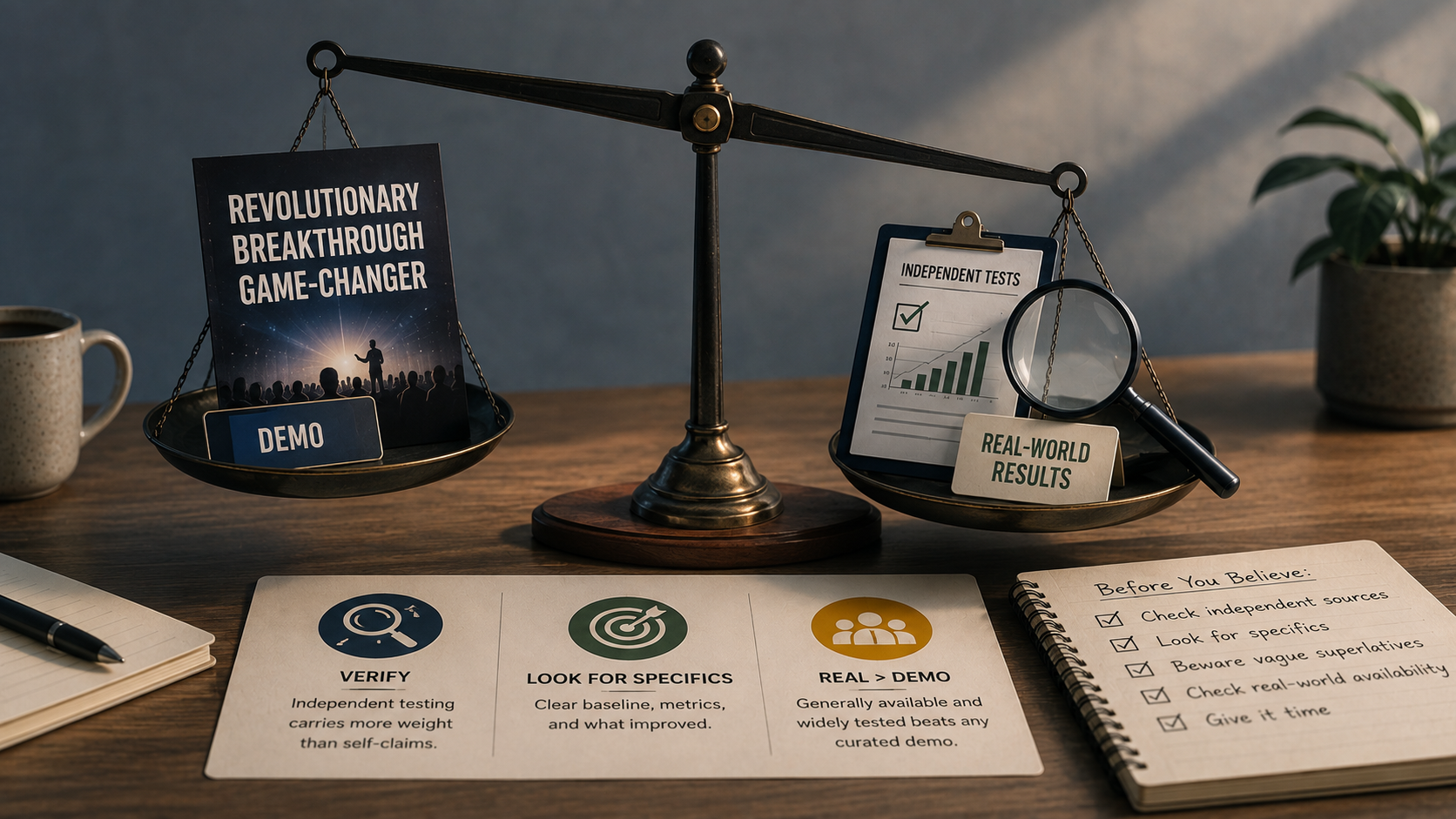
Key Takeaways
- A genuine breakthrough needs to hold up under independent scrutiny or usable real-world results - not rely purely on the announcing company's own press release.
- Sweeping, vague adjectives ("revolutionary," "unprecedented") with no concrete numbers backing them up are a familiar marketing tell worth calling out.
- Distinguishing a polished demo from a reliable, broadly available capability is one of the most useful filters around, since every demo is, by nature, stacked to look its best.
About this app
Headlines announcing a "revolutionary breakthrough" show up nonstop in AI coverage, and only a fraction of them actually describe something that matters. Separating the genuine developments from marketing framing doesn't require deep technical expertise - it just takes the habit of running the same short checklist before reacting to whatever headline just landed in your feed.
Start With Who Actually Confirmed It
A claim that's been tested or reproduced by someone with nothing riding on it carries far more weight than a company simply announcing its own numbers and stopping there. That doesn't mean every self-reported figure is fabricated - it means the sensible default is withholding a firm opinion until outside confirmation shows up. Press releases and company blog posts function as marketing material first and technical writeups a distant second, even when what's underneath is real, and those two goals don't always point the same way.
- Independent benchmarks: figures reproduced by researchers or outlets with no stake in the announcement carry more weight than a company's internal numbers.
- Third-party coverage: technical publications that ran their own testing rather than simply reprinting the press release are worth actively seeking out.
- Reactions from practitioners: experts weighing in publicly - whether agreeing, qualifying, or pushing back - tells you something useful regardless of which way it goes.
- Company-only claims: not automatically false, just worth holding loosely until confirmation from outside that single source shows up.
Pay Attention to the Wording, Not Just the Claim
A genuine technical advance can usually be described in fairly specific terms - what exactly got better, measured against what baseline, and how. Vague superlatives like "revolutionary," "game-changing," or "unprecedented" with nothing concrete underneath them are a familiar marketing pattern, and they deserve proportionate skepticism. A real result names the metric, the comparison point, and the conditions it was measured under; a marketing pitch names an adjective and leaves everything else to your imagination.
Any improvement claim only has meaning relative to a clearly stated baseline. "50% better" needs a "better than what, and measured how" attached, or it isn't actually saying anything at all. Watch for comparisons against an unnamed or outdated rival, against a cherry-picked earlier version, or against no baseline whatsoever - each one weakens the claim without technically making it false.
The Demo Test
An impressive demo is, by design, the capability shown at its absolute best - often on a hand-picked example, recorded after as many takes as it took to nail. That's not dishonest, it's just how demos work - but it means a demo alone answers "can this work under ideal conditions," not "will this actually work for me reliably." A capability that's genuinely generally available and tested by independent users across a range of real-world cases is a meaningfully stronger signal than any polished demo on its own.
- Can you actually use it today?: a capability stuck behind a waitlist, a research paper, or a curated preview is a fundamentally different thing than one anyone can pick up right now.
- Was the example cherry-picked or representative?: one striking demo tells you little about typical performance across the range of cases people actually deal with.
- Has anyone outside the company tried it?: early hands-on accounts from people unconnected to the company's marketing effort are the quickest way to sanity-check a demo.
- Are the limitations acknowledged?: teams that are candid about where a capability falls short tend to be more trustworthy than ones presenting it as flawless.
The Value of Waiting a Little Bit
For anything that looks significant, give it a short cooling-off period - anywhere from a few days to a couple of weeks - before settling on a strong opinion or repeating the claim as established fact. That's roughly enough time for independent testing and expert commentary to catch up. Most hype-fueled overclaims get meaningfully corrected or put into context within that window; most real breakthroughs hold up fine, and often get reinforced by follow-up coverage rather than quietly retracted.
This isn't about turning into a permanent cynic or refusing to get excited about new developments. It's a matter of sequencing: read the announcement, run through the questions above, and let the loudest, least specific claims sit for a while before accepting them as fact. Developments that genuinely matter tend to survive that delay without any trouble.
| Signal | Points toward genuine | Points toward hype |
|---|---|---|
| Verification | Independently tested or reproduced | Only the company's own word for it |
| Language | Specific, tied to a clear baseline | Vague superlatives, no baseline |
| Availability | Generally available and widely tested | A curated demo, nothing more |
| Limitations | Openly acknowledged | Never mentioned |
| Timing | Still holds up after independent review | Quietly walked back or reframed |
A Fast Mental Runthrough
- Who's making the claim?: the company itself, an independent tester, or both.
- What actually changed?: a concrete metric with a baseline, or just an adjective.
- Can I use it myself, or only watch it?: generally available versus demo-only.
- Does it hold up in two weeks?: whether the claim still looks the same once independent scrutiny catches up.
Why Bothering With This Filter Pays Off
None of these questions demand technical expertise, which is exactly the point - they're about the shape of a claim, not the science underneath it. Someone with zero machine learning background can still spot that a headline is all adjectives, that the only source is the company itself, or that the capability sits behind a waitlist instead of being usable. Turning this into a habit takes almost no effort once it becomes automatic, and it pays off every time a new headline shows up promising something revolutionary - which, given the current pace of AI coverage, is pretty often.
Frequently Asked Questions
Should I approach every AI announcement with default skepticism?
Proportionate skepticism, not blanket dismissal - genuine advances get announced plenty too. The point is a consistent filter for evaluating claims, not assuming everything is hype from the start.
How do I know whether a demo was cherry-picked?
Honestly, it's often hard to say for sure from the demo alone - which is exactly why looking for independent, real-world testing beyond that original demo matters more than judging the demo itself.