
Supervised vs. Unsupervised Learning: Where the Line Actually Falls
Two fundamentally different ways an AI model can learn from data - one needs labeled examples handed to it, the other has to find its own structure. Here's the plain-terms version of what splits them apart.
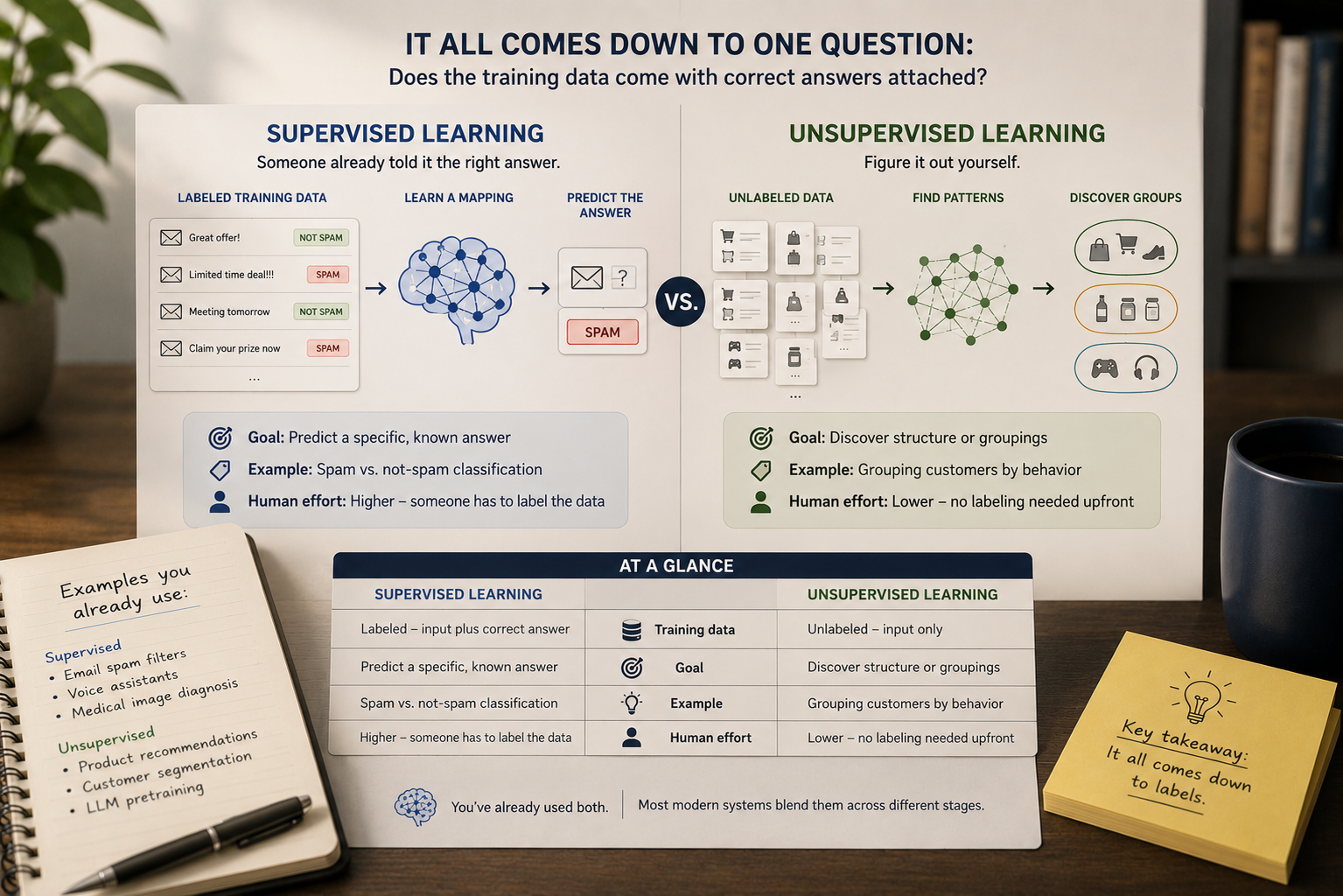
Key Takeaways
- It boils down to one question: does the training data arrive with correct answers already attached, or not?
- Supervised learning trains on labeled examples - each input paired with its correct answer - so the model learns the mapping between them.
- Unsupervised learning works from unlabeled data and has to uncover structure or groupings on its own, with no one defining what "correct" would even look like.
About this app
These two terms show up in practically every AI explainer out there, usually without anyone bothering to pin down what actually separates them. The distinction, once someone actually states it, is refreshingly straightforward: does the training data show up with correct answers attached, or doesn't it? Nearly everything else - how you'd evaluate the model, what it's suited for, how much human labor goes into prepping the data - traces back to that single fact.
Supervised: The Right Answer Was Handed Over in Advance
Every training example here arrives with the correct answer already attached. Show a model thousands of emails, each tagged "spam" or "not spam," and it learns which patterns go with which tag. Once that's done, it applies the same judgment to emails it has never encountered. It's called "supervised" precisely because a person - or a labeling pipeline someone built - told the model the right answer throughout training. The model isn't inventing the categories on its own; it's learning to reproduce labels somebody else already assigned.
- Classification: sorting into a category, such as spam versus not-spam, or which condition a scan most likely shows.
- Regression: predicting a number - a home's likely sale price, say, or next month's revenue.
- Feedback loop: the model's guess gets checked against the known correct answer, and the resulting error is used to adjust it, over and over across the entire labeled set.
Unsupervised: No Answer Key, Figure It Out
Flip the setup around and you land on unsupervised learning: the model receives data with no correct answers attached, period, and its job is to surface patterns or groupings entirely on its own. Hand it a large batch of customer purchase histories with no categories defined ahead of time, and it might notice that customers naturally split into a handful of distinct clusters - without anyone having told it in advance what those clusters should be named, or even that they'd exist.
- Clustering: grouping similar data points, like sorting customers by actual behavior instead of by a label someone assigned them.
- Dimensionality reduction: squeezing data down to its most essential patterns, often to make a huge dataset easier to visualize or work with.
- Anomaly detection: flagging data points that don't match the surrounding pattern, which is often the first line of defense fraud-detection systems use to catch "something looks off here."
Spotting Which One a Given System Relies On
The quickest test: what is the model actually trying to predict, and did someone have to sit down and label the training data beforehand? If there's a specific, known target - this email is spam, this transaction is fraudulent, this scan shows a tumor - and a person had to attach that label to every example ahead of time, you're looking at supervised learning. If the model is instead hunting for structure nobody defined in advance - these customers behave alike, this data point stands out - that's unsupervised.
- Look at what's being predicted. A specific, named outcome points to supervised.
- Look at who defined the categories. A human deciding them ahead of time means supervised; the model discovering them on its own means unsupervised.
- Look at the data-prep cost. Heavy upfront labeling work is a strong signal you're dealing with supervised learning.
The Two, Laid Out Side by Side
| Supervised learning | Unsupervised learning | |
|---|---|---|
| Training data | Labeled - input plus correct answer | Unlabeled - input alone |
| Goal | Predict a specific, known answer | Uncover structure or groupings |
| Example | Spam vs. not-spam classification | Grouping customers by behavior |
| Human effort | Higher - someone has to label the data | Lower - no upfront labeling needed |
| Evaluation | Compare predictions to known correct answers | Trickier - there's no ground truth to check against |
Where You Run Into This in Ordinary Tools
You've almost certainly used both already, even if you never clocked which was which. Spam filters, a voice assistant recognizing a specific command, a medical scan checked against a set of labeled examples - all supervised. A recommendation engine quietly noticing that certain products tend to get bought together, or the early "pretraining" stage most large language models go through before any supervised fine-tuning ever touches them - that's unsupervised. Most modern systems, LLMs included, actually mix both across different stages rather than committing to one: a model might spend pretraining doing something closer to unsupervised pattern discovery across a mountain of text, then get supervised fine-tuning layered on top using labeled examples of the exact behavior its developers are after.
Keep that blending in mind the next time a product page boasts about being trained on "labeled expert data." That's a concrete, checkable claim about supervised learning, and it implies real cost and effort - someone had to actually sit down and label a dataset, and that's neither cheap nor fast once you're doing it at scale. If a company makes that claim, it's fair to ask how much labeled data, labeled by whom, and checked for quality how. A vague claim that a model was "trained on data," with no mention of supervised or unsupervised, tells you next to nothing by comparison - virtually every model is trained on data in some form, so the phrase alone reveals nothing about how it learned or what it's actually good at.
Neither approach beats the other across the board - they're built for different jobs. Given a known answer to predict and the budget to label data for it, supervised learning is usually the more dependable, easier-to-evaluate route. Given a dataset to explore for structure nobody's defined yet, or a situation where labeling everything just isn't feasible, unsupervised learning is the better fit. Most real-world systems end up combining the two, and knowing which part is doing which job makes it much easier to figure out what an AI feature is actually claiming to do.
Frequently Asked Questions
Is one of these genuinely better than the other?
Neither one - they're built for different problems. Supervised learning is the fit when there's a specific known answer to predict and labeled data to train on. Unsupervised is the fit when the goal is uncovering unknown structure, or when labeling everything just isn't realistic.
Is there anything in between the two?
Yes, more than one thing actually. Semi-supervised learning blends a small labeled set with a much larger pool of unlabeled data. Reinforcement learning is its own separate approach entirely - the model learns through trial and error against a reward signal, not through fixed labels at all.