
The Quiet Case for a Puzzle Game With No Clock Running Against You
Arrow Escape: Logic Puzzles skips the countdown timer and the combo pressure that define most mobile puzzle games - a look at why that design choice changes how the whole genre feels to play.
Key Takeaways
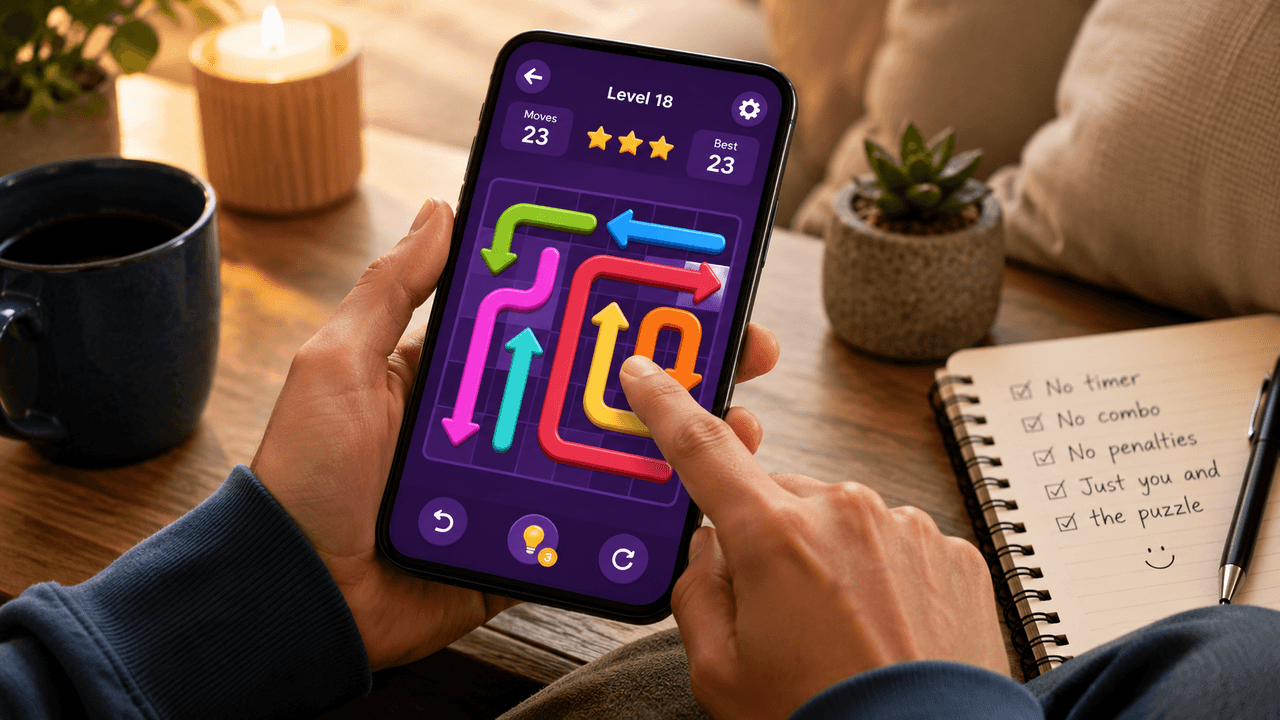
- There's no timer, no combo multiplier, and no penalty for a wrong tap - the entire challenge comes from sequencing which arrow can safely move next.
- Difficulty still escalates as levels progress, since more arrows and colors get packed onto the grid, so removing the clock doesn't remove the challenge.
- Visuals, music, and haptics are all kept minimal and toggleable, in line with the game's low-pressure design.
- It's a newer release with 500+ downloads and is ad-supported, with no in-app purchases beyond that.
Get this app
About this app
A lot of mobile puzzle games are built around pressure. A ticking clock, a combo multiplier that resets if you pause too long, a life system that punishes a wrong guess - all of it is designed to keep a level feeling urgent. It works, in the sense that it's effective at holding attention, but it also means a huge share of "quick puzzle games" aren't actually relaxing to play; they just feel that way for the first ten seconds.
Arrow Escape: Logic Puzzles is worth a look specifically because it skips almost all of that on purpose, and the difference in how it feels to play is bigger than it sounds on paper.
The mechanic, stripped down
Each level is a grid scattered with colored arrows, each pointing in a direction. Tap an arrow that has a clear path out, and it clears the board; tap one that's blocked and it just... doesn't go anywhere. There's no penalty for a wrong tap, no timer counting down in the corner, no score multiplier quietly evaporating while you think. The challenge is entirely about sequencing - figuring out which arrow can safely move without splitting your attention between the puzzle and a countdown.
Why removing pressure doesn't remove the challenge
It would be easy to assume a puzzle game with no timer and no fail state is a puzzle game with the difficulty removed too, but that's not really how it plays out here. The actual challenge comes from the arrangement itself - as levels progress, more arrows and more colors get packed onto the grid, and untangling the "right" order gets genuinely harder to plan out in your head. Removing the clock doesn't lower the ceiling on difficulty; it just means the difficulty comes from the puzzle itself rather than from a countdown forcing rushed decisions.
Who this actually suits
- Anyone who wants a genuine two-minute break, not a fifteen-minute session that a notification can interrupt mid-combo
- Players who find timed puzzle games stressful rather than fun, even when they're good at them
- People who want something to open in a waiting room or a commute without needing full concentration from the first second
The trade-off untimed puzzle design makes
Removing a timer isn't a free win - it does trade away one thing many puzzle games use pressure for, which is pushing a player to commit to a guess and move on. Without a clock, it's possible to sit on a level for a while turning the arrangement over in your head. For most people reaching for a puzzle game specifically to decompress, that trade is a clear win. For anyone who actually enjoys the adrenaline of racing a countdown, it will read as a different, calmer genre than what they're used to - worth knowing going in rather than expecting the same rush a timed puzzle game delivers.
That calmer pace also changes what "progress" feels like. Instead of chasing a high score or beating a personal best time, progress here is just clearing the level in front of you, however long that takes. It's a small shift, but it's the difference between a puzzle game that's measuring you and one that's just handing you a puzzle.
A design choice worth noticing
The app also keeps its visuals deliberately minimal - bright, clean arrows on an uncluttered grid, with music and haptics that can be toggled off entirely. That's consistent with the whole approach: nothing here is trying to compete for attention the way a lot of casual games do with constant animation and sound cues. There are optional boosters for the trickier later levels, which is a reasonable concession for anyone who gets stuck rather than a paywall dressed up as difficulty.
It's a newer release (500+ downloads so far) and carries ads, without in-app purchases beyond the ad-supported model, so go in with that context rather than expecting an ad-free experience. But as a genre exercise, it's a solid example of what a puzzle game looks like when the goal is "an escape from stress" rather than "a rush of adrenaline" - and for a lot of players, especially anyone reaching for their phone specifically to unwind, that's the more useful design.
It's also a reminder that "casual game" doesn't have to mean "low effort." The puzzles here still require real planning - working out a valid clearing order in your head - the format just removes the artificial urgency around doing that thinking. That distinction between removing pressure and removing challenge is really the whole design idea in one sentence. For anyone who's bounced off other mobile puzzle games because the timer made mistakes feel costly, this is worth a second look specifically because a wrong tap here costs nothing but a second of your attention. That combination of real, escalating difficulty without any artificial time pressure is a fairly rare thing to find well-executed in a free mobile puzzle game.
Frequently Asked Questions
Is Arrow Escape actually challenging without a timer?
Yes - the difficulty comes from the puzzle arrangement itself rather than a countdown. As levels progress, more arrows and colors get added to the grid, which makes sequencing the right order to clear it genuinely harder to plan out.
Does the game have in-app purchases?
It's ad-supported, with optional boosters available for harder levels, but no in-app purchases beyond that ad-supported model.