
What Is a Large Language Model? A Plain-English Explanation
Skip the jargon and the equations - here's what a large language model is, how it picked up the ability to write, and what that word "large" is actually referring to.
Key Takeaways
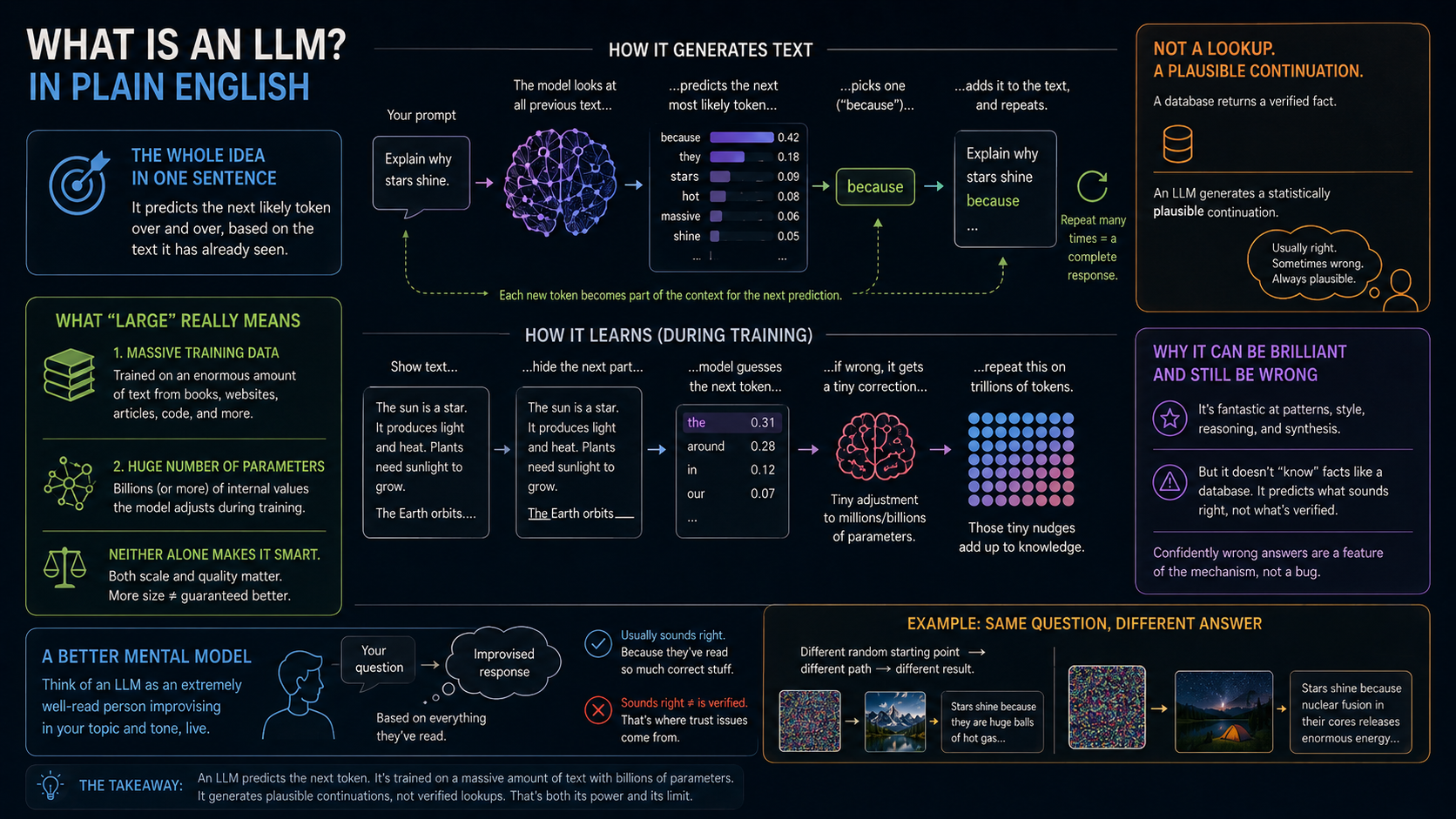
- An LLM has one job at its core: guess the next stretch of text, again and again, drawing on patterns it soaked up from a mountain of writing.
- "Large" is really shorthand for two separate numbers - the volume of text it trained on, and the count of internal parameters it has available. Either one alone tells you very little about whether it's actually good.
- It doesn't hold facts the way a lookup table does. What it produces is a plausible-sounding continuation, which lands correctly most of the time, but that's a different thing entirely from a verified answer.
About this app
Poll ten different people on what a large language model actually is and you'll hear ten different guesses - "souped-up autocomplete," "some kind of search engine," or just a shrug. None of those quite lands, though the real answer turns out to be more approachable than the name implies, and it settles a question that trips a lot of people up: why does the same tool swing between sounding sharp and stating nonsense with total confidence?
The Core Mechanic, In One Line
Given whatever's been written so far, it guesses the next likely token - a word, or a fragment of one. Nothing more elaborate than that sits underneath. When you ask it something, it builds the reply token by token, and every single one gets chosen because it reads as a strong statistical follow-on to the conversation so far, your question folded in.
It seems far too small an idea to account for everything these tools do, and yet it covers all of it. Drafting an email, condensing a report, writing code, arguing a position from both sides - every one of those comes out of that same repeating next-token loop, running until the model judges the answer finished. There isn't some separate "reasoning engine" that kicks in for the harder stuff; it's the identical prediction process, just extended across more steps.
What "Large" Is Actually Referring To
It's really two separate figures crammed into a single adjective. One is the training data - more text than any human could get through across several lifetimes. The other is the parameter count, the internal dials the model adjusts throughout training, frequently landing in the billions. Neither figure by itself guarantees quality. A massive model can still trip over something trivial, while a smaller model tuned carefully for a narrow job can beat it there. Scale tracks loosely with what a model can do - it's not a precise gauge of how good it actually is.
- Training data: everything the model was exposed to while training - books, articles, code, forum posts, and more. This is where its patterns come from, and it sets the knowledge cutoff too.
- Parameters: the adjustable internal values the model tunes as it learns. A higher count buys more room to store patterns - it doesn't automatically buy more accuracy.
- Context window: a different thing from either of those - it's the amount of text the model can hold in view during one conversation, not a measure of what it learned during training.
- Fine-tuning: an additional training pass on a smaller, hand-picked dataset, usually the step that turns a raw base model into one that actually follows instructions well.
Picking Up Grammar Without a Single Lesson
Training works by hiding the ending of a passage and making the model guess it. Get it wrong, and a small internal correction gets applied. Repeat that across a genuinely staggering volume of text, and those small corrections stack into something that has absorbed grammar, tone, everyday facts, and patterns of reasoning - with no person ever spelling out "here's how a sentence is put together."
Nowhere inside it is there a rule that reads "adjectives come before nouns in English." What's there instead is a dense mesh of statistical associations, assembled one guess and one correction at a time, until producing fluent language turned out to be the easiest route to guessing the next token correctly.
The Training Pipeline, Roughly
- Step 1 - Gather text: pull together an enormous, varied body of written material to act as the raw training signal.
- Step 2 - Pretrain on next-token prediction: over and over, hide what comes next and have the model guess it, adjusting a little after each miss.
- Step 3 - Fine-tune on instructions: run a second pass on a much smaller set of examples that demonstrate what a useful, well-structured response looks like.
- Step 4 - Align using feedback: apply human or automated ratings to steer the model toward the kinds of answers people actually want, and away from the ones they don't.
- Step 5 - Ship it: the trained model gets packaged up so it can generate token-by-token responses to real prompts from real users.
One Idea Explains Both the Genius and the Errors
Since what it's actually doing is predicting plausible text rather than pulling verified facts from storage, it's remarkably good at writing that's fluent and tuned to context - that's the exact skill the whole process trained for. The flip side is that a confident, wrong answer isn't really a malfunction. It's the same machinery doing precisely what it was built to do, just applied to a spot where the model has nothing solid to lean on.
A better mental picture than "it's a database": picture not a librarian pulling a book off a shelf, but a widely read person improvising, live, in exactly your topic and tone, drawing on everything they've absorbed over the years. That improviser will usually land close to correct, simply because they've read so much accurate material - but sounding right and being verified are two separate claims, and conflating them is where most of the trust problems with these tools actually begin.
A Database and a Language Model, Side by Side
| Question | Database | Large Language Model |
|---|---|---|
| How does it answer? | Exact lookup against stored records | Statistical prediction of likely text |
| Can it be "unsure"? | Returns nothing when there's no match | Can produce a fluent answer even with no solid grounding behind it |
| Does it update live? | Yes, as records get changed | No - its knowledge is frozen at training time unless fed outside data |
| Best suited for | Precise, verifiable facts | Drafting, summarizing, explaining, brainstorming |
What That Means for How You Should Actually Use One
None of this is grounds to write the tool off entirely - it's grounds to point it at what it's actually good for. Treat it as a quick, capable partner for writing and working through ideas, and treat anything that looks like a specific fact, number, or citation as worth a quick separate check before it ends up somewhere that matters.
- Lean on it for: drafting, rewording, condensing, explaining a concept, brainstorming, and shaping the structure of an argument.
- Verify separately: exact figures, dates, names, quotes, and anything you'd later cite as a source.
- More context beats less: since it's predicting from whatever you've handed it, pasting in the actual document or dataset outperforms summarizing it from memory.
- Mind the cutoff: its "knowledge" ends wherever its training data ended, so anything newer has to come from outside the model itself.
Frequently Asked Questions
Does a bigger model always mean better answers?
Larger models tend to do better across most tasks, but it's not an ironclad rule - the quality of the training data and how well it fits the specific job matter just as much as sheer size. A smaller model tuned well can outperform a bigger, more general one on its own turf.
Is an LLM just another word for "AI"?
No - an LLM is one particular kind of AI, built around language. "AI" itself is a far broader category that also covers image recognition, recommendation engines, robotics, and plenty of methods that have nothing to do with predicting text.