When AI Automation Backfires: The Overreach Traps to Avoid
Automating too much too quickly is a common mistake - and an avoidable one. Here are the specific overreach patterns that turn AI automation from a time-saver into a fresh source of cleanup work.
Key Takeaways
- The most common overreach pattern is pulling human review the instant an automation looks like it's working, before it has actually proven itself.
- A "silent failure" - output that's wrong with no visible error at all - is more dangerous than a loud crash, because nobody catches it until real damage has already happened.
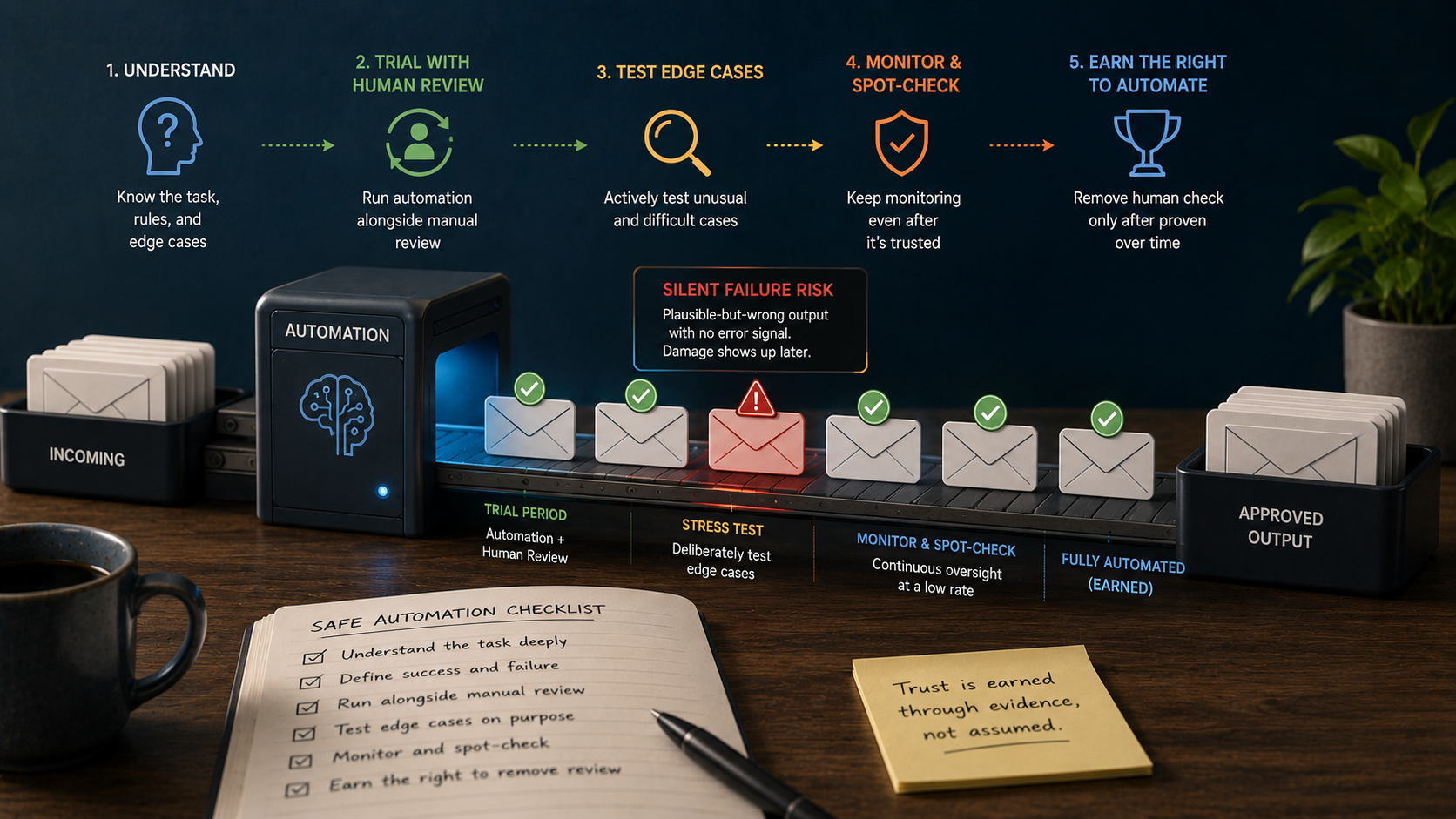
- The safer approach runs automation side by side with manual review for a set trial period, and only then earns the right to drop the human check.
About this app
AI automation really does save time. It also comes with a specific, repeatable failure pattern that can turn that saved time into a much bigger cleanup job down the road - worth understanding before you automate anything that actually matters. The pattern has nothing to do with the AI being "bad" at the task. It's about people extending trust to automation faster than the automation has actually earned it.
The core mistake: dropping review too soon
The single most common mistake is pulling human review the moment an automation appears to be working, instead of waiting until it's proven itself over an actual trial period. An automation that looked perfect on the five examples you happened to spot-check can still fail badly on the sixth case - a different one you never tried. Five clean results feel like proof. They're really just five data points, and the failure is usually hiding in whatever variation those five never touched.
Right behind that is automating a task you don't fully understand yourself. If you can't clearly lay out the real rules and edge cases of the task, you're not really positioned to judge whether the automation is handling them correctly. You end up accepting plausible-looking output without being able to identify exactly how it's wrong - because catching that requires already knowing what "right" looks like in the cases that actually matter, not just the obvious ones.
Why the quiet failures do the most damage
The most dangerous failure mode isn't loud - it's silent: output that looks plausible but is wrong, with no error signal at all, so nobody catches it until the damage shows up somewhere else entirely, disconnected from where it actually started. A script that throws an error gets fixed that same day. A script that quietly mislabels data, ships the wrong number, or skips a step without complaint can keep running for weeks before anyone traces the downstream mess back to its source.
- Output always seems reasonable: Nothing ever looks obviously off, even on inputs you'd expect to trip it up - that kind of consistency should raise suspicion, not put you at ease.
- Nobody's spot-checking it anymore: Review got dropped the moment the automation "proved itself," and no one has looked closely since.
- Downstream numbers are drifting for no clear reason: A metric is slowly moving in the wrong direction and no one has connected it back to the automated step feeding it.
- Edge cases never actually got tested: The automation was checked only against typical inputs, never against the rare-but-real ones that occasionally show up.
- There's no alert or fallback path: If the automation puts out something wrong, nothing catches it - it just flows straight into whatever system is downstream.
Scaling before you're ready multiplies the risk
Ramping up volume before you've deliberately tested edge cases just guarantees you'll find the failure at a bigger, more expensive scale instead of a small, contained one. It's tempting to widen an automation's scope the second it handles the first use case well - more documents, more customers, more categories - but each expansion is really a fresh test against inputs you haven't seen before. Treating growth as a reward for early success, instead of as a new source of risk, is exactly how a small mistake turns into a widespread one.
A rollout pattern that actually protects you
The approach that actually holds up is simple, even if it feels slower at the start:
- Run it in parallel first: Let the automation and manual review operate side by side for a set trial period before pulling the human check - don't move to automation-only until that trial is finished.
- Test edge cases on purpose: Feed it unusual, messy, and boundary-condition inputs deliberately, not just whatever typical cases happen to come up naturally.
- Define an actual trial length: Decide in advance how long, or how many cycles, the trial runs, so "it seemed fine" never quietly stands in for a genuine evaluation period.
- Keep spot-checking: Even once general trust has been earned, sample the output periodically instead of assuming performance never changes.
- Only hand off what you can evaluate: If you personally can't tell correct output from subtly wrong output, that task isn't ready to be automated yet.
| Approach | What it catches | Where it fails |
|---|---|---|
| Dropping review as soon as it "looks good" | Obvious, early-stage bugs | Rare edge cases and silent errors that show up later |
| Running in parallel for a defined trial period | Both common and rare failure patterns, over time | Takes patience and a bit more effort upfront |
| Automating first and reviewing the process afterward | Nothing, until damage is already visible downstream | The cost of failure gets paid at scale instead of caught early |
None of this argues against automation itself - it argues for treating trust as something you earn with evidence, not something you assume the moment early results look decent. Automation rolled out this way tends to stay automated, because it's already been tested against the situations that would have broken it. Automation that skips this step tends to get yanked back later anyway, right after it's caused a mess somebody has to clean up - which erases the time savings it was supposed to deliver in the first place.
Frequently Asked Questions
How long should automation run alongside manual review before I trust it completely?
There's no fixed number - it hinges on how varied your real-world inputs are and how expensive a mistake would be. Higher-stakes or higher-variability tasks warrant a longer trial; low-stakes, repetitive ones can graduate sooner.
Is it ever okay to fully automate something with no ongoing review at all?
For genuinely low-stakes, well-understood, high-volume tasks where an occasional mistake costs next to nothing, sure - but that's a conclusion you arrive at through evidence, not something you assume going in.