
That Plant on Your Windowsill Has Been Trying to Tell You Something for Weeks
GreenSnap: Plant Identifier turns a phone camera into an instant botanist, naming the species and flagging exactly what a drooping leaf or a spreading yellow patch is actually trying to say.
Key Takeaways
- Point the camera at a leaf and you'll get a species name in seconds - the harder, more useful part is what the app tells you after that.
- A yellow leaf doesn't mean the same thing on every plant, which is why matching the symptom to the actual species beats a generic search every time.
- It'll flag poison ivy and a few other things not to touch on a hike, but treat that as a strong hint rather than gospel - lookalikes exist for a reason.
- The built-in light meter is worth using on its own - most people think their windowsill gets more sun than it actually does.
About this app
Somewhere between "I should really water that" and "wait, when did it get like this," most houseplants go through a slow decline that nobody catches in time, mostly because nobody knows what they're looking at in the first place. A yellowing leaf could mean too much water, too little water, too much sun, not enough light, or a nutrient the soil ran out of months ago. Without knowing the actual species, there's no way to tell which.
GreenSnap: Plant Identifier exists for exactly that gap between owning a plant and understanding it. Point a phone camera at a leaf, a flower, or even bark, and it returns a species match along with care specifics - and, more usefully, a way to check symptoms against what that particular plant is prone to.
Identification is the easy 80%
The core feature works the way most people expect: photograph a leaf or a full plant, and image recognition trained on a large botanical database returns a best match, usually with a confidence percentage and two or three close alternatives underneath. Common houseplants and garden species get identified almost instantly and with high confidence - the visual differences between a pothos and a philodendron, for instance, are subtle enough that plenty of plant owners genuinely can't tell the two apart, but the software catches it from a single clear leaf shot.
The real value only shows up once identification is done, because a name alone doesn't fix anything. Knowing a plant is a Chinese money plant doesn't tell you why its leaves are curling - what it tells you is where to look next, which is the part most plant-ID apps quietly leave out.
Where the diagnosis feature actually does the work
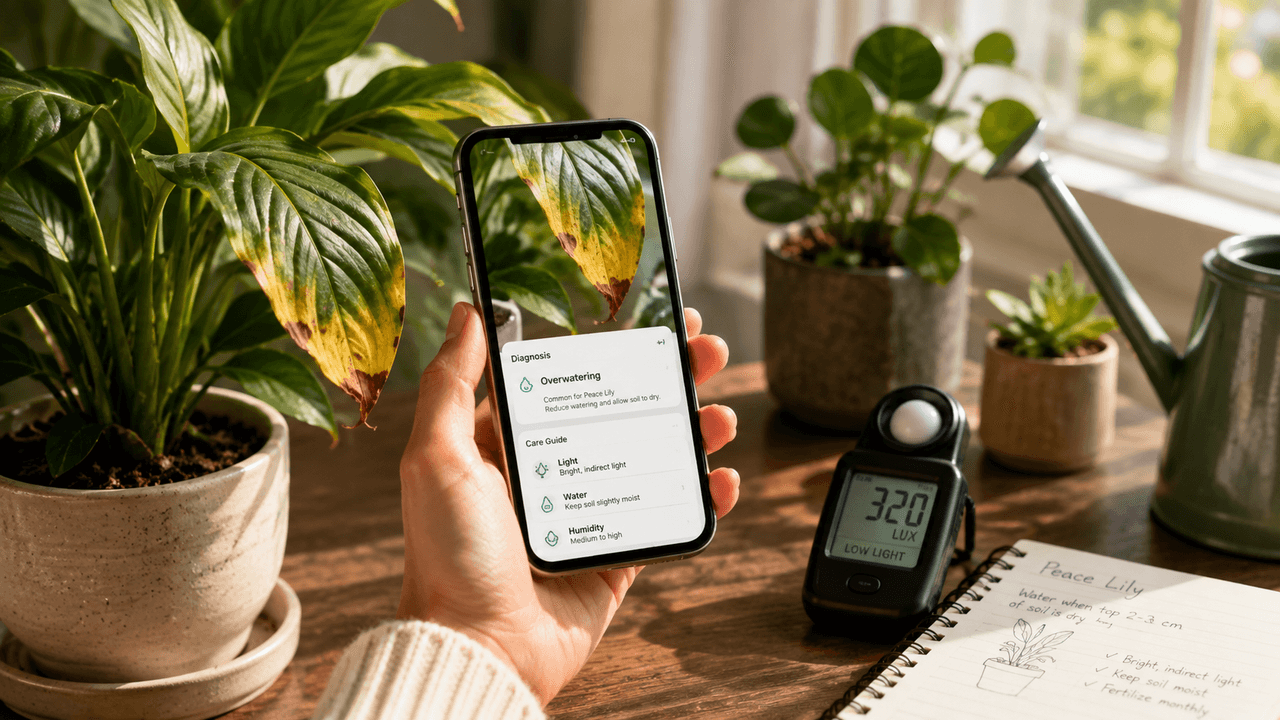
The more useful half of the app is a symptom-checker built into each plant's profile: a menu of common issues - yellowing leaves, brown crispy tips, leggy growth, leaf drop, spots or speckling - matched against what that specific species is known to be sensitive to.
This matters because the same symptom means opposite things on different plants. Yellow leaves on a peace lily usually mean overwatering, since the species is naturally prone to root rot in soggy soil. Yellow leaves on a snake plant, by contrast, more often mean the opposite problem - underwatering or too much direct sun, since it's a species built for drought and indirect light. A generic "why is my plant yellow" search returns both answers with no way to know which applies. Species-matched diagnosis narrows it down to the one that's actually relevant to what's sitting on the windowsill.
The app also tracks light and water needs per species and can send care reminders - watering schedules, misting frequency, fertilizing windows - timed to that specific plant's actual requirements rather than a generic "water once a week" default that works for exactly none of the plants it gets applied to.
The outdoor use case: knowing what not to touch
Indoors, misidentifying a plant mostly costs you a dead fern. Outdoors, hiking or working a garden, it can matter a lot more. GreenSnap's identification extends to wild plants, and that includes flagging poisonous or irritant species - poison ivy, poison oak, and a handful of toxic berries and ornamentals that look unremarkable until a kid or a pet gets curious about them.
The honest caveat: treat this as a strong first read, not a guarantee. Lookalike species exist in nature specifically because visual mimicry is a survival strategy, and no camera-based tool should be the sole basis for deciding something is safe to touch, eat, or let a pet near. Where the app earns real trust is the mundane, low-stakes identification - "what is this thing growing in the flower bed" - rather than edge-case safety calls.
The soil and light-meter tools round it out
Two smaller tools sit alongside identification and diagnosis. A light meter uses the phone's camera sensor to estimate the lux level at a given spot, translated into plain terms - "low light," "bright indirect," "direct sun" - which turns out to be a genuinely useful gut check, since most people's read on how bright a windowsill is turns out to be wildly optimistic compared to what a plant actually needs. A separate soil-moisture guide walks through the classic finger test and a few visual cues, since the app can't sense actual soil moisture through a screen and doesn't pretend otherwise.
Where this actually lands
A plant identifier that only names species is a neat trick and not much else - there are a dozen apps that do that part. What makes GreenSnap worth having installed is pairing the name with what that specific plant is actually prone to, so a yellow leaf stops being a mystery and starts being a specific, fixable answer. The gap between owning a houseplant and understanding one has always been a knowledge problem, not a green-thumb problem, and that's the gap this app is actually built to close.
Frequently Asked Questions
Can I actually trust it to tell me a plant is safe to touch or eat?
Treat it as a solid first guess, not a final answer. Some poisonous plants have harmless-looking lookalikes, so a phone camera shouldn't be the only reason you decide something outside is safe.
Why does it matter what species my plant is before I try to fix a yellow leaf?
Because the same symptom points in opposite directions depending on the plant. Yellow leaves on a peace lily usually mean too much water; the same yellow leaves on a snake plant usually mean not enough. You need the name before the advice makes sense.