
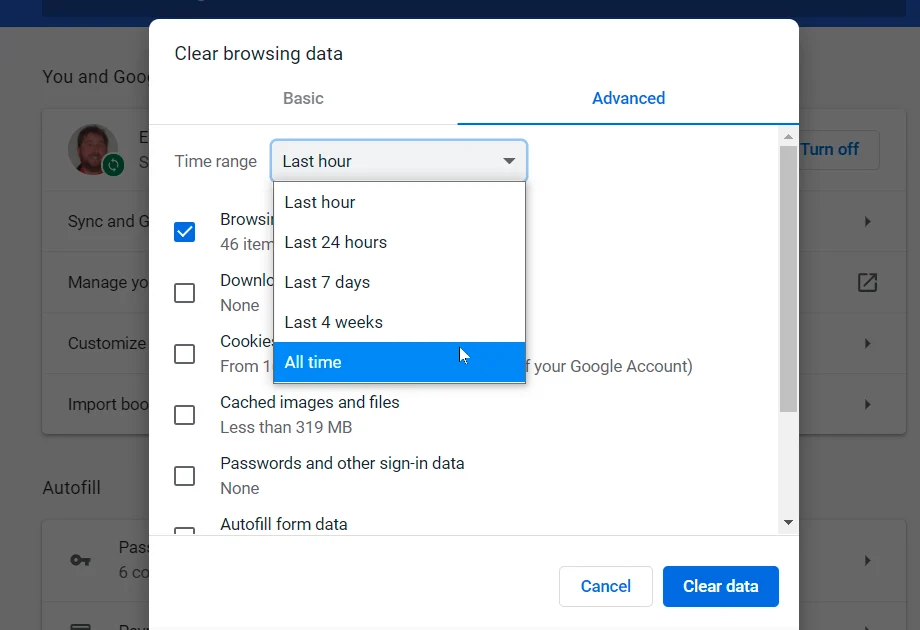
When a browser says storage is full, websites may load slowly, pages may behave strangely, or the browser may keep asking you to clear data. The problem can be confusing because browsers store several different types of information, and deleting the wrong category can sign you out of websites or remove locally stored data.
The safest approach is to identify what is taking up space and what each type of browser data actually does before deleting anything.
This guide explains what you can usually clear safely, what requires more caution, and how to free browser storage without unnecessarily losing important browsing information.
First, Understand What “Browser Storage” Means
A browser does not store everything in one single location.
Depending on the browser and operating system, it can keep:
- Cached images and files
- Cookies
- Site data and local storage
- Browsing history
- Download history
- Saved passwords
- Autofill information
- Site permissions
- Extensions and their data
- Offline website data
- Browser settings
- Bookmarks
- Synced account information
These categories have different purposes.
Deleting cached files is very different from deleting cookies or site data.
That distinction is the most important thing to understand before cleaning the browser.
What You Can Usually Clear Safely
Cached Images and Files
Cached files are temporary copies of website resources that the browser saves so pages can load more efficiently later.
Clearing the cache is generally one of the safest browser-cleanup steps.
After clearing it, websites may initially load a little more slowly because the browser has to download some resources again.
You normally do not need to delete your bookmarks or saved passwords to clear the cache.
Browsing History
Browsing history records websites and pages you have visited.
Deleting history generally does not remove your bookmarks or saved passwords.
However, if you use your history to find previously visited pages, clearing it means you lose that local record.
Therefore, history is usually safe from a password or bookmark perspective, but it is not necessarily safe from an information perspective.
If you rely on browser history for work or research, consider keeping it.
Download History
Download history is the browser’s record of files you downloaded.
Deleting download history does not normally delete the downloaded files themselves.
This distinction is important.
Removing an entry from the browser’s download list is different from deleting the actual file from your Downloads folder.
Before deleting anything, check whether the browser’s cleanup screen says it is deleting history only or the downloaded files themselves.
What Requires More Caution
Cookies
Cookies can store information that websites use to remember your session, preferences, and other settings.
Deleting cookies can sign you out of websites.
It can also reset website preferences.
For this reason, do not automatically select Cookies and other site data when you only want to clear temporary files.
If one website is causing problems, clearing that site’s cookies and data can be a useful troubleshooting step.
Clearing cookies for every website is a much broader change.
Site Data
Modern websites can store information locally in the browser.
This may include:
- Login-related session information
- Website preferences
- Local application data
- Offline information
- Web application state
- Cached application resources
The exact contents vary by website.
If you clear site data globally, some websites may behave as though you are visiting them for the first time.
You may need to sign in again.
For that reason, site data should not be treated as equivalent to ordinary cache files.
Saved Passwords: Do Not Delete Them Casually
Saved passwords are different from cached website files.
If you delete saved passwords, you may lose credentials stored in the browser.
Before changing anything related to passwords, make sure you know where your passwords are stored and whether they are synchronized with your browser account or password manager.
If you use a dedicated password manager, confirm that your passwords are available there before making major browser changes.
Do not select a password-related option simply because the browser’s storage-cleanup screen recommends clearing data.
Autofill Information Is Also Separate
Browsers may store information used to automatically fill forms.
Depending on your browser and settings, this can include names, addresses, contact details, and other form information.
Deleting autofill data can make forms less convenient to complete.
It is usually unnecessary when your only goal is to reduce temporary browser storage.
Bookmarks Are Not the Same as Browsing History
Bookmarks are saved links that you intentionally keep.
Browsing history is a record of pages you visited.
Clearing browsing history does not mean you should assume your bookmarks are also deleted, but you should still read the browser’s cleanup options carefully.
If a browser offers a separate checkbox for bookmarks or related saved information, leave it unchecked unless you intentionally want to remove those items.
How to Check What Is Taking Up Space
Before clearing anything, look at the browser’s storage or privacy settings.
The exact menu names vary between Chrome, Edge, Firefox, Safari, and other browsers.
Look for areas such as:
Settings → Privacy and security → Clear browsing data
or a similarly named storage/privacy section.
Do not immediately press Clear.
First examine the available categories.
You are trying to answer three questions:
- What type of data is taking up space?
- How much data can actually be removed?
- What information could disappear if you select that category?
This simple check prevents many accidental deletions.
Start With the Least Disruptive Cleanup
If your goal is simply to free space, begin with temporary data.
A sensible order is:
- Cached images and files
- Old browsing history, if you do not need it
- Download history, if you do not need the record
- Site-specific data for websites causing problems
- Broader cookies and site data only when necessary
Leave passwords, bookmarks, and autofill information alone unless you have a specific reason to remove them.
How to Clear Cache Without Clearing Everything Else
The exact steps vary by browser, but the process is similar.
Open your browser’s settings and find Clear browsing data or its equivalent.
Select only:
Cached images and files
Leave options such as these unchecked if you want to preserve them:
- Cookies and other site data
- Passwords
- Autofill data
- Site settings
- Browsing history
Then clear the selected cache.
Restart the browser and test the websites again.
If the browser was displaying outdated page content or a website was behaving strangely because of cached resources, this may resolve the problem.
Clear Data for One Website Instead of Every Website
Suppose one website is malfunctioning, but everything else works normally.
Do not immediately clear the entire browser.
Look for the browser’s site-data controls and remove stored data for that specific website if the browser provides that option.
This can be useful when:
- One website repeatedly logs you out
- A website displays stale information
- A web application behaves incorrectly
- One site consumes unusually large local storage
- A website keeps asking you to repeat a setup step
You may need to sign in again after removing its cookies or site data.
That is expected.
Why Clearing Everything Is Usually a Poor First Step
A browser cleanup screen can make it tempting to select every checkbox.
That is rarely necessary.
If you select every category, you may change:
- Login sessions
- Website preferences
- Saved passwords
- Autofill information
- Browsing history
- Site permissions
- Locally stored application data
You then have to determine whether the original problem was actually fixed or whether the cleanup simply changed the browser environment.
For troubleshooting, smaller changes are easier to understand.
Check Your Downloads Folder Separately
Sometimes people say their “browser storage” is full when the actual problem is the computer’s storage.
Check the Downloads folder on your device.
Large files such as:
- Videos
- Installation packages
- ZIP archives
- Documents
- Disk images
- Duplicate files
can consume far more space than browser cache.
Deleting the browser’s cache will not necessarily solve a nearly full Windows drive.
Before deleting a downloaded file, open it or check its filename and location so you know whether you still need it.
Browser Storage and Device Storage Are Different Problems
A browser can have a large amount of stored data without the entire computer being out of disk space.
Likewise, a computer can have almost no free disk space even if the browser itself is not storing much data.
If Windows is reporting low storage, check:
Settings → System → Storage
Look at the categories Windows reports.
This can help you determine whether the browser is actually the main source of the storage problem.
Check Individual Websites That Use Large Amounts of Data
Web applications can store significant amounts of local information.
Cloud applications, video services, collaboration platforms, document editors, and other complex websites may use more local browser data than a simple information page.
If your browser provides a site-storage list, sort or inspect it to identify unusually large sites.
Do not assume that the largest site is defective.
Some applications intentionally store substantial amounts of data locally to improve performance or support offline functionality.
The goal is to identify what can be removed without disrupting something you need.
What Happens After Clearing Cache?
Do not be surprised if the browser uses storage again after you clear it.
A cache exists partly because websites need to store temporary resources.
After visiting websites again, the browser will download and cache files.
Therefore, seeing the cache grow again does not automatically mean the cleanup failed.
The important question is whether the browser remains within a reasonable storage range and whether the original problem is gone.
If a Website Becomes Slow After Clearing Cache
Clearing cache can temporarily make some websites load more slowly.
The browser has to download resources again instead of using previously cached copies.
Give the website a little time to rebuild its cache.
If the site remains slow after repeated visits, investigate other causes such as:
- Network performance
- Browser extensions
- High CPU or memory usage
- Website-side problems
- VPN or proxy connections
- Browser compatibility
- Hardware acceleration
Do not repeatedly clear the cache expecting it to permanently improve browser performance.
If Clearing Cookies Signs You Out
This is normal.
Cookies can contain session information used by websites.
If you intentionally cleared cookies and are now signed out, sign back in through the normal website.
If you do not know the password, do not clear more browser data until you have confirmed that you can recover access.
This is particularly important for accounts where you use browser-saved credentials or another authentication method.
Check Password Synchronization Before Major Cleanup
If your browser synchronizes passwords, bookmarks, or other settings through an account, verify the synchronization status before making major changes.
Do not assume that every piece of browser data is synchronized.
Some website data is local to the device.
Some information may be associated with your browser profile.
Some information may exist only on the website itself.
The safest approach is to confirm what you can recover before deleting anything important.
Be Careful With “Reset Browser” Options
A browser reset is much broader than clearing cache.
Depending on the browser, a reset may restore settings such as:
- Default search engine
- Startup behavior
- New-tab settings
- Pinned tabs
- Content settings
- Extensions or related configuration
A reset can be useful for a genuine configuration problem, but it is not a routine storage-cleanup method.
Do not use it simply because the browser has accumulated cache files.
Do Not Delete Browser Folders Manually
Avoid browsing into hidden application folders and deleting browser files manually.
Modern browsers maintain databases and files that work together.
Removing individual files without understanding their purpose can cause profile problems or unexpected data loss.
Use the browser’s own privacy and storage controls whenever possible.
Do Not Download Random “Browser Cleaner” Programs
You do not need a third-party cleaner simply because your browser has accumulated temporary data.
Browser vendors already provide tools for clearing common categories of stored information.
A random cleanup program can introduce another variable into the problem and may request permissions you do not need to give it.
If you need more storage, first identify which files are actually consuming space.
What You Should Usually Leave Alone
If your only goal is to free temporary browser storage, leave these alone unless you specifically intend to remove them:
- Saved passwords
- Bookmarks
- Autofill information
- Important site-specific data
- Browser profiles
- Authentication information
- Extensions
- Downloaded files you still need
The exact cleanup options vary between browsers, so always read the labels on the confirmation screen.
A Safe Browser Cleanup Routine
For routine maintenance, you usually do not need an aggressive cleanup.
A safer routine is:
Step 1: Check the browser’s storage controls
Find the privacy or storage section and review the categories.
Step 2: Identify the actual problem
Determine whether the browser, a particular website, or the entire computer is low on storage.
Step 3: Clear temporary cache first
Select cached files without selecting passwords or other important categories.
Step 4: Review browsing history separately
Delete older history only if you no longer need it.
Step 5: Investigate large websites
If one site is using unusually large amounts of local data, consider clearing that site’s data rather than everything.
Step 6: Check the computer’s storage
If the operating system itself is low on disk space, browser cleanup may not be enough.
Step 7: Restart and test
Open the browser again and use the pages that previously showed the problem.
Step 8: Only make broader changes when necessary
Cookies, site data, profile resets, and other disruptive options should be targeted rather than used automatically.
A Simple Risk Guide
| Browser data | Usually safe to clear? | What to consider |
|---|---|---|
| Cached images and files | Yes | Websites may temporarily load resources again |
| Browsing history | Usually | You lose your local browsing record |
| Download history | Usually | The history entry is different from the downloaded file |
| Cookies | With caution | Can sign you out and reset preferences |
| Site data | With caution | Can remove local website state and sessions |
| Saved passwords | No, unless intentional | May remove stored credentials |
| Autofill data | No, unless intentional | Removes saved form information |
| Bookmarks | No, unless intentional | Removes saved links |
| Browser profile | No, unless intentional | Can affect substantial browser data |
| Downloaded files | Not as browser cleanup | Check the actual file before deleting |
How to Confirm That the Cleanup Worked
After clearing selected data, do not judge the result only by the amount of storage immediately shown.
Instead, check:
- Does the browser open normally?
- Do important websites still work?
- Are your required bookmarks still present?
- Are your passwords still available?
- Are you still signed in where expected?
- Did the original storage warning disappear?
- Did the original performance or loading problem improve?
If everything works and the browser has recovered useful space, the cleanup was successful.
When Clearing Browser Data Is Not the Real Solution
If the browser keeps reporting storage problems after a controlled cleanup, investigate further.
Possible causes include:
- A website storing large amounts of local data
- Many browser profiles
- Large extensions or extension data
- Offline web applications
- A nearly full system drive
- Repeatedly recreated cache files
- Browser configuration problems
- A corrupted browser profile
If the entire computer is low on disk space, move the investigation to the operating system’s storage tools rather than repeatedly clearing the browser.
Frequently Asked Questions
Will clearing browser cache delete my passwords?
Clearing only cached images and files should not delete saved passwords. Make sure the password option is not selected before confirming the cleanup.
Will clearing cookies delete my bookmarks?
Cookies and bookmarks are separate types of browser data. Clearing cookies should not normally remove bookmarks, but always review the browser’s selected cleanup categories before confirming.
Does clearing browser history delete downloaded files?
Normally, clearing download history removes the browser’s record of downloads rather than the files themselves. Check the browser’s wording because cleanup options can vary.
Why does my browser storage become full again after clearing it?
The browser will create new cache and site data as you browse. Some websites also store significant amounts of local information. A growing cache is not automatically a problem.
Should I clear cookies or cache first?
If your goal is simple cleanup, start with the cache. If one website is malfunctioning, targeted site-data or cookie removal can be considered afterward.
Can clearing browser data speed up my computer?
It may help with a browser-specific problem in some cases, but clearing cache is not a general Windows performance fix. If the computer’s storage is nearly full or another application is consuming resources, investigate those causes directly.
Is it safe to use a browser cleaner?
You generally do not need a third-party cleaner for normal browser data cleanup. The browser’s built-in privacy and storage controls give you more direct control over what is removed.
Final Checklist: What to Clear and What to Keep
If your browser storage is full, take the least disruptive route first.
Usually safe to clear:
- Cached images and files
- Old browsing history you no longer need
- Download history you no longer need
Clear with caution:
- Cookies
- Site data
- Offline website data
Keep unless you intentionally want to remove it:
- Saved passwords
- Bookmarks
- Autofill information
- Important profile data
- Files you downloaded and still need
Most importantly, do not treat every browser-data category as disposable temporary files. Cache can usually be rebuilt, while cookies, site data, passwords, and other saved information can affect how websites and accounts work.
Start with the smallest cleanup that addresses the actual problem, then test the browser before making broader changes.